
Add year-round ambiance to your Sanibel home.
Winters here rarely dip below 54°F, so a gas fireplace on Sanibel is about mood, resale value, and comfort on cool Gulf-front evenings—not survival heat. Find the right unit and connect with a trusted local dealer.
Every Project Starts From One of These Five Situations
Ambiance first, heat second—and that's fine.
Sanibel sits at sea level on a barrier island off Fort Myers, with an average winter low near 54°F and only a light dusting of truly cold days each year. Compare that to a place like Duluth, MN, which has a long, brutal winter and needs a wood stove or furnace running around the clock—Sanibel homes simply don't carry that heat load. What a gas fireplace does here is different: it adds a warm focal point on the handful of genuinely chilly nights each winter, and it's become a near-standard feature in the island's higher-end Gulf-front and bayside homes, where it reads as a design statement and a resale asset as much as a heat source.
One local wrinkle worth knowing before you shop: Sanibel has no municipal natural gas main running to the island, so nearly every gas fireplace here runs on propane, either from a buried or above-ground tank serviced by a regional supplier like AmeriGas or Suburban Propane. Because the island sits at roughly 1 foot of elevation and falls within FEMA-mapped flood zones, equipment placement (including tank siting and any gas appliance mounted low on an exterior wall) has to account for flood-vent and elevation rules enforced by the City of Sanibel Building Department. And because much of the island borders the J.N. "Ding" Darling National Wildlife Refuge, a clean-burning, smoke-free direct-vent gas unit is generally a better neighbor to the wildlife habitat than an open wood fire—one more reason gas has become the default here even though wood is barely used on the island at all.
Three steps. No salesperson until you're ready.
Tell us about your project
Your zip code, your situation, and the fuel you're leaning toward—or let the answers point you to one.
See what's actually available
The brands dealers within 100 miles genuinely carry—real options, never a catalog mirage.
Get your dealer & Project Guide
A trusted local dealer, plus the free Project Guide & Parts List that names every component of the job.
Frequently Asked Questions
How much does a gas fireplace installation cost on Sanibel?
Most Sanibel gas fireplace installations run $3,500 to $8,500. Because the island has no natural gas main, that estimate usually includes propane line work from an existing or new tank rather than a utility hookup—which is one reason island installs can run a bit higher than mainland Fort Myers or Cape Coral projects on natural gas. A direct-vent gas insert into an existing masonry fireplace sits toward the lower end; a new built-in unit requiring fresh gas line runs, coastal-rated venting materials, and wind-load-compliant mounting sits toward the higher end. Local dealers who work regularly on the island will know the flood-zone and wind-code details before they ever quote you a number.
Does Sanibel have natural gas, or is it all propane?
It's propane. There's no municipal natural gas main serving the island, so any gas fireplace, range, or water heater on Sanibel runs on propane delivered and stored in a tank, typically serviced by AmeriGas, Suburban Propane, or another regional Lee County supplier. This isn't a limitation so much as the local norm—most gas appliance installers on the island are set up to spec fireplaces for propane's higher BTU content and correct orifice sizing from the start, so it doesn't add friction to the project.
Do I need a permit to install a gas fireplace on Sanibel?
Yes. Because Sanibel is its own incorporated city, permits go through the City of Sanibel Building Department rather than unincorporated Lee County. Expect both a building permit for the fireplace enclosure or insert and a separate permit for propane line and tank work. Given the island's flood-zone designation and 1-foot average elevation, inspectors also check that any gas equipment, shutoffs, and tank placement meet FEMA flood-vent and elevation requirements, plus Florida Building Code wind-load provisions for anything penetrating an exterior wall. Most established local dealers pull these permits as part of the install so you're not coordinating separate trades yourself.
What kind of gas fireplace actually makes sense in a warm climate like Sanibel's?
Since real heat output isn't the priority, many islanders choose smaller-BTU direct-vent gas fireplaces or gas log inserts chosen mainly for flame realism rather than maximum heat—oversized units can make a Gulf-front great room uncomfortably warm even on a 60-degree evening. Linear direct-vent fireplaces with clean glass fronts are popular in the newer coastal-contemporary builds going up post-Hurricane Ian, while more traditional propane log sets remain common in older Sanibel cottages. A local dealer can help you pick BTU output that matches ambiance goals rather than a heating load calculation.
Will a gas fireplace still work if the power goes out during a hurricane?
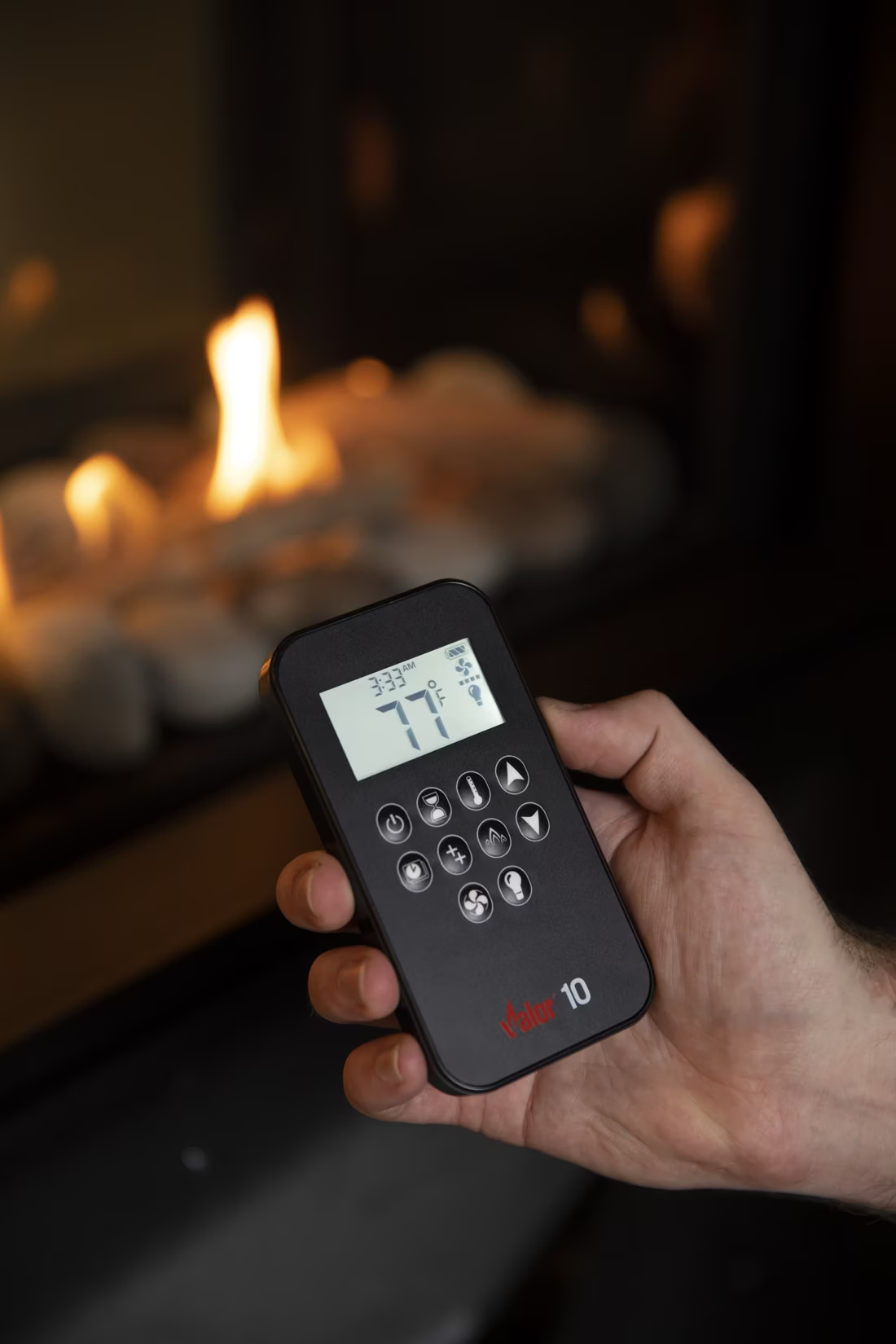
In most cases, yes, and that matters here—Sanibel lost power island-wide for weeks after Hurricane Ian in 2022. Gas fireplaces with intermittent pilot ignition (IPI) run on AA battery backup that kicks in automatically when grid power drops, so the unit still lights on demand. Valor fireplaces go a step further: their pilot generates its own electricity through the thermocouple, so there's no battery to remember or replace. Since your fuel source is a propane tank rather than a pipeline, the fireplace itself isn't dependent on utility gas service either—which is a real advantage during extended post-storm outages when FPL restoration can take time on the causeway-connected island.
Are vent-free gas fireplaces allowed on Sanibel?
Vent-free (ventless) gas units are legal under Florida code, but they release combustion byproducts—water vapor and small amounts of CO and NO₂—directly into the room, and they carry strict room-sizing and ventilation rules. Given Sanibel's high ambient humidity and the tight building envelopes common in newer hurricane-resistant construction, most local dealers steer homeowners toward direct-vent sealed units instead, which exhaust outside and don't add moisture load to an already humid coastal home. Direct-vent is by far the more common choice on the island.
How often does a gas fireplace need servicing in a coastal climate like Sanibel's?
Plan on an annual inspection, same as anywhere, but don't skip it here—salt air and high humidity accelerate corrosion on burner components, venting hardware, and any exposed metal trim faster than they would inland. A technician should check the pilot, burner, gas connections, and venting, and look specifically for salt-related corrosion on any component near an exterior wall. Given how much stress island homes take from storm season generally, a fireplace that's been sitting unused through a humid, hurricane-heavy summer is worth a check before you light it again in the fall.
What size gas fireplace do I actually need if I barely need heat?
Most Sanibel homeowners are better served by a smaller-BTU unit than a mainland heating chart would suggest—with only a light dusting of truly cold days each year, you're not fighting January cold the way a Duluth, MN homeowner would be. A modest direct-vent fireplace or insert sized for a single great room is usually plenty, even in a larger Gulf-front home, because the goal is a warm-looking focal point on the occasional cool front rather than whole-home heat. Oversizing just means you'll rarely run it at full output, which wastes propane and can make the room stuffy.
Gas vs. electric fireplace—which fits a Sanibel home better?
Both work well here, and the choice often comes down to install complexity and look. Gas fireplaces give you a real flame and genuine (if modest, given the climate) heat output, but require a propane line and permitting through the City of Sanibel Building Department. Electric fireplaces skip the gas line entirely, run on standard household current from Florida Power & Light at around 13.7 cents per kWh, and install in a fraction of the time—often just a matter of framing and a dedicated outlet. For a primary living space or a fireplace meant to be the visual centerpiece of a Gulf-front great room, gas usually wins on realism. For guest suites, rental units, or homes where minimizing construction and permitting is the priority, electric is often the practical choice.
What's the difference between an insert and a zero-clearance fireplace?
An insert is a fireplace that slides into a pre-existing wood-burning fireplace—if you don't have one, there's nothing to insert it into. A zero-clearance fireplace is built into a framed wall, which makes it the answer for remodels and new construction. Simple test: existing masonry fireplace means insert; blank or framed wall means zero-clearance.
Why is my open fireplace making my house colder?
Open fireplaces suck—literally. As the fire burns, it consumes air your furnace already paid to heat and pulls it out through the chimney, so the house is actually colder after the fire goes out than before you lit it. An insert fixes this: it seals the chimney, puts fixed glass across the front, and turns that hole in your house into a real heat source.
What is an in-home preview and do I need one?
It's a visit where a hearth professional measures your space, confirms the model you picked actually works in your home, and walks the specs—framing, gas line, venting, finish work—before anything is ordered. Some details you just can't know until you see the house. Never make a down payment without one; it's the single most-skipped step that burns buyers.
Does a fireplace add value to my home?
On average, a fireplace adds back to the home about the same amount you spent installing it. Add the monthly savings from heating the rooms you actually use instead of the whole house—often hundreds of dollars a year—and the value case is strong before you even count what a fire does for how your family uses the room.
Nearby Dealers
Hearth shops serving Sanibel and the surrounding area. Every listing shows whether it is a WhyFire partner, a dealer we have verified as authorized for the brands we recommend, or a local business carrying hearth products. No manufacturer pays for placement. How we verify dealers →
We’ve paused dealer listings for this connection today. Enter your zip or postal code above to find dealers near you, or come back tomorrow.
Popular Gas Brands
Where each brand came from, what's inside it today, and every current model. No brand pays to be here. Not every dealer carries every brand, so enter your zip code to see what's sold near Sanibel.
Kozy Heat
Kozy Heat was founded in 1976 by Dudley Hussong in Lakefield, Minnesota, and incorporated as Hussong Manufacturing Co., Inc. in 1978.
28 gas models →Fireplace Xtrordinair
Fireplace Xtrordinair, now often called FireplaceX, is the fireplace brand of Travis Industries, Inc., of Mukilteo, Washington.
25 gas models →Town & Country
Town & Country Fireplaces is the luxury gas fireplace brand of Pacific Energy Fireplace Products Ltd., of Duncan, British Columbia.
14 gas models →Lopi
Lopi is a wood, pellet, and gas stove brand founded by Kurt Rumens in Bellevue, Washington, in 1979.
7 gas models →Forge & Flame
Forge & Flame is the stove brand Hearth & Home Technologies introduced in August 2023 to bring Vermont Castings, Harman, and Quadra-Fire under one name.
6 gas models →Vermont Castings
Vermont Castings was founded in 1975 by Duncan Syme, the designer, and his brother-in-law Murray Howell, the business partner, in Randolph, Vermont.
6 gas models →Find your gas fireplace on Sanibel.
Tell us a bit about your home and we'll put together a free Project Guide & Parts List—the right gas fireplace or insert, the propane line and vent kit it needs, and a trusted local dealer to install it.
Find Your Fireplace →