
Add the Glow. Skip the Chimney You Don't Need.
Pinecrest winters rarely dip below 60. An electric fireplace gives you the look and the focal point without a flue, a gas line, or a heating bill that makes sense in Buffalo but not here.
Every Project Starts From One of These Five Situations
Warmth is optional here. Ambiance isn't.
Pinecrest sits at 9 feet of elevation in climate zone 1A, with a winter low average of 64°F and one of the shortest, mildest heating seasons in the country—a fraction of what a place like Duluth, MN logs in a single January week. The live oak, mahogany, and pine canopy that shades Pinecrest's famously large lots is landscape architecture, not a firewood supply, and wood-burning fireplaces are genuinely rare here—a handful of older estate homes have one, mostly unused, sometimes converted away entirely. Heat, in the traditional hearth sense, isn't really what homeowners in this village are shopping for.
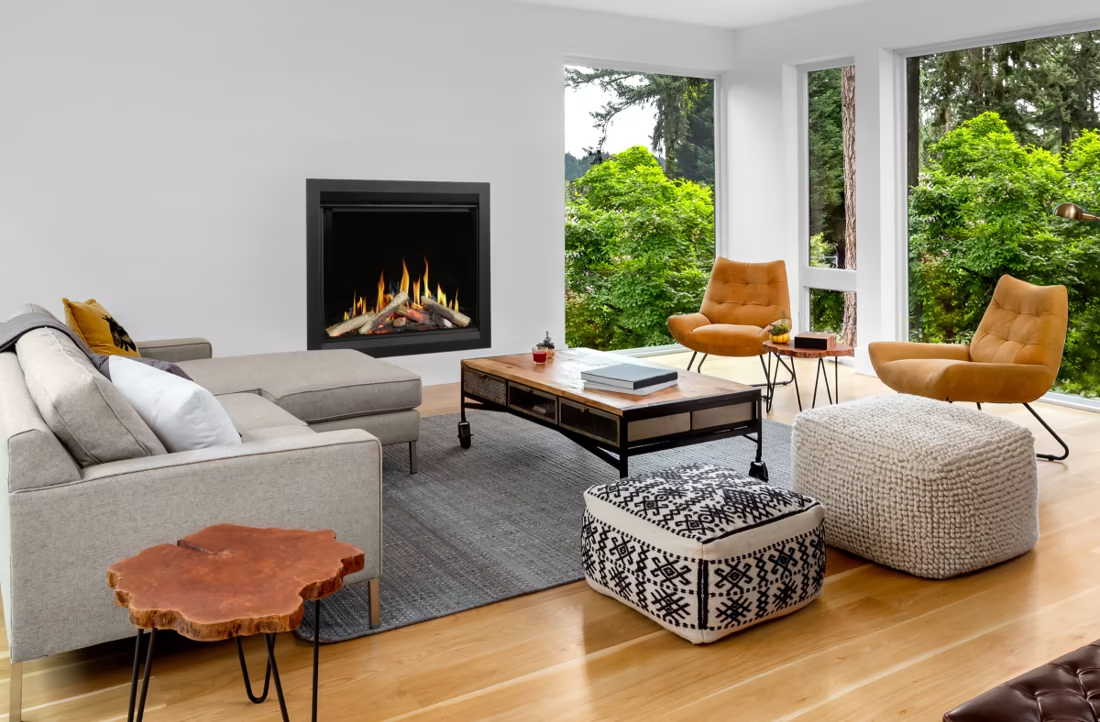
What Pinecrest homeowners do want is the visual: a linear flame feature over a media wall, a mantel surround in a formal living room, a fireplace insert in a primary suite renovation. Electric units deliver that without venting, without a chimney, and without triggering the kind of exterior architectural review that a masonry addition might. Florida Power & Light serves the village at roughly $0.1371 per kWh, so even running the flame effect and a 1,500-watt heater on the rare 45-degree morning costs well under a quarter an hour. A trusted local dealer can walk you through which units run flame-only (no heat at all) versus which add real supplemental warmth for the handful of cold fronts each winter.
Three steps. No salesperson until you're ready.
Tell us about your project
Your zip code, your situation, and the fuel you're leaning toward—or let the answers point you to one.
See what's actually available
The brands dealers within 100 miles genuinely carry—real options, never a catalog mirage.
Get your dealer & Project Guide
A trusted local dealer, plus the free Project Guide & Parts List that names every component of the job.
Frequently Asked Questions
How much does an electric fireplace installation cost in Pinecrest?
Plug-in freestanding or wall-mount units run roughly $200 to $2,000 installed—often just a matter of hanging the unit and plugging into an existing outlet, which most Pinecrest homeowners can do without an electrician. Built-in linear inserts set into a media wall or new construction typically run $1,500 to $4,500 once you add framing, a dedicated 120V or 240V circuit, and finish trim. Full mantel packages with custom surrounds in a renovated living room can reach $3,000 to $6,000. Because there's no venting or gas line involved, electric is consistently the least expensive fireplace category to install in a Pinecrest home.
Do I need a permit to install an electric fireplace in Pinecrest?
A plug-in, freestanding electric fireplace that runs off an existing outlet doesn't require a permit. A hardwired built-in unit tied to a new dedicated circuit does require an electrical permit through the Village of Pinecrest Building Department, since it involves new wiring, not just an appliance swap. If the install is part of a larger renovation—a new media wall, a reframed opening—that work may also fall under the village's residential permitting review. Most local dealers coordinate the electrical permit as part of the installation quote.
Why would anyone in Pinecrest want a fireplace at all, given the climate?
Almost nobody in Pinecrest needs a fireplace for heat—with a 64°F average winter low and barely any real need for indoor heating all year, a fireplace here is doing design work, not thermal work. Homeowners install electric units as a focal point in a great room, a primary suite, or a home theater; as a design feature during a renovation; or because it adds real resale appeal in a market where buyers expect a finished, move-in-ready look. It's an honest trade: you're not getting BTUs, you're getting ambiance on demand, with a flame-only mode for the 350 days a year when heat would just run the AC harder.
What does it cost to run an electric fireplace on FPL rates?
Florida Power & Light bills Pinecrest residential customers around $0.1371 per kWh. A flame-only setting (no heat) on most units draws under 100 watts—pennies per hour. If you switch on the supplemental heater, most units draw 1,500 watts, which works out to roughly $0.21 an hour. Given how rarely Pinecrest sees heating-appropriate weather, most owners run these units for the visual effect far more often than for warmth, keeping the annual electric cost of ownership well under what a gas or wood setup would run in fuel and maintenance.
Electric vs. gas fireplace—which fits a Pinecrest home better?
Gas fireplaces are common in Pinecrest's larger renovations and new builds, but almost always run on propane rather than piped natural gas, since municipal gas mains are limited through much of this part of Miami-Dade County—that means a propane tank and supply line as part of the project. Electric skips that entirely: no tank, no gas permit, no combustion byproducts to vent. For a straightforward design upgrade—a linear insert over a media wall, a mantel feature in a bedroom—electric is usually simpler and cheaper to install. Gas still has the edge if you want a real flame with visible combustion and don't mind the added infrastructure.
What kind of electric fireplace works best in a Pinecrest home?
Linear, wall-mounted units from brands like Dimplex, Napoleon, and Amantii are popular for Pinecrest's open-concept renovations because they read as a design element first—many run a realistic flame with the heater switched off entirely, which suits a climate where heat is rarely the point. For a more traditional look in an older estate home, a mantel-and-insert package can replace or sit in front of an existing unused wood fireplace opening. A local dealer can match the unit to your wall depth, framing, and whether you want any supplemental heat capability at all.
Do electric fireplaces need a chimney or venting like a wood or gas unit?
No—that's the main reason they've become the practical choice for a lot of Pinecrest renovations. There's no flue, no combustion air intake, and nothing to route through a roof or exterior wall. That matters in a village where exterior architectural changes can trigger design review, and where many homes simply don't have an existing chimney to work with. Installation is essentially electrical and finish carpentry work, which keeps timelines and costs down compared to a vented gas or wood project.
Will an electric fireplace actually heat a room during a Pinecrest cold front?
For the handful of nights each winter when temperatures drop into the 40s, a 1,500-watt electric fireplace can meaningfully take the edge off a single room—enough supplemental warmth that some homeowners skip turning on central heat for the night. It's not designed to be a primary heat source, and given how little real winter chill Pinecrest sees each year, it doesn't need to be. Most owners treat the heat function as a rare-use feature and run the unit on flame-only the rest of the year.
I have an old wood-burning fireplace in my Pinecrest home—should I convert it to electric?
It's a common project in Pinecrest's older estate homes. Wood fireplaces here see little real use—the local oak, mahogany, and pine canopy is landscaping, not firewood, and running a masonry chimney in a humid, termite-prone climate creates maintenance headaches most owners would rather avoid. Swapping in an electric insert keeps the existing mantel and opening as a design feature while eliminating chimney upkeep, ash cleanup, and the smoke concerns that come with occasional use in a dense residential village. A local dealer can measure your existing firebox opening to find an insert that fits without masonry work.
Can I put a TV above my fireplace?
Yes—with an asterisk. Fireplaces are hot and TVs don't like heat. Either put a mantel between them to deflect rising warmth, or choose a fireplace with heat-management technology that creates a cool zone on the wall above—the wall stays around 125 degrees, barely warm, while the room still gets full heat. If you like clean lines and don't want a mantel, heat management is the answer.
Do electric fireplaces actually produce heat?
Yes—most put out around 4,800–5,000 BTUs from a standard outlet, which comfortably warms a bedroom, office, or den as a comfort-zone heater. What they won't do is carry a whole house the way wood, gas, or pellet can. Think of electric as ambiance-first with honest supplemental heat: flames on with no heat in July, flames plus warmth in January.
What is an in-home preview and do I need one?
It's a visit where a hearth professional measures your space, confirms the model you picked actually works in your home, and walks the specs—framing, gas line, venting, finish work—before anything is ordered. Some details you just can't know until you see the house. Never make a down payment without one; it's the single most-skipped step that burns buyers.
How much should I budget for a fireplace?
For an average home—covering the fireplace, the vent pipe, and basic installation—a budget between $3,900 and $5,500 gives you a lot of options across wood, gas, and pellet. By the time you add finish work, gas line, and electrical, the average complete installation lands between $5,000 and $12,000 all-in. In a remodel or new build, a good rule is to put about 2.5% of the total project cost toward the fireplace.
Nearby Dealers
Hearth shops serving Pinecrest and the surrounding area. Every listing shows whether it is a WhyFire partner, a dealer we have verified as authorized for the brands we recommend, or a local business carrying hearth products. No manufacturer pays for placement. How we verify dealers →
We’ve paused dealer listings for this connection today. Enter your zip or postal code above to find dealers near you, or come back tomorrow.
Popular Electric Brands
Where each brand came from, what's inside it today, and every current model. No brand pays to be here. Not every dealer carries every brand, so enter your zip code to see what's sold near Pinecrest.
Fireplace Xtrordinair
Fireplace Xtrordinair, now often called FireplaceX, is the fireplace brand of Travis Industries, Inc., of Mukilteo, Washington.
5 electric models →DaVinci
DaVinci Custom Fireplaces is a brand of Travis Industries, Inc., of Mukilteo, Washington, the company behind Lopi and Fireplace Xtrordinair.
5 electric models →Kozy Heat
Kozy Heat was founded in 1976 by Dudley Hussong in Lakefield, Minnesota, and incorporated as Hussong Manufacturing Co., Inc. in 1978.
3 electric models →Forge & Flame
Forge & Flame is the stove brand Hearth & Home Technologies introduced in August 2023 to bring Vermont Castings, Harman, and Quadra-Fire under one name.
1 electric model →Electric Service in Pinecrest
An electric fireplace's heater draws about 1,500 watts—pennies per hour at local rates.
Florida Power & Light Co
Find your electric fireplace in Pinecrest.
Tell us about your home and your project, and we'll help you find a trusted local dealer and send over a free Project Guide & Parts List—the right unit, the wiring it needs, and what installation actually involves in Pinecrest.
Find Your Fireplace →