
Add a Real Flame to Your North Miami Home—No Furnace Required.
In North Miami, a gas fireplace is about ambiance, design, and the occasional cool front—not survival heat. Find the right unit and get matched with a trusted local dealer.
Every Project Starts From One of These Five Situations
A fireplace here is about atmosphere, not survival.
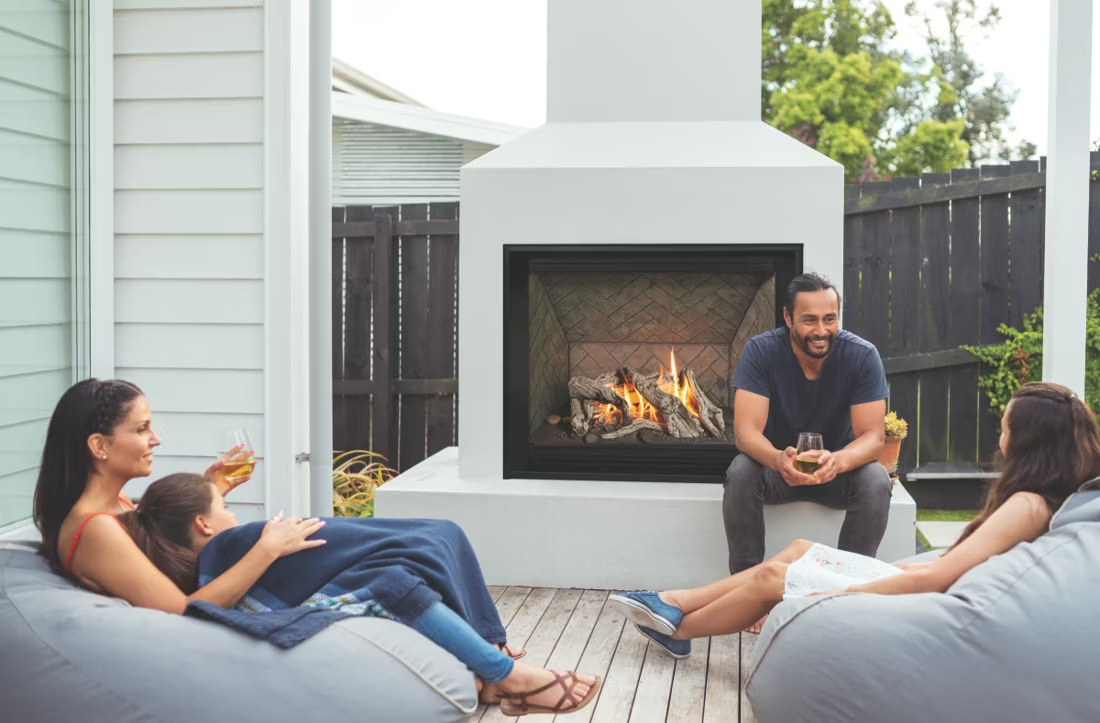
North Miami sits at 5 feet of elevation in climate zone 1A, where the average winter low is a mild 59°F and the entire heating season is barely there—a city like Duluth, MN can rack up more heating need than that in a single cold week. Nobody in North Miami is buying a fireplace to keep from freezing. What's driving demand instead is design: gas fireplaces and linear fire features have become a standard upgrade in South Florida great rooms, primary suites, and covered lanais, where builders and remodelers use them as a focal point rather than a heat source.
Piped natural gas is limited across this part of Miami-Dade County, so the large majority of gas fireplace projects in North Miami run on propane, with a small tank installed alongside the unit rather than a tie-in to a municipal gas line. Electric service throughout the city comes from Florida Power & Light. On the handful of nights each winter when a cold front pushes lows into the 40s—and during hurricane-season power outages, when the grid can be down for days—a propane gas fireplace with battery-backed ignition gives homeowners real, instant flame without depending on FPL at all.
Three steps. No salesperson until you're ready.
Tell us about your project
Your zip code, your situation, and the fuel you're leaning toward—or let the answers point you to one.
See what's actually available
The brands dealers within 100 miles genuinely carry—real options, never a catalog mirage.
Get your dealer & Project Guide
A trusted local dealer, plus the free Project Guide & Parts List that names every component of the job.
Frequently Asked Questions
How much does a gas fireplace installation cost in North Miami?
Most propane gas fireplace installations in North Miami run $4,000 to $9,000, including the unit, venting, and a small propane tank if the home isn't already set up for gas. A simple gas log set added to an existing masonry firebox—rare in this area, since most homes are slab-built without a chimney—comes in lower, around $2,000 to $4,000. Linear or see-through units built into new construction or a lanai remodel land at the higher end once framing and finish work are included. A local dealer will give you a firm number after seeing the space and confirming whether propane tank placement works with your lot setback.
Can I add a gas fireplace to a home that doesn't have a chimney?
Yes—this is actually the norm in North Miami. Most homes here are built on slab foundations with block or frame construction and no masonry chimney to convert, unlike older housing stock up north. A direct-vent gas fireplace solves this: it vents horizontally through an exterior wall rather than up through a chimney, so it can go into a great room, primary suite, or covered lanai wall without any existing masonry. This is the most common configuration local installers quote in this part of Miami-Dade.
Should I use propane or natural gas for my fireplace?
For most North Miami addresses, propane is the practical answer, since piped natural gas service doesn't reach much of this part of Miami-Dade County. Your installer will typically spec a buried or pad-mounted propane tank sized to the fireplace's BTU output, refilled a few times a year by a local propane supplier. If your street does have natural gas service already run for a water heater or range, a gas fireplace can tie into that line instead—worth confirming with your installer before they quote tank placement.
Will my gas fireplace work during a hurricane-season power outage?
Most modern gas fireplaces will, which is a real point in their favor in Miami-Dade. Units with IPI (intermittent pilot ignition) run on battery backup and light on demand even with the grid down—useful when FPL outages after a storm stretch into days. Valor fireplaces go a step further: their pilot assembly generates its own electricity through the thermocouple, so there's no battery to remember or replace, ever. Ask your local dealer specifically about the ignition system on any unit you're considering if storm-season reliability matters to you.
What's the difference between a gas fireplace, insert, and log set?
A gas fireplace is a fully self-contained, built-in unit framed into a wall—the most common choice for North Miami new construction and remodels since there's usually no existing firebox to work with. A gas insert is built to slide into an existing masonry fireplace, which applies to only a small share of older homes in this area. A vented gas log set is the simplest option: realistic ceramic logs installed into an existing masonry or prefab firebox using the current flue. For most North Miami homeowners without an existing wood fireplace, a direct-vent built-in unit is the right starting point.
Do I need a permit to install a gas fireplace in North Miami?
Yes—gas fireplace installations require a building permit and a separate gas permit through the City of North Miami Building and Code Enforcement Department, and the work falls under Miami-Dade County's High Velocity Hurricane Zone code, which is stricter than most of the country on wall penetrations and exterior venting. A licensed gas fitter has to handle the propane or gas line connection. Most local hearth dealers coordinate the permitting and inspections as part of the installation, which is worth confirming before you sign a contract.
Are vent-free gas fireplaces a good fit for North Miami's humidity?
Vent-free (unvented) gas fireplaces are legal in Florida and technically usable in North Miami, but I'd steer most homeowners toward a direct-vent unit instead. Ventless units release combustion byproducts—including water vapor—directly into the room, and South Florida's year-round humidity and closed-up, air-conditioned homes are exactly the environment where added indoor moisture causes problems. Direct-vent units exhaust everything outside through a sealed system, which keeps your indoor air quality and humidity levels unaffected. Ask a local dealer to walk you through both if you're deciding.
How often does a gas fireplace need to be serviced in North Miami?
Once a year is standard, even in a climate where the fireplace might only run a few dozen hours all winter. A technician checks the burner, pilot or ignition system, gas connections, and venting, and cleans the glass. Salt air near the coast—relevant for the 33160 and 33161 zip codes closer to the water—can accelerate corrosion on exterior venting components, so coastal homeowners in particular shouldn't skip the annual check. Expect to pay in the neighborhood of $150 to $250 for a standard inspection.
Gas vs. electric—which fireplace makes more sense in North Miami?
Wood fireplaces are essentially a non-factor here—North Miami's mild winters and lack of chimneys mean almost nobody installs one, aside from an occasional decorative unit in a vacation home. The real choice locally is gas versus electric. A gas fireplace delivers a real flame, real heat output for the rare cold snap, and a design centerpiece that adds resale appeal—but it needs venting and, in most cases, a propane tank. An electric fireplace or insert needs only a standard outlet, costs far less to install (often under $1,200), and runs efficiently off Florida Power & Light service with none of the tank or venting logistics. For a purely decorative feature or a rental property, electric is often the simpler call; for a primary living space where you want authentic flame, gas is usually worth the extra installation cost.
Why is a fireplace insert so efficient?
An insert does two things: it seals the chimney completely, so you stop losing air you already paid to heat, and it radiates warmth into the room through the firebox and glass. Most add a heat-exchange fan that pulls cool room air underneath, wraps it around the hot firebox, and pushes it back out warm. Your home is more efficient before you've even lit the first fire.
Why is my open fireplace making my house colder?
Open fireplaces suck—literally. As the fire burns, it consumes air your furnace already paid to heat and pulls it out through the chimney, so the house is actually colder after the fire goes out than before you lit it. An insert fixes this: it seals the chimney, puts fixed glass across the front, and turns that hole in your house into a real heat source.
How much should I budget for a fireplace?
For an average home—covering the fireplace, the vent pipe, and basic installation—a budget between $3,900 and $5,500 gives you a lot of options across wood, gas, and pellet. By the time you add finish work, gas line, and electrical, the average complete installation lands between $5,000 and $12,000 all-in. In a remodel or new build, a good rule is to put about 2.5% of the total project cost toward the fireplace.
Can I install a fireplace myself?
If you're putting a fire in your house on purpose, it's best to work with an expert. Unless you're genuinely experienced in framing, gas line, vent pipe, and the national code on clearances to combustibles, have a professional do it—and ideally the same company that sells you the fireplace, so warranty, service, and liability all live under one roof.
Nearby Dealers
Hearth shops serving North Miami and the surrounding area.
Find your gas fireplace in North Miami.
Tell us a bit about your space and we'll put together a free Project Guide & Parts List—the exact parts, including venting, for your North Miami gas fireplace project—and match you with a trusted local dealer to install it.
Find Your Fireplace →