
A fireplace built for island living, not winter survival.
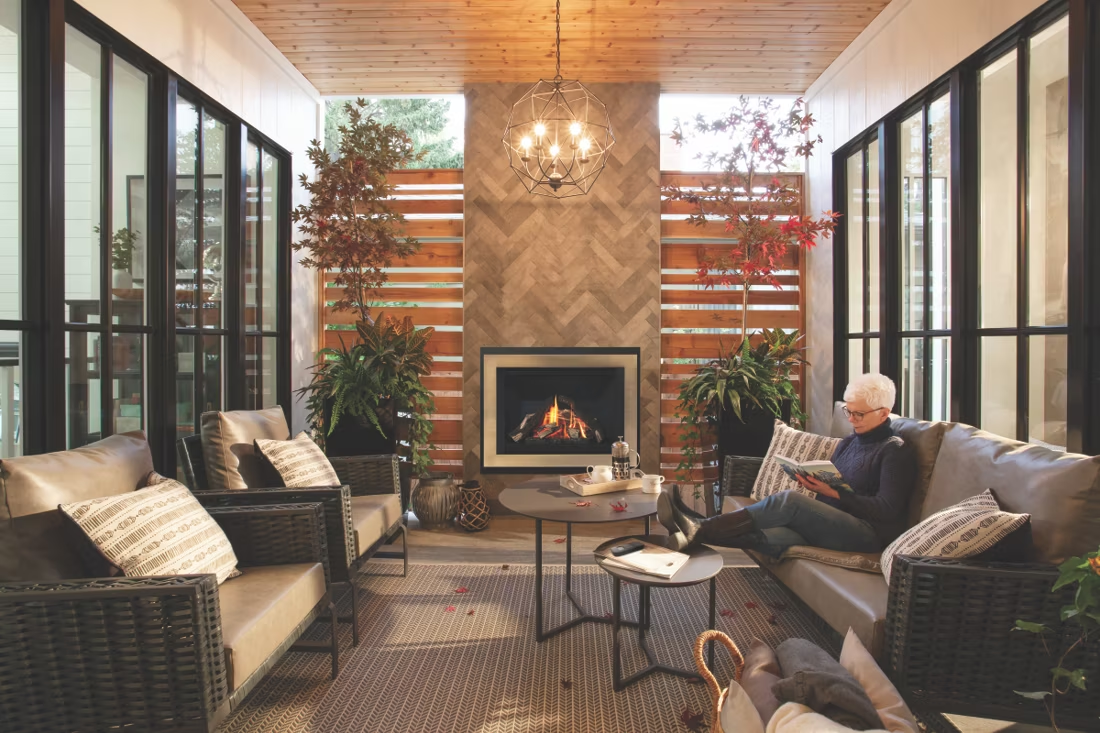
With barely any real winter chill to speak of, nobody in Cudjoe Key needs a fireplace to stay warm. They install one anyway—for the glow, the focal point, and the backup flame when a storm takes out the grid.
Every Project Starts From One of These Five Situations
Virtually no need for winter heat. Real design demand anyway.
Cudjoe Key sits at roughly sea level in the Lower Keys, with an average winter low around 66°F and practically no real winter heating need—for comparison, a city like Duluth, MN faces a long, brutal heating season that lasts most of the year. This is not a place anyone buys a fireplace to survive January. It's a place people buy one for the same reason they add string lights to a lanai: it makes a great room or outdoor living space feel finished, and it gives guests something to look at during a rare cold front when temperatures dip into the upper 40s.
There's no natural gas utility serving Cudjoe Key—homes here run on propane, delivered and stored in tanks rather than piped from a main. That shapes the whole project: your installer is sizing a tank, running gas line to code, and choosing venting that can hold up to salt air and hurricane-force wind without corroding out in five years. Add in Monroe County's flood-zone and wind-load construction requirements—most homes here are elevated on pilings—and a gas fireplace installation in the Keys looks different from one inland, even if the box on the wall is the same.
Three steps. No salesperson until you're ready.
Tell us about your project
Your zip code, your situation, and the fuel you're leaning toward—or let the answers point you to one.
See what's actually available
The brands dealers within 100 miles genuinely carry—real options, never a catalog mirage.
Get your dealer & Project Guide
A trusted local dealer, plus the free Project Guide & Parts List that names every component of the job.
Frequently Asked Questions
How much does a gas fireplace installation cost in Cudjoe Key?
Most Lower Keys gas fireplace installs run in the neighborhood of $3,500 to $8,500, though the range swings on a few local factors: whether you already have a propane tank and gas line in place, whether the unit is going into an elevated stilt home (which can mean longer gas runs and additional support work), and whether you're choosing marine-grade or corrosion-resistant venting components to hold up against salt air. Outdoor or lanai installations tend to land on the lower end; a built-in great-room fireplace with new gas line work sits higher. A local dealer will walk your home before quoting a firm number—worth doing given how much elevation and flood-zone construction affect the job here.
Do I need natural gas, or does everyone use propane in Cudjoe Key?
Propane. There's no natural gas main serving Cudjoe Key or the surrounding Lower Keys, so virtually every gas appliance here—fireplaces included—runs on propane from a tank, either buried, mounted on a stand, or shared with your grill and water heater. Suppliers deliver by truck from the mainland or Key West-area distributors. Your installer will size the tank (or connect to an existing one) and set the fireplace's regulator and orifice for propane specifically, which is a different setup than a natural-gas unit.
Do I actually need a gas fireplace for heat in Cudjoe Key?
Realistically, no. With winter lows averaging 66°F and practically no real winter heating need all year, Cudjoe Key almost never sees conditions where a fireplace is doing meaningful heating work—even the occasional January cold front rarely drops below the upper 40s overnight. Most homeowners here choose a gas fireplace for the visual focal point in a living room or lanai, for entertaining, and as a source of flame that keeps working if a storm knocks out FPL power. If you're deciding between an ambiance-first electric unit and a real-flame gas unit, that's the honest tradeoff to weigh.
What permits do I need for a gas fireplace in Cudjoe Key?
Installations go through the Monroe County Building Department, which enforces some of the strictest wind-load and flood-elevation codes in the state given the Keys' hurricane exposure and FEMA base flood elevation requirements. Expect a building permit and a separate gas permit for the propane line work, both typically pulled by your installer. Because so many homes here are elevated on pilings, inspectors also check that gas line routing and venting terminations meet clearance and wind-uplift standards—another reason to use an installer who's done Keys-specific work before rather than a general contractor unfamiliar with the county's requirements.
Should I get a vented or vent-free gas fireplace given the salt air here?
Direct-vent units are generally the better call in Cudjoe Key. They exhaust combustion byproducts outside through a sealed system, which matters in a humid, salt-laden coastal environment where indoor air quality and moisture control are already a challenge. Vent-free units are technically permitted in Florida, but they release combustion moisture directly into the room—not ideal in a climate that's already fighting humidity year-round. Whichever you choose, ask your installer about corrosion-resistant venting materials; standard galvanized components don't last long a few hundred feet from open water.
Are outdoor or lanai gas fire features popular in the Keys?
Very. A lot of Cudjoe Key gas fireplace projects aren't indoor units at all—they're linear fire features or fire tables built into a screened lanai or outdoor kitchen, where island homeowners spend most of their time anyway. These tie into the same propane tank as your grill or indoor fireplace and give you a gathering point on the rare cool evening, plus that focal-point glow year-round. Local dealers who work in the Lower Keys can spec units rated for exposed, high-humidity outdoor use rather than repurposing an indoor model.
Will a gas fireplace still work if a hurricane knocks out power?
In most cases, yes, and it's one of the better arguments for one out here. Units with intermittent pilot ignition (IPI) run on battery backup and will light on demand even with FPL power down, and since the fuel source is a propane tank rather than the electric grid, you're not dependent on utility restoration to have a working flame. Valor fireplaces take it a step further—the pilot's thermocouple generates its own electricity, so there's no battery to remember to replace before storm season. Given how long post-hurricane power outages can run in the Keys, that reliability is worth asking your dealer about specifically.
Gas fireplace vs. electric—which makes more sense in Cudjoe Key?
Since heating output is basically irrelevant here, the decision comes down to ambiance, resilience, and upkeep. Gas gives you a real flame, works during a power outage if you have propane on hand, and holds up as a genuine design centerpiece—but it means maintaining a tank and running gas line. Electric fireplaces cost far less to install (often under $1,500), have zero venting or fuel logistics, and at FPL's residential rate of about $0.137/kWh are cheap to run for looks alone—but they go dark the moment the power does, which matters in a hurricane-prone area. Many Cudjoe Key homeowners land on electric for a guest room or den and gas for the main living space or outdoor entertaining area.
What about a wood-burning fireplace instead?
Wood-burning units are essentially a non-starter in Cudjoe Key, and honest local dealers will tell you so. Most homes are elevated concrete-block or stilt construction without a masonry chimney to begin with, firewood isn't a local resource the way it is inland, and with next to no heating need, there's no functional case for one. The oak, mahogany, and pine that grow in the Keys are more commonly seen as furniture or trim than firewood. If you want the look of a wood fire, a gas unit with a realistic log set gets you the aesthetic without the venting, humidity, and pest issues that come with true wood-burning in a marine climate.
Is my gas fireplace wasting gas?
If it was installed more than 15 years ago, probably. Older gas fireplaces keep a standing pilot light burning all the time, and that little flame can cost a couple hundred dollars a year. Newer models use pilot-on-demand ignition—the pilot lights only when you use the fireplace and goes out when you turn it off.
Why is a fireplace insert so efficient?
An insert does two things: it seals the chimney completely, so you stop losing air you already paid to heat, and it radiates warmth into the room through the firebox and glass. Most add a heat-exchange fan that pulls cool room air underneath, wraps it around the hot firebox, and pushes it back out warm. Your home is more efficient before you've even lit the first fire.
Can a fireplace actually lower my heating bill?
Yes—by creating a comfort zone. A furnace heats every square foot of the house just to warm the one room you're in; a gas fireplace on low burns roughly a sixth of the gas a typical furnace does. Set the furnace around 55–60 degrees as a baseline, then heat the rooms your family actually uses. Families who heat this way commonly save $20–$60 a month.
What is an in-home preview and do I need one?
It's a visit where a hearth professional measures your space, confirms the model you picked actually works in your home, and walks the specs—framing, gas line, venting, finish work—before anything is ordered. Some details you just can't know until you see the house. Never make a down payment without one; it's the single most-skipped step that burns buyers.
Nearby Dealers
Hearth shops serving Cudjoe Key and the surrounding area. Every listing shows whether it is a WhyFire partner, a dealer we have verified as authorized for the brands we recommend, or a local business carrying hearth products. No manufacturer pays for placement. How we verify dealers →
We’ve paused dealer listings for this connection today. Enter your zip or postal code above to find dealers near you, or come back tomorrow.
Popular Gas Brands
Where each brand came from, what's inside it today, and every current model. No brand pays to be here. Not every dealer carries every brand, so enter your zip code to see what's sold near Cudjoe Key.
Kozy Heat
Kozy Heat was founded in 1976 by Dudley Hussong in Lakefield, Minnesota, and incorporated as Hussong Manufacturing Co., Inc. in 1978.
28 gas models →Fireplace Xtrordinair
Fireplace Xtrordinair, now often called FireplaceX, is the fireplace brand of Travis Industries, Inc., of Mukilteo, Washington.
25 gas models →Town & Country
Town & Country Fireplaces is the luxury gas fireplace brand of Pacific Energy Fireplace Products Ltd., of Duncan, British Columbia.
14 gas models →Lopi
Lopi is a wood, pellet, and gas stove brand founded by Kurt Rumens in Bellevue, Washington, in 1979.
7 gas models →Forge & Flame
Forge & Flame is the stove brand Hearth & Home Technologies introduced in August 2023 to bring Vermont Castings, Harman, and Quadra-Fire under one name.
6 gas models →Vermont Castings
Vermont Castings was founded in 1975 by Duncan Syme, the designer, and his brother-in-law Murray Howell, the business partner, in Randolph, Vermont.
6 gas models →Find your gas fireplace in Cudjoe Key.
Tell us about your home—stilt house, ground-level, indoor or lanai—and we'll help you find a trusted local dealer and a free Project Guide & Parts List sized for propane, salt air, and Monroe County code.
Find Your Fireplace →