
Electric heat and ambiance, built for the Keys.
No chimney, no gas line, no venting through a hurricane-rated roof. Find the right electric fireplace for your Big Pine Key home and connect with a trusted local dealer.
Every Project Starts From One of These Five Situations
The Lower Keys are built for cooling, not heating.
Big Pine Key sits at sea level in the Lower Florida Keys, inside climate zone 1A, where the average winter low hovers around 64 degrees and the entire county has barely any winter heating need at all. For comparison, a home in Duluth, Minnesota can face a heating season demand more than a hundred times greater in a single winter. Nobody here is installing a wood stove to survive January. But that doesn't mean fireplaces are absent from Keys homes—it means the job they do is different.
Most homes on Big Pine Key are elevated on pilings or built slab-on-grade with concrete block and stucco to meet Monroe County's flood and wind-load codes, and many are second homes or vacation rentals where a fireplace is about atmosphere, resale value, and the occasional cool snap when a January cold front pushes lows into the 40s and 50s. An electric fireplace fits that reality well: no roof penetration to engineer around hurricane strapping, no combustion air intake to seal against salt-laden humidity, and no gas line to run in a place where propane still has to arrive by truck. Florida Power & Light serves the grid here at roughly 13.7 cents per kWh, and a wall-mounted or built-in electric unit sips power compared to running central AC—which, in the Keys, is the appliance actually doing the heavy lifting most of the year.
Three steps. No salesperson until you're ready.
Tell us about your project
Your zip code, your situation, and the fuel you're leaning toward—or let the answers point you to one.
See what's actually available
The brands dealers within 100 miles genuinely carry—real options, never a catalog mirage.
Get your dealer & Project Guide
A trusted local dealer, plus the free Project Guide & Parts List that names every component of the job.
Frequently Asked Questions
How much does an electric fireplace installation cost in Big Pine Key?
A simple plug-in electric insert or mantel unit can run as little as $500 to $900 installed, since it just needs a standard 120V outlet and no dedicated wiring. A hardwired wall-mounted linear unit set into a stud wall or a CBS (concrete block stucco) opening typically runs $1,200 to $2,500, once you factor in an electrician to run a dedicated circuit and a carpenter or mason to frame the opening. Homes on pilings sometimes add a bit to the labor side, since running new circuits up through an elevated structure takes more time than a slab-on-grade job. Local dealers will quote a firm number after seeing your wall type and panel capacity.
Does it even make sense to install a fireplace in a climate this warm?
It's a fair question when Big Pine Key barely has any winter heating need at all. The honest answer is that almost nobody here is buying an electric fireplace to heat a home—central AC and the occasional space heater cover the handful of nights that dip into the 40s. What homeowners are buying is the look and feel of a fire: a linear unit behind a TV wall, a mantel piece in a great room, or an insert in a vacation rental that photographs well and gives guests a cozy focal point. Electric units are popular here precisely because they deliver that ambiance without any of the venting, chimney, or combustion concerns that come with wood or gas in a hurricane-zone home.
Do I need a permit to install an electric fireplace in Big Pine Key?
Big Pine Key is unincorporated Monroe County, so permitting runs through the Monroe County Building Department. A plug-in unit that uses an existing outlet generally doesn't require a permit. A hardwired built-in or wall-mounted unit that needs a new dedicated circuit does require an electrical permit, and any structural opening cut into a load-bearing or hurricane-rated wall may need a separate building permit and inspection. Most local dealers coordinate the electrician and, if needed, the permit paperwork as part of the install so you're not chasing down two separate trades.
What type of electric fireplace holds up best in Keys homes?
Look for units rated for the humidity and salt air that come standard on Big Pine Key—sealed electronics and corrosion-resistant hardware matter more here than in a dry inland climate. Linear wall-mount units built into a CBS or stud wall tend to do well because the internals stay protected behind the wall finish. Freestanding or mantel-style units placed near sliding doors or louvered windows should have any exposed metal trim checked for corrosion resistance, since salt air finds its way into homes even a few blocks from open water. A local dealer familiar with Keys installs will steer you away from units that aren't built for this environment.
Electric fireplace, insert, or mantel unit—which fits my home?
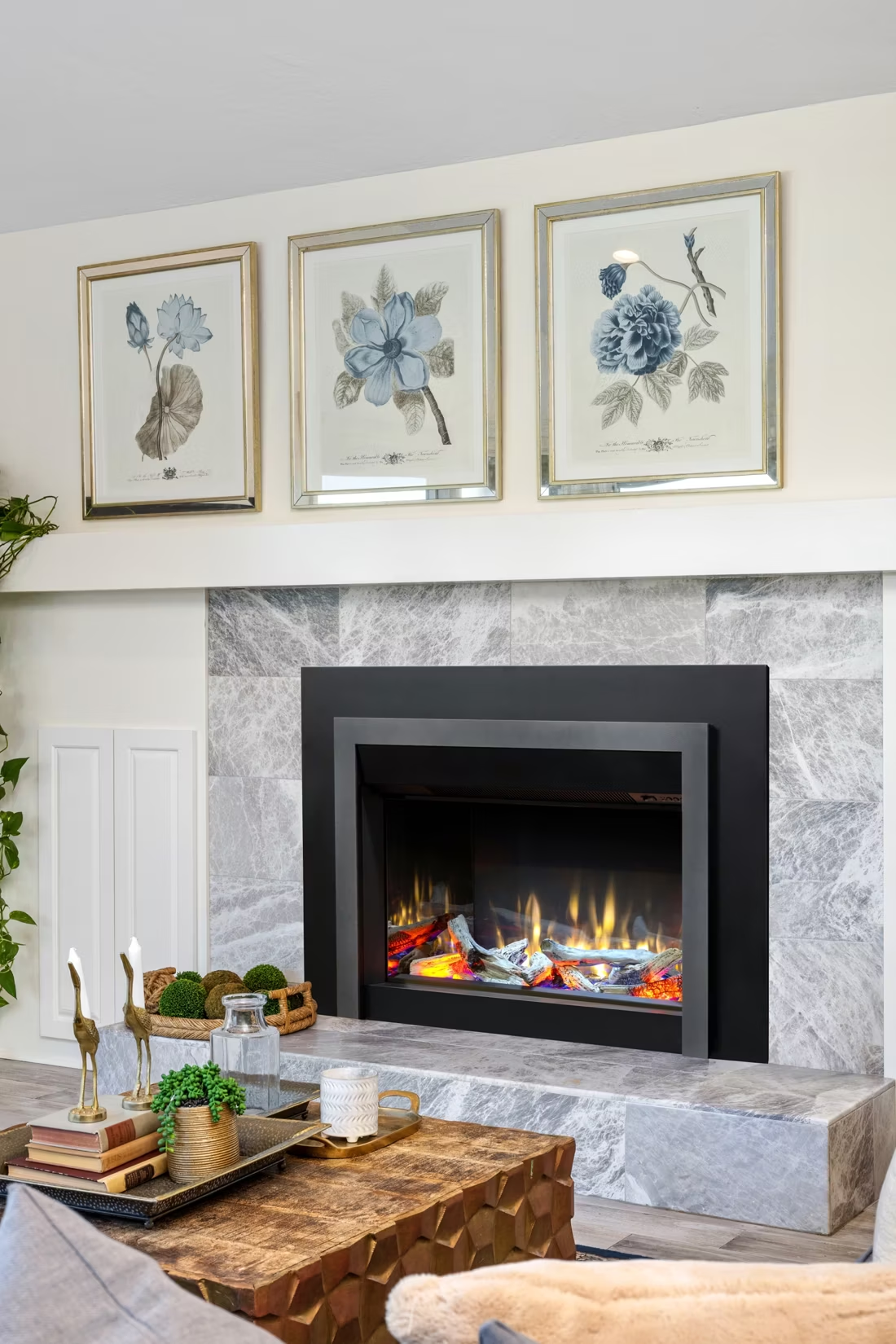
A built-in linear electric fireplace recessed into a wall gives the cleanest look and works well in new construction or a remodel, which is common in Big Pine Key's rebuild-after-storm renovation cycle. An electric insert is sized to slide into an existing masonry or built-in firebox opening—useful if your home has an old, unused wood-burning fireplace shell you want to convert without the venting hassle. A freestanding mantel package is the simplest option and the easiest to move if you're outfitting a vacation rental or don't want to commit to permanent wiring. For most single-family homes here, a hardwired linear unit built into the main living area gets the strongest resale response.
Will an electric fireplace still work if the power goes out during a storm?
No—electric fireplaces are entirely dependent on grid power or a generator, and Big Pine Key sees real outage risk during hurricane season, sometimes for days at a time after a direct hit. If backup heat or a heat source during extended outages is a priority, that's a case where a propane-fueled unit has a real advantage, since some gas fireplaces can run on battery backup ignition. Most homeowners here treat the electric fireplace purely as a daily-use ambiance feature and rely on a whole-home or portable generator for anything storm-related.
Electric vs. gas—which makes more sense for a Big Pine Key home?
Gas fireplaces here run on propane, since there's no natural gas main serving the Lower Keys, which means a tank and delivery contract in addition to the fireplace itself. Gas gives you real, if modest, heat output and can be set up to work during a power outage. Electric skips the tank, the delivery contract, and any gas line work entirely—you're just adding a circuit—and it's the lower-cost, lower-maintenance option for anyone who wants the visual of a fire without adding another fuel system to a home that already runs on AC and FPL power. For most Big Pine Key homeowners focused on ambiance rather than supplemental heat, electric is the simpler and less expensive path.
What does an electric fireplace cost to run day to day?
At Florida Power & Light's residential rate of roughly 13.7 cents per kWh, a typical 1,500-watt electric fireplace running on flame-only mode (no heater engaged) costs just a few cents an hour—closer to $1.50 to $2.50 for an evening's use. Running the heater element pushes that up, but since almost nobody in Big Pine Key needs supplemental heat given the mild winters, most owners run their unit in ambiance mode most of the year, which keeps the operating cost negligible compared to central air conditioning.
How well do electric fireplaces hold up long-term in this humidity?
Electric units generally do well in the Keys because they have no chimney, no combustion byproducts, and no creosote or soot to manage—but the ambient humidity and salt air do shorten the lifespan of cheaper electronics and unsealed metal components. Expect a quality unit to run 8 to 12 years before the LED and heating elements need service or replacement, a bit less if it's installed near an exterior wall with regular salt spray exposure. Vacation rental owners in particular should budget for more frequent bulb and component checks given the turnover and occasional storm-related power surges.
Does an electric fireplace need a vent or chimney?
No—that's its superpower. An electric fireplace needs a wall and an outlet, period. No vent pipe, no gas line, no clearances to design around, which is why it works in bedrooms, offices, apartments, and walls where venting a gas or wood unit would be impractical or impossible. Installation is typically the simplest and least expensive of any fireplace type.
Can I put a TV above my fireplace?
Yes—with an asterisk. Fireplaces are hot and TVs don't like heat. Either put a mantel between them to deflect rising warmth, or choose a fireplace with heat-management technology that creates a cool zone on the wall above—the wall stays around 125 degrees, barely warm, while the room still gets full heat. If you like clean lines and don't want a mantel, heat management is the answer.
Can a fireplace actually lower my heating bill?
Yes—by creating a comfort zone. A furnace heats every square foot of the house just to warm the one room you're in; a gas fireplace on low burns roughly a sixth of the gas a typical furnace does. Set the furnace around 55–60 degrees as a baseline, then heat the rooms your family actually uses. Families who heat this way commonly save $20–$60 a month.
Does a fireplace add value to my home?
On average, a fireplace adds back to the home about the same amount you spent installing it. Add the monthly savings from heating the rooms you actually use instead of the whole house—often hundreds of dollars a year—and the value case is strong before you even count what a fire does for how your family uses the room.
Nearby Dealers
Hearth shops serving Big Pine Key and the surrounding area. Every listing shows whether it is a WhyFire partner, a dealer we have verified as authorized for the brands we recommend, or a local business carrying hearth products. No manufacturer pays for placement. How we verify dealers →
We’ve paused dealer listings for this connection today. Enter your zip or postal code above to find dealers near you, or come back tomorrow.
Popular Electric Brands
Where each brand came from, what's inside it today, and every current model. No brand pays to be here. Not every dealer carries every brand, so enter your zip code to see what's sold near Big Pine Key.
Fireplace Xtrordinair
Fireplace Xtrordinair, now often called FireplaceX, is the fireplace brand of Travis Industries, Inc., of Mukilteo, Washington.
5 electric models →DaVinci
DaVinci Custom Fireplaces is a brand of Travis Industries, Inc., of Mukilteo, Washington, the company behind Lopi and Fireplace Xtrordinair.
5 electric models →Kozy Heat
Kozy Heat was founded in 1976 by Dudley Hussong in Lakefield, Minnesota, and incorporated as Hussong Manufacturing Co., Inc. in 1978.
3 electric models →Forge & Flame
Forge & Flame is the stove brand Hearth & Home Technologies introduced in August 2023 to bring Vermont Castings, Harman, and Quadra-Fire under one name.
1 electric model →Electric Service in Big Pine Key
An electric fireplace's heater draws about 1,500 watts—pennies per hour at local rates.
Florida Power & Light Co
Find your electric fireplace in Big Pine Key.
Tell us a bit about your home and we'll help you find the right electric fireplace or insert—plus a free Project Guide & Parts List and a trusted local dealer who knows Monroe County's building codes.
Find Your Fireplace →