
Quiet warmth for Essex Village's historic riverfront homes.
Electric heat that adds warmth to Essex Village's 18th-century houses without a flue, gas line, or chimney work—matched with a trusted local dealer.
Every Project Starts From One of These Five Situations
The easiest heat to add to a 1780s house.
Essex Village sits along the tidal Connecticut River in the Lower Connecticut River Valley, home to one of the largest and best-preserved historic districts in New England, with sea captains' houses dating to the 1700s and 1800s. At just 71 feet in elevation near open water, winters here are somewhat milder than inland Connecticut—average lows around 25°F and a winter heating season comparable to much of coastal New England, moderated by the river and nearby Long Island Sound. Milder is relative in New England, though, and owners of the village's Federal and Greek Revival houses often want supplemental warmth without altering the architecture the Essex Historic District Commission works to protect.
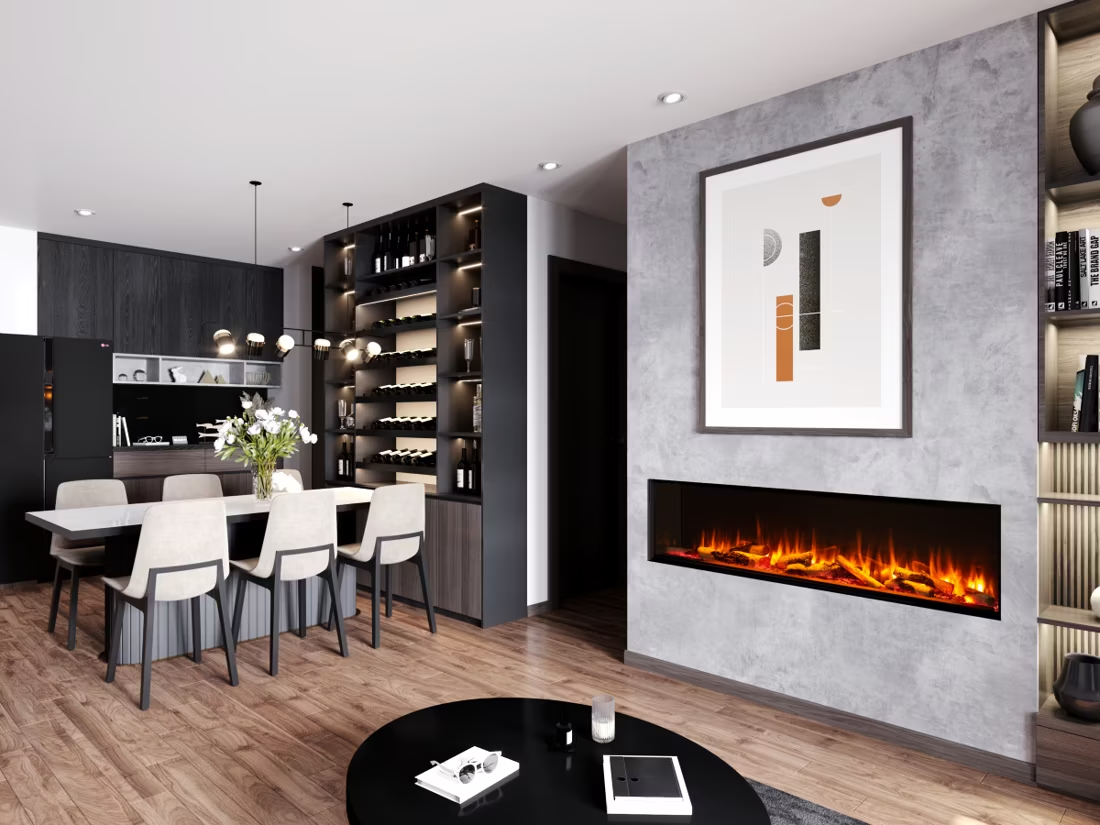
With no natural gas utility serving most of the village and new masonry chimneys or propane tanks often impractical for landmark properties, electric fireplaces and inserts have become the practical middle ground. A plug-in unit or a hardwired zero-clearance insert adds real supplemental heat to a study, a converted keeping room, or a waterfront addition without a flue, gas line, or fuel storage tank. Connecticut Light & Power's residential rate here runs about 25 cents per kWh, among the higher rates in the country, so most homeowners in Essex Village treat electric fireplaces as targeted zone heat—a 1,500-watt unit costs roughly 35 to 40 cents an hour to run—rather than a whole-house heating replacement.
Three steps. No salesperson until you're ready.
Tell us about your project
Your zip code, your situation, and the fuel you're leaning toward—or let the answers point you to one.
See what's actually available
The brands dealers within 100 miles genuinely carry—real options, never a catalog mirage.
Get your dealer & Project Guide
A trusted local dealer, plus the free Project Guide & Parts List that names every component of the job.
Frequently Asked Questions
How much does it cost to add an electric fireplace in Essex Village?
Most electric fireplace projects here fall into one of two categories. A plug-in insert or freestanding unit that runs on a standard 120-volt outlet costs $300 to $1,200 installed, since there's usually no new wiring needed beyond confirming the circuit can handle a 1,500-watt draw. A built-in wall unit or a zero-clearance insert set into an existing masonry firebox—common in Essex's older captain's houses—runs $1,200 to $3,000 once you add a licensed electrician's time for a dedicated 20-amp circuit and any custom surround work. Because there's no venting, gas line, or chimney liner involved, electric installs are consistently the least expensive hearth upgrade available in the Lower Connecticut River Valley.
Do I need approval from the Essex Historic District Commission to install an electric fireplace?
In most cases, no. Electric fireplaces don't require a chimney, flue, or exterior vent termination, so they don't touch the exterior features—window openings, siding, roofline—that the Essex Historic District Commission reviews for the village's landmark district. You will still need an electrical permit through the Essex Building Department if the installation requires a new dedicated circuit, which a licensed electrician typically pulls as part of the job. If you're adding a mantel surround that changes an interior fireplace opening on a designated landmark structure, it's worth a quick call to the town to confirm, but the electrical work itself is usually the simplest part of the project.
Can an electric fireplace heat my whole house?
Not realistically, and that's true almost everywhere, but it's especially worth noting in Essex Village given Connecticut Light & Power's residential rate of roughly 25 cents per kWh—one of the higher rates in the country. A typical 1,500-watt electric fireplace produces about 5,000 BTUs, enough to comfortably heat a single room of 300 to 400 square feet, at a running cost of roughly 35 to 40 cents an hour. Most homeowners here use electric fireplaces as zone heat for a den, sunroom, or bedroom rather than a replacement for the oil, propane, or heat pump systems carrying the rest of the home's heating load.
What's the difference between an electric fireplace, insert, and stove?
An electric fireplace is typically a wall-mounted or built-in unit designed to look like a framed hearth. An electric insert is sized to slide into an existing masonry firebox—a natural fit for Essex Village's 18th- and 19th-century homes where the original fireplace opening is still intact but the flue is no longer safe or practical to burn wood in. An electric stove is a freestanding cabinet-style unit that mimics a wood or gas stove and can sit anywhere near an outlet. All three use the same resistive-heat and LED flame technology; the choice mostly comes down to whether you have an existing firebox to fill or open wall space to work with.
I have an old masonry fireplace that's been sealed off for years—can I still use it?
Yes, and it's one of the more common projects in the village's historic housing stock. Many of Essex's Federal and Greek Revival homes have original masonry fireboxes that haven't safely burned wood in decades because of deteriorated flue liners or structural concerns. Rather than the expense of relining a chimney for wood or running new gas service, an electric insert slides into that existing opening, plugs into a nearby outlet or dedicated circuit, and restores both the look and the heat without touching the flue at all.
Do modern electric fireplaces actually look like a real fire?
The technology has improved considerably. LED and mirror-reflection flame effects from brands like Dimplex, Napoleon, and Touchstone create a realistic, layered flame with adjustable color, brightness, and simulated ember beds—most people can't tell it's electric from across a room. For a village like Essex, where many homes sit on the historic register and owners care about appearance as much as heat output, that visual quality matters. Ask a local dealer to run a floor unit in person before you buy; flame realism varies more between brands than most other electric fireplace features.
Will my electric fireplace still work if the power goes out?
No—and that's worth planning around in Essex Village, where nor'easters and coastal storms moving up the Connecticut River regularly knock out power for CL&P customers, sometimes for days at a stretch. An electric fireplace needs grid power or a generator to run, unlike a wood stove that keeps producing heat through an extended outage. If storm resilience matters to you, some homeowners here pair an electric fireplace for everyday ambiance and zone heat with a wood stove or pellet insert elsewhere in the house—burning local oak, maple, or ash—specifically as backup.
Should I choose electric over wood or pellet for my Essex Village home?
It depends on what you're solving for. Electric is the simplest and least expensive option when you want supplemental warmth and ambiance without a chimney, gas line, or fuel storage—a strong fit for the village's historic homes where venting options are limited. Wood, burning local oak, maple, birch, or ash, and pellet stoves using brands like Lignetics or New England Wood Pellet remain the better choice if you want heat that works through a power outage or want to meaningfully offset oil or propane heating costs. Several Essex Village homeowners run electric in main living spaces for daily convenience and keep a wood or pellet unit on hand as backup.
What size or wattage electric fireplace do I need?
Standard electric fireplaces are built around a 1,500-watt heating element regardless of the unit's visual size—that's a code-driven limit for a standard 120-volt circuit, producing roughly 5,000 BTUs, enough for a room up to about 400 square feet. If you're heating a larger open space, like a converted carriage house or an addition with vaulted ceilings, some larger units offer dual heating zones, or your dealer may recommend a hardwired 240-volt unit for higher output. The flame width and cabinet size—30-inch, 50-inch, 60-inch, and so on—is really a design decision based on your wall or firebox opening, separate from heating capacity.
Can I put a TV above my fireplace?
Yes—with an asterisk. Fireplaces are hot and TVs don't like heat. Either put a mantel between them to deflect rising warmth, or choose a fireplace with heat-management technology that creates a cool zone on the wall above—the wall stays around 125 degrees, barely warm, while the room still gets full heat. If you like clean lines and don't want a mantel, heat management is the answer.
Does an electric fireplace need a vent or chimney?
No—that's its superpower. An electric fireplace needs a wall and an outlet, period. No vent pipe, no gas line, no clearances to design around, which is why it works in bedrooms, offices, apartments, and walls where venting a gas or wood unit would be impractical or impossible. Installation is typically the simplest and least expensive of any fireplace type.
Can a fireplace actually lower my heating bill?
Yes—by creating a comfort zone. A furnace heats every square foot of the house just to warm the one room you're in; a gas fireplace on low burns roughly a sixth of the gas a typical furnace does. Set the furnace around 55–60 degrees as a baseline, then heat the rooms your family actually uses. Families who heat this way commonly save $20–$60 a month.
How much should I budget for a fireplace?
For an average home—covering the fireplace, the vent pipe, and basic installation—a budget between $3,900 and $5,500 gives you a lot of options across wood, gas, and pellet. By the time you add finish work, gas line, and electrical, the average complete installation lands between $5,000 and $12,000 all-in. In a remodel or new build, a good rule is to put about 2.5% of the total project cost toward the fireplace.
Nearby Dealers
Hearth shops serving Essex Village and the surrounding area. Every listing shows whether it is a WhyFire partner, a dealer we have verified as authorized for the brands we recommend, or a local business carrying hearth products. No manufacturer pays for placement. How we verify dealers →
Spicer Advanced Gas<br>The Propane Store
Fireworks Hearth And Home LLC
Jj Sullivan Inc.
Superior Hearth, Spas & Leisure
Fireside Supply
Electric Service in Essex Village
An electric fireplace's heater draws about 1,500 watts—pennies per hour at local rates.
Connecticut Light & Power Co
Find your electric fireplace in Essex Village.
Tell us about your home in Essex Village and we'll match you with a trusted local dealer and send over a free Project Guide & Parts List—the exact electric fireplace or insert, mounting hardware, and circuit requirements for your space.
Find Your Fireplace →