
Add Fireplace Warmth Without Adding a Chimney.
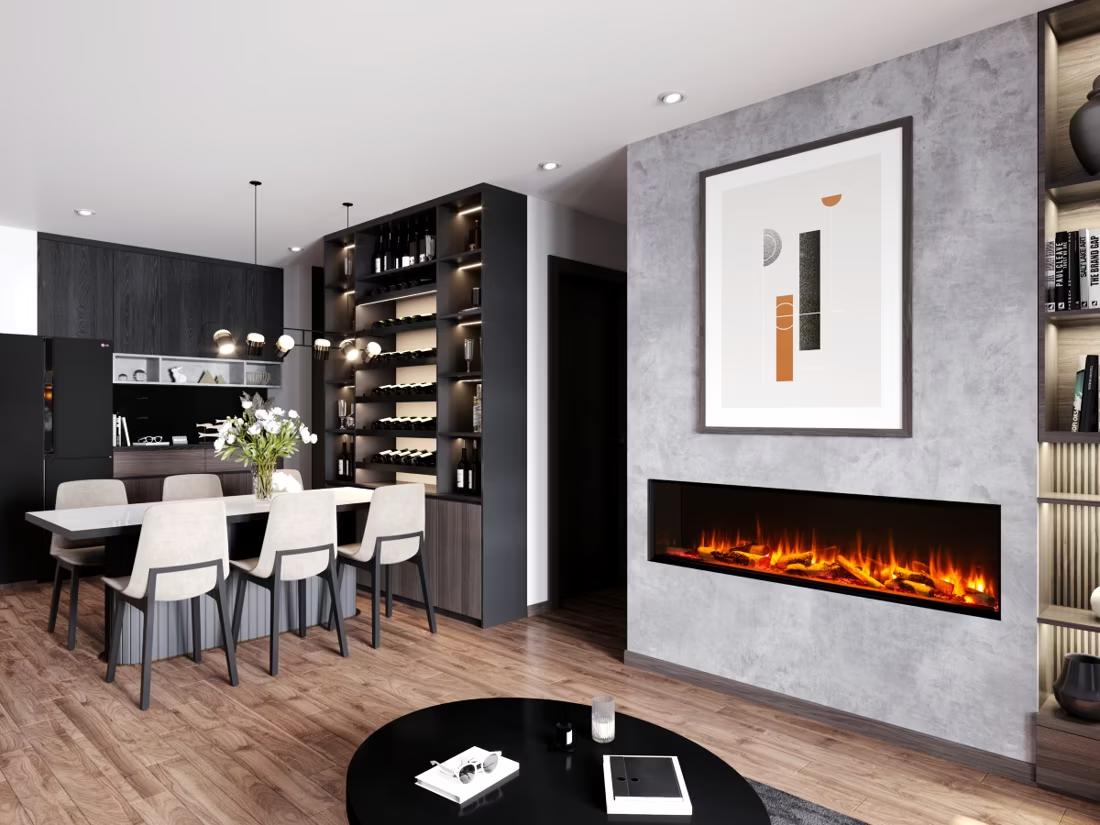
Timnath's newer subdivisions weren't built with masonry chimneys or gas lines to the family room. An electric fireplace fills that gap—plug it in or wire it in, no venting required.
Every Project Starts From One of These Five Situations
Built for new construction, not open flame.
Timnath sits at 4,867 feet on Colorado's Front Range in Larimer County, with winter lows averaging around 15°F and a winter heating season that stretches from about October well into spring—a real but moderate cold-climate winter, nowhere near what a town like Bozeman, MT or Fargo, ND sees, but enough that homeowners want supplemental heat in the rooms they actually live in. What sets Timnath apart isn't the climate, though—it's the housing stock. This is one of the fastest-growing towns in Colorado, and nearly every neighborhood, from Trails at Timnath to Serratoga Falls, has gone up in the last decade or so. These homes were built with forced-air furnaces and no masonry chimneys, and most HOAs here restrict solid-fuel appliances entirely.
That's also why wood and pellet stoves are essentially off the table in Timnath—between HOA covenants written for new subdivisions and the North Front Range's ozone nonattainment status (wildfire smoke already stresses air quality most summers), solid-fuel appliances just aren't a fit here. Electric is the practical answer: no flue, no gas line, no combustion byproducts, and it installs in a wall, a mantel surround, or an existing niche in an afternoon. Depending on your address, your power comes from either Public Service Company of Colorado (Xcel Energy) or Poudre Valley REA, the rural electric cooperative that still serves pockets of unincorporated Larimer County around town—both keep a 120V or 240V electric fireplace cheap to run for supplemental zone heat or pure ambiance.
Three steps. No salesperson until you're ready.
Tell us about your project
Your zip code, your situation, and the fuel you're leaning toward—or let the answers point you to one.
See what's actually available
The brands dealers within 100 miles genuinely carry—real options, never a catalog mirage.
Get your dealer & Project Guide
A trusted local dealer, plus the free Project Guide & Parts List that names every component of the job.
Frequently Asked Questions
How much does it cost to install an electric fireplace in Timnath?
A plug-in electric insert or a mantel package that fits into an existing niche typically runs $300 to $1,200 installed, since there's no venting or gas line to run. A built-in, zero-clearance electric fireplace framed into a new wall—common in Timnath's newer builds where the family room was designed around one—usually lands between $1,500 and $4,000 once an electrician sets a dedicated circuit and a carpenter finishes the surround. The single biggest cost driver isn't the unit itself, it's whether the wall already has a 120V outlet in the right spot or needs new electrical run behind drywall.
Do I need a permit to install an electric fireplace in Timnath?
A simple plug-in unit that uses an existing outlet generally doesn't require a permit. If your installer needs to run a new dedicated circuit or do any wiring inside a wall, that work needs an electrical permit through the Town of Timnath Building Division, and it should be pulled by a licensed electrician regardless of the unit's price point. One thing that catches people off guard here: because so much of Timnath is HOA-governed new construction, your neighborhood's architectural review committee may want to see the surround design even though there's no exterior venting involved—worth a quick check before you finalize a built-in.
Why don't more homes in Timnath use wood or pellet stoves?
Two things work against solid fuel here. First, the housing: almost every home in Timnath was built in the last fifteen years without a masonry chimney, and many HOA covenants in communities like Sarasota and Serratoga Falls simply prohibit wood or pellet-burning appliances. Second, air quality: the North Front Range is a designated ozone nonattainment area, and wildfire smoke already pushes summer air quality into unhealthy ranges most years—adding wood smoke to that mix isn't something local jurisdictions or HOAs are eager to encourage. Ponderosa pine, aspen, and juniper are still cut under Forest Service permits up in the Arapaho-Roosevelt and Medicine Bow-Routt National Forests, but that wood mostly heads to campfires and older homes in unincorporated Larimer County, not new Timnath subdivisions.
What size electric fireplace do I need for my room?
Most electric fireplaces pair a fixed-wattage heater (commonly 1,500W) with a flame-effect display, and that 1,500W heater is generally rated to comfortably supplement 400 to 1,000 square feet depending on ceiling height and insulation. With Timnath's long, cold winter heating season and winter lows near 15°F, an electric fireplace should be treated as zone heat for the room it's in—your furnace or heat pump still needs to carry the rest of the house. If you're trying to heat an open-concept great room, a wider unit or two smaller units placed strategically will outperform one oversized fireplace in a corner.
Does it matter whether Xcel Energy or Poudre Valley REA serves my house?
It affects your running cost slightly, but not the installation itself. Public Service Company of Colorado (Xcel Energy) bills residential customers around $0.1505 per kWh, while Poudre Valley REA, the cooperative that still covers pockets of unincorporated land near Timnath, runs closer to $0.1221 per kWh. Either way, a fireplace on the flame-effect setting alone (with the heater off) draws very little power—the cost difference only shows up when you're actually running the 1,500W heat element for hours at a time. Check a recent bill to confirm which utility serves your specific address if you're not sure.
Electric insert vs. built-in vs. freestanding mantel—what's the difference?
An electric insert drops into an existing fireplace opening or cabinet niche—the fastest option if you already have a framed space to fill. A built-in (zero-clearance) unit gets framed directly into a wall during construction or remodel, which is common in Timnath's newer great rooms where builders left a rough opening but no actual fireplace. A freestanding mantel package is furniture—no wall modification at all, which makes it the easiest option for renters or anyone not ready to commit to a permanent installation. For the newer homes going up around Trails at Timnath and similar developments, a built-in unit tends to give the cleanest, most finished look.
How much does it cost to run an electric fireplace per hour?
With the heater running at full output (1,500W) on Xcel Energy's residential rate of $0.1505/kWh, that's roughly $0.23 an hour. On Poudre Valley REA's $0.1221/kWh rate, it's closer to $0.18 an hour. Run the unit on flame-effect only, with the heater switched off, and most models draw under 50 watts—a few cents a day, which is why plenty of Timnath homeowners run the ambiance year-round and only switch on heat during the coldest stretches.
Can an electric fireplace actually heat my Timnath home in winter?
Not on its own. With average winter lows around 15°F and a winter heating season that runs well over half the year, Timnath needs a real central heating system, and an electric fireplace isn't sized or designed to replace one. What it does well is zone heating—letting you turn the thermostat down a couple of degrees while the family room stays warm off the fireplace's 1,500W heater. It's also worth noting electric fireplaces need power to run at all, so unlike a wood stove they offer no backup heat during an outage.
Electric vs. gas—which is right for my home?
Gas fireplaces put out real, substantial heat and can be sized to help carry a room through Timnath's cold snaps, but they require venting and a gas line, which adds cost and construction complexity, especially retrofitting into a home that wasn't plumbed for it. Electric fireplaces skip all of that—no venting, no gas line, install in a day, and work in nearly any room, including bedrooms and finished basements where gas venting would be impractical. For homes where the goal is ambiance plus modest supplemental warmth without construction hassle, electric is usually the simpler and cheaper path in Timnath; for homeowners who want a fireplace to meaningfully offset furnace use during the coldest months, gas is worth the extra investment.
Do electric fireplaces actually produce heat?
Yes—most put out around 4,800–5,000 BTUs from a standard outlet, which comfortably warms a bedroom, office, or den as a comfort-zone heater. What they won't do is carry a whole house the way wood, gas, or pellet can. Think of electric as ambiance-first with honest supplemental heat: flames on with no heat in July, flames plus warmth in January.
Can I put a TV above my fireplace?
Yes—with an asterisk. Fireplaces are hot and TVs don't like heat. Either put a mantel between them to deflect rising warmth, or choose a fireplace with heat-management technology that creates a cool zone on the wall above—the wall stays around 125 degrees, barely warm, while the room still gets full heat. If you like clean lines and don't want a mantel, heat management is the answer.
Can I install a fireplace myself?
If you're putting a fire in your house on purpose, it's best to work with an expert. Unless you're genuinely experienced in framing, gas line, vent pipe, and the national code on clearances to combustibles, have a professional do it—and ideally the same company that sells you the fireplace, so warranty, service, and liability all live under one roof.
Does a fireplace add value to my home?
On average, a fireplace adds back to the home about the same amount you spent installing it. Add the monthly savings from heating the rooms you actually use instead of the whole house—often hundreds of dollars a year—and the value case is strong before you even count what a fire does for how your family uses the room.
Nearby Dealers
Hearth shops serving Timnath and the surrounding area. Every listing shows whether it is a WhyFire partner, a dealer we have verified as authorized for the brands we recommend, or a local business carrying hearth products. No manufacturer pays for placement. How we verify dealers →
Masun Energy Systems
Western Fireplace Supply
Cedar Supply Lumber
Quality Energy Installation
The Stove Shop
Advanced Comfort
Poulsen Ace Hardware
Advantage Mechanical
Electric Service in Timnath
An electric fireplace's heater draws about 1,500 watts—pennies per hour at local rates.
Public Service Co Of Colorado
Poudre Valley Rea, Inc
Find your electric fireplace in Timnath.
Tell us about your home and we'll put together a free Project Guide & Parts List—the right electric fireplace or insert for your space, plus a trusted local dealer near Timnath to install it.
Find Your Fireplace →