
Dependable gas heat at 9,047 feet, where lows average 2°F.
Dillon sits in a Zone 7 alpine climate with a heating season colder and longer than International Falls, Minnesota, just at nearly two miles of elevation instead of the Minnesota flatlands. We'll help you find a trusted local dealer who understands propane supply, high-altitude appliance derating, and what actually survives a Summit County winter.
Every Project Starts From One of These Five Situations
Altitude changes the equation here.
Dillon sits at 9,047 feet along the Dillon Reservoir in the heart of Summit County, surrounded by Keystone, Breckenridge, and Copper Mountain. With a Zone 7 classification, a long, brutal heating season that rivals the coldest towns in the Lower 48, and a winter low average around 2°F, this is one of the coldest inhabited corners of Colorado. Most homes rely on propane for primary heat rather than piped natural gas, since gas main infrastructure in the valley is limited, and a gas fireplace or insert usually runs as a supplemental or backup heat source alongside a forced-air propane furnace—one that keeps working when a Vail Pass or Loveland Pass storm knocks out power.
A meaningful share of Dillon's housing stock is second homes and vacation rentals clustered around the reservoir, which puts a premium on reliable, remote-friendly ignition for owners who aren't around to babysit a pilot light after weeks away. Elevation itself is a real engineering factor: most gas fireplace manufacturers require a high-altitude derate kit above roughly 7,000 feet, and at 9,047 feet that's not optional—a dealer who doesn't carry the correct orifice and venting kit for this altitude will hand you a unit that underperforms or won't stay lit. Wildfire smoke is also a recognized summer and fall concern in Summit County, which is one more reason some residents lean toward gas over wood for their main living space.
Three steps. No salesperson until you're ready.
Tell us about your project
Your zip code, your situation, and the fuel you're leaning toward—or let the answers point you to one.
See what's actually available
The brands dealers within 100 miles genuinely carry—real options, never a catalog mirage.
Get your dealer & Project Guide
A trusted local dealer, plus the free Project Guide & Parts List that names every component of the job.
Frequently Asked Questions
How much does a gas fireplace installation cost in Dillon?
Installs in Dillon typically run $5,500 to $12,500, higher than the statewide average mostly because of altitude and propane logistics. A direct-vent insert going into an existing masonry firebox with a propane line already run to the house lands toward the low end. A new built-in unit for a remodel near the reservoir—with a fresh propane tank set, line run, and a high-altitude venting kit sized correctly for 9,047 feet—pushes toward the top. Mountain-town labor and scheduling around ski season also factor into the final number.
Is Dillon on natural gas or propane?
It depends on where in town you are. Public Service Company of Colorado runs limited natural gas service into parts of the Dillon core, but a large share of homes—especially out along Dillon Dam Road, Swan Mountain Road, and the more spread-out parcels toward Keystone—run on propane tanks instead. If your furnace and water heater are already on propane, adding a propane fireplace is the simpler path; your local dealer can confirm which utility footprint your address falls into before you commit to a system.
Do I need a permit to install a gas fireplace in Dillon?
Yes. Dillon properties generally go through the Summit County Building Safety Division for the building permit, plus a separate gas-fitter permit for the propane or gas line work, which needs to be pulled by a licensed installer. Most hearth dealers who regularly work this corridor handle both permits and the final inspection as part of the job, which matters here since coordinating county inspectors around a mountain-town work schedule can otherwise add weeks to a project.
Does elevation actually affect how a gas fireplace performs in Dillon?
Yes, significantly. Most manufacturers require a high-altitude derate kit for installs above roughly 7,000 feet, and Dillon sits at 9,047—well past that threshold. Without the correct orifice and venting kit sized for this elevation, a fireplace can run with an unstable pilot or deliver noticeably less heat than its rated BTU output. Local dealers who regularly install around Summit County and the White River National Forest boundary stock these kits as standard practice, which is one of the clearest reasons to avoid a big-box unit shipped without altitude-specific parts.
What happens to a gas fireplace during a power outage in Dillon?
It depends on the ignition system. Units with intermittent pilot ignition (IPI) run on AA battery backup that kicks in automatically when Public Service Company of Colorado's lines go down, which happens periodically during heavy snow events over Loveland and Vail Passes. Valor fireplaces skip the battery entirely—their pilot's thermocouple generates its own current, so the unit keeps running through an extended outage. Given how isolating a multi-day storm closure can be in Summit County, that self-powered option is worth asking about specifically.
Gas vs. wood—which makes more sense for a Dillon home?
Wood still has a following here—ponderosa pine, aspen, pinyon, and juniper are all cut under White River National Forest permits for $5 to $20 per cord during the May-to-October season—and a wood stove keeps working without any utility at all. But Dillon's summer and fall wildfire smoke, combined with the number of second homes and short-term rentals around the reservoir, pushes many owners toward gas: no stacking, no ash, and reliable ignition for guests or owners who show up for a long weekend and want heat immediately.
Vented vs. vent-free gas fireplaces—what should I know at this elevation?
Direct-vent is the standard recommendation in Dillon, and most local dealers won't install vent-free units at all at 9,047 feet, since combustion efficiency already runs lower in thinner mountain air and vent-free appliances burn directly into the room. Direct-vent units pull combustion air from outside and exhaust it back out through sealed venting, sidestepping that altitude penalty. One added local detail: exterior vent terminations need extra clearance from grade given the heavy snowpack that builds up around Lake Dillon each winter, so your installer should account for snow accumulation, not just code minimums.
How often does a gas fireplace need to be serviced in Dillon?
An annual service before ski season, ideally in October, is the standard recommendation—and it matters more for Dillon's vacation rentals and second homes than for full-time residences, since a unit that sits idle through mud season can develop a pilot or ignition issue that nobody notices until guests arrive for a holiday week. A technician checks the burner, pilot assembly, and the high-altitude orifice calibration, and cleans the glass. Expect roughly $150 to $250 for a standard visit, more if the derate kit needs adjustment.
What size gas fireplace do I need for a Dillon home?
With a heating season among the longest and coldest in the Lower 48 and winter lows averaging 2°F, a lot of Dillon living rooms—especially open-concept layouts near the reservoir with big windows framing the mountain views—lose heat fast through glass, which pushes many homeowners toward a larger-BTU direct-vent unit than square footage alone would suggest. A gas fireplace here is usually sized to genuinely supplement the propane furnace on the coldest nights, not just add ambiance. A local dealer will size it against your actual window area, ceiling height, and insulation rather than a generic square-footage chart.
Can I put a TV above my fireplace?
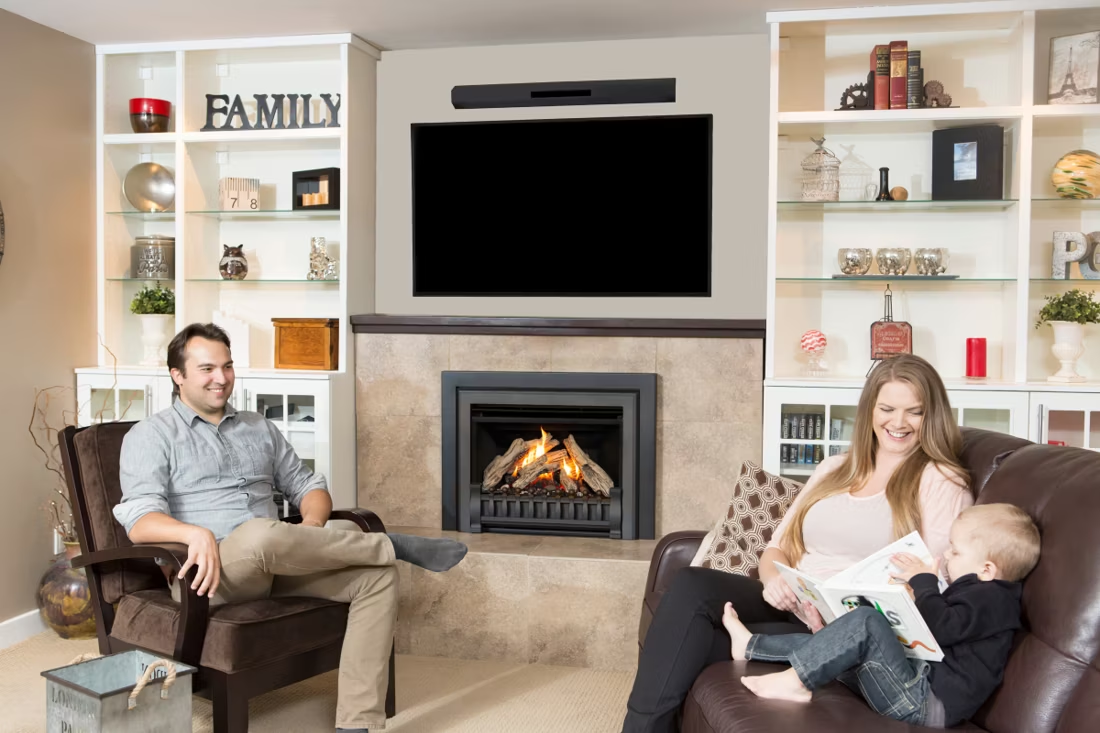
Yes—with an asterisk. Fireplaces are hot and TVs don't like heat. Either put a mantel between them to deflect rising warmth, or choose a fireplace with heat-management technology that creates a cool zone on the wall above—the wall stays around 125 degrees, barely warm, while the room still gets full heat. If you like clean lines and don't want a mantel, heat management is the answer.
What's the difference between an insert and a zero-clearance fireplace?
An insert is a fireplace that slides into a pre-existing wood-burning fireplace—if you don't have one, there's nothing to insert it into. A zero-clearance fireplace is built into a framed wall, which makes it the answer for remodels and new construction. Simple test: existing masonry fireplace means insert; blank or framed wall means zero-clearance.
Can a fireplace actually lower my heating bill?
Yes—by creating a comfort zone. A furnace heats every square foot of the house just to warm the one room you're in; a gas fireplace on low burns roughly a sixth of the gas a typical furnace does. Set the furnace around 55–60 degrees as a baseline, then heat the rooms your family actually uses. Families who heat this way commonly save $20–$60 a month.
Can I install a fireplace myself?
If you're putting a fire in your house on purpose, it's best to work with an expert. Unless you're genuinely experienced in framing, gas line, vent pipe, and the national code on clearances to combustibles, have a professional do it—and ideally the same company that sells you the fireplace, so warranty, service, and liability all live under one roof.
Nearby Dealers
Hearth shops serving Dillon and the surrounding area. Every listing shows whether it is a WhyFire partner, a dealer we have verified as authorized for the brands we recommend, or a local business carrying hearth products. No manufacturer pays for placement. How we verify dealers →
We’ve paused dealer listings for this connection today. Enter your zip or postal code above to find dealers near you, or come back tomorrow.
Popular Gas Brands
Where each brand came from, what's inside it today, and every current model. No brand pays to be here. Not every dealer carries every brand, so enter your zip code to see what's sold near Dillon.
Kozy Heat
Kozy Heat was founded in 1976 by Dudley Hussong in Lakefield, Minnesota, and incorporated as Hussong Manufacturing Co., Inc. in 1978.
28 gas models →Fireplace Xtrordinair
Fireplace Xtrordinair, now often called FireplaceX, is the fireplace brand of Travis Industries, Inc., of Mukilteo, Washington.
25 gas models →Town & Country
Town & Country Fireplaces is the luxury gas fireplace brand of Pacific Energy Fireplace Products Ltd., of Duncan, British Columbia.
14 gas models →Lopi
Lopi is a wood, pellet, and gas stove brand founded by Kurt Rumens in Bellevue, Washington, in 1979.
7 gas models →Forge & Flame
Forge & Flame is the stove brand Hearth & Home Technologies introduced in August 2023 to bring Vermont Castings, Harman, and Quadra-Fire under one name.
6 gas models →Vermont Castings
Vermont Castings was founded in 1975 by Duncan Syme, the designer, and his brother-in-law Murray Howell, the business partner, in Randolph, Vermont.
6 gas models →Get your free Project Guide & Parts List for a Dillon gas fireplace.
Tell us about your home, whether you're on piped gas or propane, and we'll help you find a trusted local dealer who carries the right high-altitude derate kit and send a free Project Guide & Parts List with the exact vent kit and parts your 9,047-foot install needs.
Find Your Fireplace →