
Real Ambiance, Zero Emissions, Any Denver Home.
No flue, no gas line, no smoke on inversion days—just plug it in. Find the right electric unit for your Denver home and connect with a trusted local dealer.
Every Project Starts From One of These Five Situations
No flue, no gas line, no air-quality tradeoffs.
Denver sits at 5,287 feet with 5,765 heating degree days and an average winter low of 18°F—cold enough that supplemental heat matters, on par with what a home in Helena, Montana deals with most winters. But the bigger factor shaping fireplace choice here isn't just the cold. The Denver metro area is a federal nonattainment zone for ozone and fine particulates, and winter inversions along the Front Range trap wood smoke close to the ground for days at a time. Denver's building codes have restricted new wood-burning fireplace installations since the late 1980s, which is why wood shows up as essentially off the table for new installs even though ponderosa pine, aspen, and pinyon are abundant just up in the foothills.
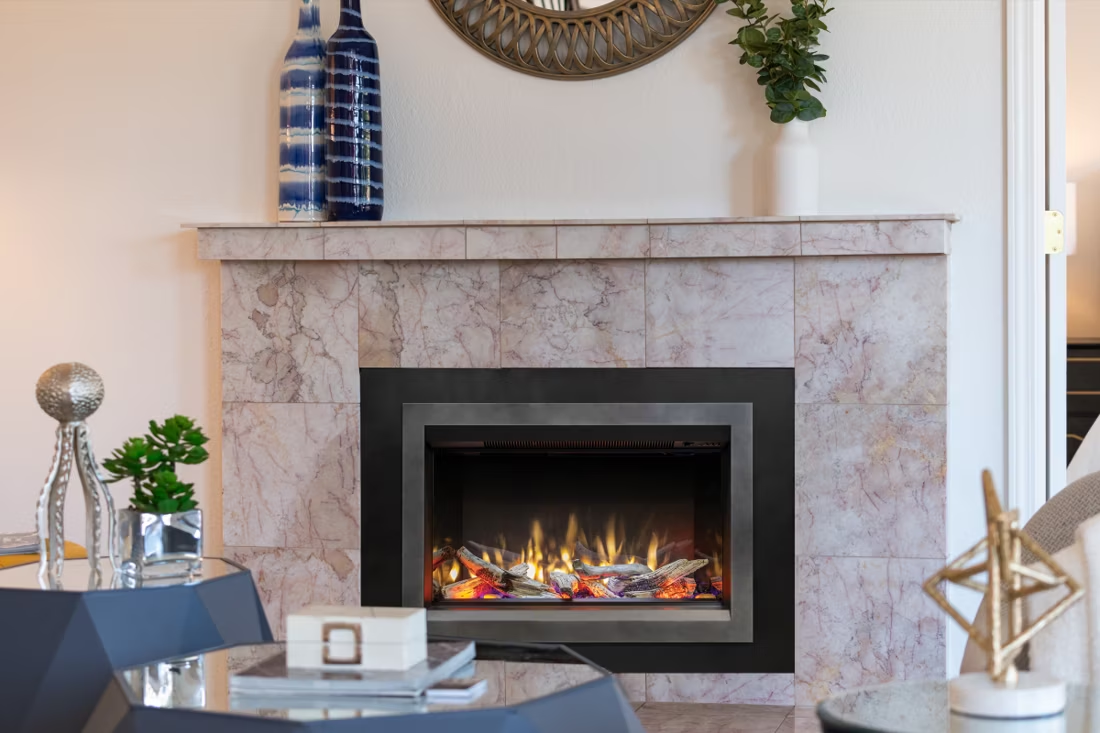
That regulatory reality, combined with how much of Denver's housing stock is condos, lofts, and townhomes without existing chimneys, makes electric fireplaces a genuinely practical fit—not just a consolation prize. There's no venting to run, no gas line to plumb, and no combustion byproducts to worry about on a wildfire-smoke day. Public Service Company of Colorado (Xcel Energy) serves the metro area at roughly $0.1505 per kWh, and most electric units run on a standard or lightly upgraded circuit. For downtown high-rises in zip codes like 80202 and 80203, or HOA buildings that prohibit anything requiring a flue, electric is often the only fireplace option that's actually allowed.
Three steps. No salesperson until you're ready.
Tell us about your project
Your zip code, your situation, and the fuel you're leaning toward—or let the answers point you to one.
See what's actually available
The brands dealers within 100 miles genuinely carry—real options, never a catalog mirage.
Get your dealer & Project Guide
A trusted local dealer, plus the free Project Guide & Parts List that names every component of the job.
Frequently Asked Questions
How much does an electric fireplace installation cost in Denver?
Plug-in electric inserts that slide into an existing mantel or opening typically run $300 to $1,500 for the unit itself, with little to no installation cost since they use a standard outlet. Built-in wall-mount or linear electric fireplaces designed for a new-construction niche or remodel run $1,500 to $4,000 installed, including framing and a dedicated 20-amp circuit if your electrical panel needs it. Denver electricians typically charge $200 to $600 for that circuit work alone if your unit draws more than a standard outlet can handle. Local dealers will spec the exact model and circuit requirements after seeing your space.
What types of electric fireplaces are available for a Denver home?
Three main formats show up most often here: plug-in inserts that drop into an existing masonry firebox (common in Denver's older Capitol Hill and Park Hill bungalows), built-in wall or linear units for new construction and remodels, and freestanding or mantel-style units for renters and condo owners who can't modify walls. Because Denver's downtown and Cherry Creek condo stock often has no chimney at all, the wall-mount and freestanding formats are especially popular in those buildings—zero clearance requirements mean they can go almost anywhere with an outlet nearby.
Do I need a permit to install an electric fireplace in Denver?
In most cases, no separate fireplace permit is required since there's no venting or gas work involved—but if the installation requires a new dedicated circuit or panel work, that electrical work needs a permit through Denver's Community Planning and Development office and must be pulled by a licensed electrician. A simple plug-in insert into an existing outlet typically needs nothing at all. This is one of the reasons electric is popular in HOA buildings downtown: it sidesteps the permitting and inspection process that gas or masonry work would trigger.
Will an electric fireplace actually heat my Denver home?
Most electric fireplaces are rated around 1,500 watts, which works out to roughly 5,100 BTUs—enough to comfortably warm a single room (200 to 400 square feet) but not enough to serve as primary heat during a stretch of 18°F nights, which is Denver's average winter low. Think of it as zone heat for a living room or bedroom, layered on top of your furnace, rather than a whole-home solution. If you're trying to meaningfully cut furnace runtime in a well-insulated room, look for a unit with a true infrared heating element rather than a basic fan-forced coil—infrared units tend to hold heat more evenly.
Electric vs. gas fireplace—which makes more sense in Denver?
Gas remains standard and widely available in Denver through Xcel Energy's natural gas service, and a direct-vent gas fireplace or insert will out-heat any electric unit and keep working during a power outage if it has standing pilot ignition. Electric wins on install simplicity—no gas line, no venting, no combustion byproducts—and it's the only realistic option in many condo and HOA buildings downtown that don't allow venting through the exterior wall. If your home already has gas service and you want real supplemental heat, gas is usually the better call. If you're in a high-rise, renting, or simply want ambiance without construction, electric is the practical answer.
Why is wood not really an option for a new fireplace in Denver?
Denver sits inside the Front Range's ozone and particulate nonattainment area, and city code has restricted new wood-burning fireplace installations for decades because of winter inversions that trap smoke over the metro area. Older homes with existing wood-burning fireplaces are generally grandfathered in, but adding a new wood-burning unit to a home or condo in the city today is either prohibited or heavily restricted depending on the specific building and jurisdiction. That's a big part of why electric and gas dominate new installs here, even though ponderosa pine, aspen, pinyon, and juniper are all abundant in the nearby Arapaho-Roosevelt National Forest for anyone who still burns wood at a cabin or on rural property outside city limits.
How much does it cost to run an electric fireplace in Denver?
At Xcel Energy's residential rate of about $0.1505 per kWh, a typical 1,500-watt electric fireplace costs roughly 22 to 23 cents per hour on the heat setting, or a little over $5 for a full 24-hour day of continuous use. Most people run it a few hours an evening rather than around the clock, which puts monthly cost in the $10 to $30 range for regular use. Ambiance-only mode (flame effect without heat) draws a fraction of that, often under 50 watts.
Will my electric fireplace work during a power outage?
No—electric fireplaces require power to run the heating element, flame effect, and any fan, so they'll shut off along with everything else during an outage. If backup heat during winter storms is a priority, a gas fireplace with standing pilot ignition (no electronics required to light) is the better choice, since some models will keep producing heat even with the power out. Electric fireplaces in Denver are best thought of as convenience and ambiance appliances rather than emergency heat sources.
Can I put an electric fireplace in my Denver condo or apartment?
In most cases, yes, and it's one of the most common reasons people choose electric in the first place. Because there's no venting, chimney, or gas line involved, a plug-in or wall-mount electric fireplace typically doesn't run into the restrictions that HOAs and building codes place on combustion appliances. This makes electric the go-to option for downtown lofts, high-rises, and rental units throughout zip codes like 80202, 80203, and 80218 where a masonry chimney or gas line simply isn't available. Check with your building management on any weight or mounting restrictions for wall units, but electrical requirements alone rarely stop a project.
Can I put a TV above my fireplace?
Yes—with an asterisk. Fireplaces are hot and TVs don't like heat. Either put a mantel between them to deflect rising warmth, or choose a fireplace with heat-management technology that creates a cool zone on the wall above—the wall stays around 125 degrees, barely warm, while the room still gets full heat. If you like clean lines and don't want a mantel, heat management is the answer.
Does an electric fireplace need a vent or chimney?
No—that's its superpower. An electric fireplace needs a wall and an outlet, period. No vent pipe, no gas line, no clearances to design around, which is why it works in bedrooms, offices, apartments, and walls where venting a gas or wood unit would be impractical or impossible. Installation is typically the simplest and least expensive of any fireplace type.
Can a fireplace actually lower my heating bill?
Yes—by creating a comfort zone. A furnace heats every square foot of the house just to warm the one room you're in; a gas fireplace on low burns roughly a sixth of the gas a typical furnace does. Set the furnace around 55–60 degrees as a baseline, then heat the rooms your family actually uses. Families who heat this way commonly save $20–$60 a month.
How much should I budget for a fireplace?
For an average home—covering the fireplace, the vent pipe, and basic installation—a budget between $3,900 and $5,500 gives you a lot of options across wood, gas, and pellet. By the time you add finish work, gas line, and electrical, the average complete installation lands between $5,000 and $12,000 all-in. In a remodel or new build, a good rule is to put about 2.5% of the total project cost toward the fireplace.
Nearby Dealers
Hearth shops serving Denver and the surrounding area. Every listing shows whether it is a WhyFire partner, a dealer we have verified as authorized for the brands we recommend, or a local business carrying hearth products. No manufacturer pays for placement. How we verify dealers →
Rio Grande Co.
Fireplace And Grill Experts - Service Only
Spa Brokers (Corporate)
Spa Brokers V
Distinctive Mantel Designs
Aria Custom Design
Spa Brokers
Outdoor Kitchen Dist. Inc
Proud Souls Barbecue & Provisions
Spa Brokers
Spa Brokers
Spa Brokers Iii
Thoshini LLC
Spa Brokers
Electric Service in Denver
An electric fireplace's heater draws about 1,500 watts—pennies per hour at local rates.
Public Service Co Of Colorado
Find your electric fireplace in Denver.
Tell us a bit about your home and we'll put together a free Project Guide & Parts List—the right electric fireplace or insert for your space, plus a trusted local Denver dealer to install it.
Find Your Fireplace →