
Find a gas fireplace built for Castle Rock's high-altitude winters.
Douglas County winters bring average lows near 18°F and a heating season about as demanding as Bozeman, Montana's, at 6,297 feet of elevation. A properly sized, altitude-rated gas fireplace delivers instant heat without the wood-burning restrictions common in Castle Rock's newer HOA communities.
Every Project Starts From One of These Five Situations
The practical choice for a fast-growing foothills suburb.
Castle Rock sits at 6,297 feet along the I-25 corridor between Denver and Colorado Springs, in a Douglas County that has been one of the fastest-growing in the country for two decades. Zone 5B winters here average lows around 18°F and rack up a heating season about as demanding as Bozeman, Montana's—cold enough that a comparison to that mountain town isn't far off. But the housing stock tells a different story than a mountain town: most of Castle Rock was built after 1990, and a large share of that growth sits inside HOA-governed subdivisions where covenants and defensible-space rules—driven by real wildfire smoke concerns along the Rampart Range foothills—restrict or discourage wood-burning appliances entirely.
That's why gas is the default here, not wood. Natural gas service reaches most in-town neighborhoods and newer developments, while some larger-acreage properties in unincorporated Douglas County (the 80108 and 80109 zips cover a lot of that territory) rely on propane instead. Either way, a direct-vent gas fireplace or insert gives you real, immediate heat with none of the ash, smoke, or defensible-space paperwork—and at 6,297 feet, it needs to be installed by someone who knows how to adjust for altitude. A local dealer who's done this before matters more here than almost anywhere else on the Front Range.
Three steps. No salesperson until you're ready.
Tell us about your project
Your zip code, your situation, and the fuel you're leaning toward—or let the answers point you to one.
See what's actually available
The brands dealers within 100 miles genuinely carry—real options, never a catalog mirage.
Get your dealer & Project Guide
A trusted local dealer, plus the free Project Guide & Parts List that names every component of the job.
Frequently Asked Questions
How much does a gas fireplace installation cost in Castle Rock?
Costs vary by unit and venting path, but most Castle Rock gas fireplace and insert projects run in the $4,000 to $10,000 range. A direct-vent insert going into an existing masonry fireplace with gas already run to that wall sits toward the lower end. A new built-in unit in a remodel or new-construction wall—with fresh gas line work and framing—lands in the middle to upper end. Homes on propane, or anyone needing a longer gas line run from the meter, should expect the higher end of that range. A local dealer will give you a firm number after seeing the space and the altitude-adjusted BTU output you actually need.
Can I convert an existing wood fireplace to gas in Castle Rock?
Yes, and it's a common project in Castle Rock's older neighborhoods near downtown—homes built before the town's big growth wave in the 1990s and 2000s that came with a traditional masonry fireplace. A gas insert slides into that existing firebox and vents through a stainless liner run up your current chimney, so you keep the look of the fireplace while gaining real, thermostat-controlled heat. Most newer subdivisions in Castle Rock never had a wood fireplace to convert in the first place—they were built gas-ready from the start.
Do I need natural gas service, or can I use propane?
Either works, and which one applies to you depends mostly on where in Douglas County you live. Established in-town Castle Rock neighborhoods generally have natural gas service and an existing gas meter, which makes adding a fireplace straightforward. Larger-lot and rural properties in the unincorporated parts of the 80108 and 80109 zip codes more often run on propane, with a tank on the property. Nearly every gas fireplace model on the market can be set up for either fuel—your installer swaps the orifice and regulator to match.
Will my gas fireplace still work if the power goes out?
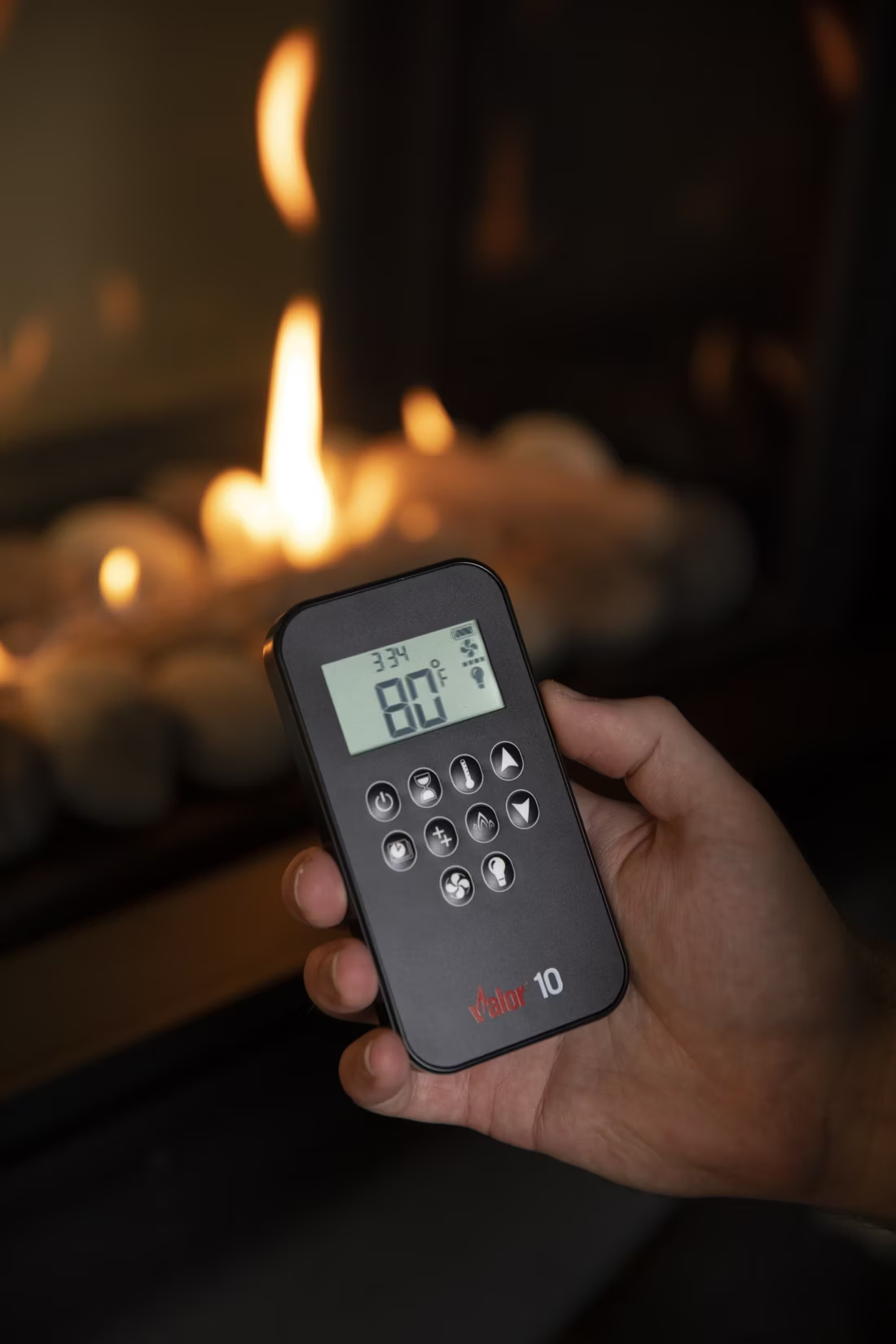
In most cases, yes. Front Range storms can knock out power for hours even in town, and gas fireplaces with intermittent pilot ignition (IPI) run on a small battery backup that kicks in automatically when Core Electric Cooperative service drops. Valor fireplaces skip the battery altogether—their pilot generates its own electricity through the thermocouple, so there's nothing to remember to replace. Worth asking about specifically if outage backup matters to you, since not every model handles it the same way.
What's the difference between a gas fireplace, insert, and stove?
A gas fireplace is a fully built-in unit framed into a wall—the standard choice for new construction, which describes most of Castle Rock's housing stock. A gas insert fits into an existing masonry firebox, which matters mainly for older homes near downtown. A gas stove is a freestanding unit that sits on the floor and vents out the back or top, useful in a basement or a room without an existing chimney. For most Castle Rock homeowners building or remodeling, a built-in direct-vent fireplace is the typical fit.
Do I need a permit to install a gas fireplace in Castle Rock?
Yes. In-town addresses go through the Town of Castle Rock Building Division; unincorporated Douglas County addresses (common in the 80108 and 80109 zips) go through the Douglas County Building Division instead. Both require a building permit and a gas line permit, and the gas piping itself has to be run or inspected by a licensed gas-fitter. Most local hearth dealers handle the full permit package as part of the installation, which is one less thing to coordinate yourself.
Vented vs. vent-free gas fireplaces—which should I choose at this elevation?
Direct-vent (sealed, vented) units are the strong default in Castle Rock, and altitude is part of why. At 6,297 feet, gas appliances need altitude-derated BTU ratings and adjusted orifices to burn correctly—an installer who skips that step will hand you a unit that runs rich or underperforms. Vent-free units are legal in Colorado but come with strict room-sizing and oxygen-sensor requirements, and they release combustion byproducts into the room air, which matters more when indoor air exchange is already a bigger factor at elevation. Nearly every installer in this market will point you toward a direct-vent unit correctly rated for 6,000+ feet.
How often should a gas fireplace be serviced?
Plan on an annual inspection—a technician checks the burner, pilot assembly, venting, and gas connections, and cleans the glass and interior. Expect to pay somewhere in the $150 to $250 range for that visit. It's a much smaller job than wood-stove chimney sweeping, but skipping it is still the main way small problems, like a dirty igniter or a failing thermocouple, turn into a fireplace that won't light on the first cold night of the season.
Can I just install a wood-burning fireplace instead?
Technically, in some cases—but it's genuinely uncommon here, and for good reason. Most Castle Rock subdivisions were built under HOA covenants that restrict or outright prohibit wood-burning appliances, largely because of defensible-space and wildfire-smoke rules tied to the town's proximity to the Rampart Range foothills. If you're on a larger unincorporated property and want to burn wood, permits for cutting your own ponderosa pine, aspen, pinyon, or juniper are available through the Arapaho-Roosevelt National Forests for $5 to $20 per cord during the May-to-October season—but almost nobody uses wood as a primary heat source inside Castle Rock proper. Electric fireplaces, powered through Core Electric Cooperative at roughly 15 cents per kWh, are a more realistic ventless alternative for condos and townhomes than a wood-burning unit would be.
What's the difference between an insert and a zero-clearance fireplace?
An insert is a fireplace that slides into a pre-existing wood-burning fireplace—if you don't have one, there's nothing to insert it into. A zero-clearance fireplace is built into a framed wall, which makes it the answer for remodels and new construction. Simple test: existing masonry fireplace means insert; blank or framed wall means zero-clearance.
Why is a fireplace insert so efficient?
An insert does two things: it seals the chimney completely, so you stop losing air you already paid to heat, and it radiates warmth into the room through the firebox and glass. Most add a heat-exchange fan that pulls cool room air underneath, wraps it around the hot firebox, and pushes it back out warm. Your home is more efficient before you've even lit the first fire.
What is an in-home preview and do I need one?
It's a visit where a hearth professional measures your space, confirms the model you picked actually works in your home, and walks the specs—framing, gas line, venting, finish work—before anything is ordered. Some details you just can't know until you see the house. Never make a down payment without one; it's the single most-skipped step that burns buyers.
Can a fireplace actually lower my heating bill?
Yes—by creating a comfort zone. A furnace heats every square foot of the house just to warm the one room you're in; a gas fireplace on low burns roughly a sixth of the gas a typical furnace does. Set the furnace around 55–60 degrees as a baseline, then heat the rooms your family actually uses. Families who heat this way commonly save $20–$60 a month.
Nearby Dealers
Hearth shops serving Castle Rock and the surrounding area. Every listing shows whether it is a WhyFire partner, a dealer we have verified as authorized for the brands we recommend, or a local business carrying hearth products. No manufacturer pays for placement. How we verify dealers →
Midtown Chimney Fireplace Store
Western Fireplace Supply
Spa Brokers
Thoshini LLC
Spa Brokers Iii
Spa Brokers
Proud Souls Barbecue & Provisions
Spa Brokers V
Outdoor Kitchen Dist. Inc
Find your gas fireplace in Castle Rock.
Tell us about your home and elevation, and we'll match you with a trusted local Castle Rock dealer and send over a free Project Guide & Parts List—the exact parts, vent kit, and recommended dealer for your project.
Find Your Fireplace →