
Reliable Gas Heat for a Community Natural Gas Never Reached.
Warm Springs homes run on propane, not piped gas—find the right fireplace or insert for your setup and connect with a trusted local dealer.
Every Project Starts From One of These Five Situations
Propane fills the gap that piped gas leaves behind.
Warm Springs is an unincorporated community in Riverside County's chaparral foothills, sitting at about 1,396 feet between the San Bernardino and Angeles National Forests. Winters here are mild by any standard—average lows around 42°F and only a short, light heating season each year, a fraction of what a place like Bismarck ND or Duluth MN racks up in a single month. Heating in Warm Springs is rarely about survival; it's about taking the chill off a desert evening or warming a single room during a cold snap.
No natural gas main service reaches Warm Springs, so propane is the standard fuel behind almost every gas fireplace, insert, or log set installed here. The fireplace itself works the same way as a natural-gas unit—instant flame, no ash, no smoke—but it draws from an on-site propane tank instead of a utility line. Wood is largely off the table given the area's non-attainment air quality status and heavy wildfire smoke exposure most summers and falls, and running electric heat for anything beyond occasional use gets expensive fast under Southern California Edison's residential rate of roughly 28 cents per kWh. Propane splits the difference: clean, code-compliant, and economical for the kind of supplemental and ambiance-driven use most Warm Springs homes actually need.
Three steps. No salesperson until you're ready.
Tell us about your project
Your zip code, your situation, and the fuel you're leaning toward—or let the answers point you to one.
See what's actually available
The brands dealers within 100 miles genuinely carry—real options, never a catalog mirage.
Get your dealer & Project Guide
A trusted local dealer, plus the free Project Guide & Parts List that names every component of the job.
Frequently Asked Questions
How much does a gas fireplace installation cost in Warm Springs?
A gas fireplace or insert installation in Warm Springs typically runs $4,500 to $10,000, and the propane tank and line run are the biggest swing factor since there's no natural gas main out here. Homes with an existing propane tank and appliances already on the system—a water heater or range, for example—land on the lower end, often $4,500 to $6,500 for a direct-vent insert. Homes that need a new propane tank installed, whether above-ground or buried, run higher, sometimes $8,000 to $10,000 once the tank, regulator, and buried gas line are factored in alongside the fireplace unit itself.
Do I need natural gas, or does propane work for a gas fireplace?
There's no piped natural gas service in Warm Springs, so nearly every gas fireplace here runs on propane instead. The fireplace itself operates the same way—same flame, same remote or wall-switch start, similar efficiency—but propane requires an on-site tank, leased or owned, that gets refilled periodically by a local supplier. Propane burns hotter per cubic foot than natural gas, so your installer sets the unit's orifice and regulator specifically for propane fuel; that's not a swap you can make yourself. If your home already has propane appliances, adding a fireplace to the existing tank keeps costs down considerably.
Do I need a permit to install a gas fireplace in Warm Springs?
Yes. Because Warm Springs is unincorporated, gas fireplace installations go through the Riverside County Department of Building and Safety rather than a city building department. You'll need a building permit for the fireplace or insert itself and a separate permit for propane line work, which has to be done by a licensed gas fitter. If you're adding a new propane tank rather than tying into an existing one, the county fire marshal's office may also require tank placement approval. Most hearth dealers who work this part of Riverside County handle all of this as part of the installation.
Will my gas fireplace still work during a power outage?
Most modern gas fireplaces use a battery-backed ignition system, so they'll still light and run when the power's out—a real advantage in Warm Springs, where rural power lines through the foothills are subject to Southern California Edison's public safety power shutoffs during high fire-risk wind events. Some brands, like Valor, go a step further with a pilot-generated ignition system that never needs batteries at all. Given how often SCE proactively cuts power in this part of Riverside County during Santa Ana conditions, it's worth asking your installer directly about a model's outage performance before you commit to one.
What's the difference between a gas fireplace, gas insert, and gas stove?
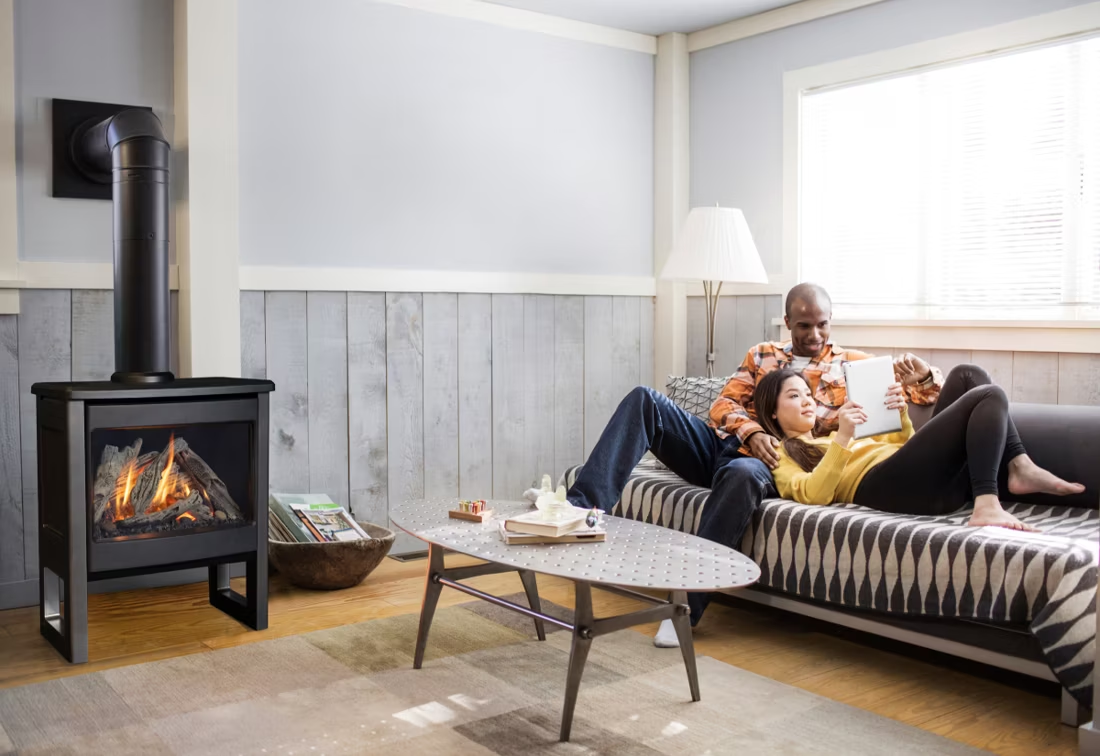
A gas fireplace is a fully built-in unit framed into a wall—the right choice for new construction or a remodel. A gas insert slides into an existing masonry fireplace opening, sealing it up and turning a decorative firebox into an actual heat source. A gas stove is freestanding, sitting on the floor like a wood stove but running on propane. For Warm Springs homes with an older masonry fireplace that was built for wood but rarely gets used, an insert is usually the simplest upgrade—it keeps the existing structure and just needs a propane line run to it.
Can I install a wood stove in Warm Springs instead?
Technically yes, but very few homeowners here do, and for good reason. Warm Springs sits in a designated non-attainment area for air quality, and wildfire smoke already burdens the local airshed for much of the summer and fall—adding wood smoke on top of that runs against both regional air district restrictions and basic comfort. With winter lows averaging just 42°F and only a short, light heating season each year, most homes simply don't need the heat output a wood stove provides. A handful of larger rural properties near the San Bernardino or Angeles National Forest boundary keep a wood stove for backup heat, sourcing oak or Douglas fir through Forest Service cutting permits ($5 to $20 per cord, May through October), but it's the exception. Gas and electric cover the overwhelming majority of installs in this community.
What's the difference between vented and vent-free gas fireplaces?
Vented (direct-vent) gas fireplaces draw combustion air from outside and exhaust it back outside through a sealed vent—they're the standard, code-compliant choice everywhere, including Warm Springs. Vent-free units burn fuel directly into the room without external venting; they're prohibited in most California jurisdictions, including unincorporated Riverside County, because of indoor air quality standards under Title 24. In practice, that means virtually every gas fireplace or insert installed in Warm Springs is a direct-vent model, which is also the better fit for a propane-fueled home since it keeps combustion byproducts entirely outside the living space.
How often should my gas fireplace be serviced?
Plan on an annual inspection for any gas fireplace or insert—a certified technician checks the burner, pilot assembly, venting, and gas connections, and cleans the glass and interior. For a propane system specifically, it's also worth having the technician check the regulator and tank connection during that same visit, since propane systems see slightly more wear at the regulator than natural gas hookups. Most gas appliance service providers serving this part of Riverside County charge $150 to $250 for a standard annual inspection.
Gas vs. electric—which makes more sense for a Warm Springs home?
Electric fireplaces are simple to install, need no venting or propane tank, and work well for ambiance or light supplemental warmth in a single room. But Southern California Edison's residential rate here runs around 28 cents per kWh—one of the higher rates in the country—so running an electric unit as a real heat source for hours at a time gets expensive. Propane gas costs more upfront to install (tank, line, venting) but delivers more heat per dollar of ongoing fuel cost and isn't tied to the grid, which matters given how often power gets shut off preemptively during fire-weather events in this area. For a mantel accent or a rarely-used guest room, electric is fine. For a room you actually want to heat, gas is usually the better long-term choice.
Can I put a TV above my fireplace?
Yes—with an asterisk. Fireplaces are hot and TVs don't like heat. Either put a mantel between them to deflect rising warmth, or choose a fireplace with heat-management technology that creates a cool zone on the wall above—the wall stays around 125 degrees, barely warm, while the room still gets full heat. If you like clean lines and don't want a mantel, heat management is the answer.
Why is a fireplace insert so efficient?
An insert does two things: it seals the chimney completely, so you stop losing air you already paid to heat, and it radiates warmth into the room through the firebox and glass. Most add a heat-exchange fan that pulls cool room air underneath, wraps it around the hot firebox, and pushes it back out warm. Your home is more efficient before you've even lit the first fire.
How much should I budget for a fireplace?
For an average home—covering the fireplace, the vent pipe, and basic installation—a budget between $3,900 and $5,500 gives you a lot of options across wood, gas, and pellet. By the time you add finish work, gas line, and electrical, the average complete installation lands between $5,000 and $12,000 all-in. In a remodel or new build, a good rule is to put about 2.5% of the total project cost toward the fireplace.
Can a fireplace actually lower my heating bill?
Yes—by creating a comfort zone. A furnace heats every square foot of the house just to warm the one room you're in; a gas fireplace on low burns roughly a sixth of the gas a typical furnace does. Set the furnace around 55–60 degrees as a baseline, then heat the rooms your family actually uses. Families who heat this way commonly save $20–$60 a month.
Nearby Dealers
Hearth shops serving Warm Springs and the surrounding area. Every listing shows whether it is a WhyFire partner, a dealer we have verified as authorized for the brands we recommend, or a local business carrying hearth products. No manufacturer pays for placement. How we verify dealers →
We’ve paused dealer listings for this connection today. Enter your zip or postal code above to find dealers near you, or come back tomorrow.
Popular Gas Brands
Where each brand came from, what's inside it today, and every current model. No brand pays to be here. Not every dealer carries every brand, so enter your zip code to see what's sold near Warm Springs.
Kozy Heat
Kozy Heat was founded in 1976 by Dudley Hussong in Lakefield, Minnesota, and incorporated as Hussong Manufacturing Co., Inc. in 1978.
28 gas models →Fireplace Xtrordinair
Fireplace Xtrordinair, now often called FireplaceX, is the fireplace brand of Travis Industries, Inc., of Mukilteo, Washington.
25 gas models →Town & Country
Town & Country Fireplaces is the luxury gas fireplace brand of Pacific Energy Fireplace Products Ltd., of Duncan, British Columbia.
14 gas models →Lopi
Lopi is a wood, pellet, and gas stove brand founded by Kurt Rumens in Bellevue, Washington, in 1979.
7 gas models →Forge & Flame
Forge & Flame is the stove brand Hearth & Home Technologies introduced in August 2023 to bring Vermont Castings, Harman, and Quadra-Fire under one name.
6 gas models →Vermont Castings
Vermont Castings was founded in 1975 by Duncan Syme, the designer, and his brother-in-law Murray Howell, the business partner, in Randolph, Vermont.
6 gas models →Find your gas fireplace in Warm Springs.
Tell us about your home and propane setup, and we'll help you find a trusted local dealer and send a free Project Guide & Parts List—the exact parts, vent kit, and recommended installer for your gas fireplace project in Warm Springs.
Find Your Fireplace →