
Warmth that doesn't wait for a burn day.
From Modesto to Turlock, Oakdale to Patterson, gas fireplaces keep Stanislaus County homes warm through tule fog mornings and winter inversion days—no wood curtailment, no smoke. Find the right unit and connect with a trusted local dealer.
Every Project Starts From One of These Five Situations
Clean heat when the Valley air says no to wood.
Stanislaus County sits in the heart of the San Joaquin Valley, with a moderate winter heating season and an average winter low around 39°F—mild compared to mountain counties, but not warm enough to skip heat, especially on the tule fog mornings that settle over Modesto, Turlock, and Ceres from December through February. What makes gas particularly relevant here isn't just the mild-but-real cold; it's the air. Stanislaus County is part of a federal non-attainment area, and the San Joaquin Valley Air Pollution Control District's winter inversion layers trap PM2.5 close to the ground badly enough that the district calls mandatory no-burn days under its Check Before You Burn program. On those days, wood stoves and open fireplaces without EPA certification are legally off-limits—but gas fireplaces keep running.
PG&E provides natural gas service across most of the county's incorporated cities—Modesto, Turlock, Ceres, Oakdale, Riverbank, Patterson, and Newman all sit within the service territory. Outside city limits, in the unincorporated ag land and foothill fringes toward Knights Ferry and the Diablo Range, propane is the standard fallback. Either way, a gas fireplace gives Stanislaus County homeowners instant zone heat that supplements central HVAC on the county's colder nights, and—with the right ignition system—a source of heat and light during Pacific Safety Power Shutoffs when wildfire-season winds put PG&E's grid on alert.
Three steps. No salesperson until you're ready.
Tell us about your project
Your zip code, your situation, and the fuel you're leaning toward—or let the answers point you to one.
See what's actually available
The brands dealers within 100 miles genuinely carry—real options, never a catalog mirage.
Get your dealer & Project Guide
A trusted local dealer, plus the free Project Guide & Parts List that names every component of the job.
Frequently Asked Questions
How much does a gas fireplace installation cost in Stanislaus County?
Costs vary widely based on the unit and the venting path, but most Stanislaus County installations land somewhere between $4,000 and $11,000. A direct-vent gas insert dropped into an existing masonry fireplace with a gas line already run to the hearth is on the lower end—common in older Modesto and Turlock neighborhoods with mid-century brick fireplaces. A new built-in gas fireplace for a remodel or new construction, requiring framing and a fresh gas line, sits in the middle to upper range. Homes outside PG&E's service footprint that need a propane tank set can run higher still. A local dealer will give you a firm number after an in-home walkthrough.
Can I convert my existing wood fireplace to gas?
Yes, and it's a common project across Stanislaus County, particularly for homeowners tired of watching Check Before You Burn advisories dictate whether they can light a fire. A gas insert typically drops into your existing masonry fireplace using a stainless liner run through your current chimney, converting an oak-burning firebox into a sealed, code-compliant gas unit. Costs generally run $4,000 to $9,500 depending on the insert and whether new gas line work is needed. Once converted, the unit is exempt from winter wood-burning curtailments entirely, since the restrictions target uncertified wood appliances, not gas.
Do I need natural gas, or can I use propane?
Either works, but it depends on where in the county you live. PG&E natural gas lines reach most of Modesto, Turlock, Ceres, Oakdale, Riverbank, Patterson, and Newman, so if your home already has gas appliances, adding a fireplace is straightforward. Homes on the rural fringes—out toward the ag land west of Patterson or the foothill approach near Knights Ferry—often fall outside PG&E's gas footprint and rely on a propane tank instead. Nearly every gas fireplace model on the market can be set up for either fuel; your installer just configures the correct orifice and regulator for your supply.
Will my gas fireplace work during a power outage?
Most modern gas fireplaces will, which matters in a county where PG&E occasionally initiates Public Safety Power Shutoffs during high fire-danger wind events. Units with intermittent pilot ignition (IPI) run on AA batteries that kick in automatically when the grid drops, so the fireplace lights and operates normally as long as those batteries are fresh. Valor fireplaces skip batteries altogether—the pilot's thermocouple generates its own electricity to run the unit, so there's nothing to remember to swap out. Ask your local dealer which ignition system a given model uses before you buy, especially if you're in an area more prone to PSPS events.
What's the difference between a gas fireplace, gas insert, and gas stove?
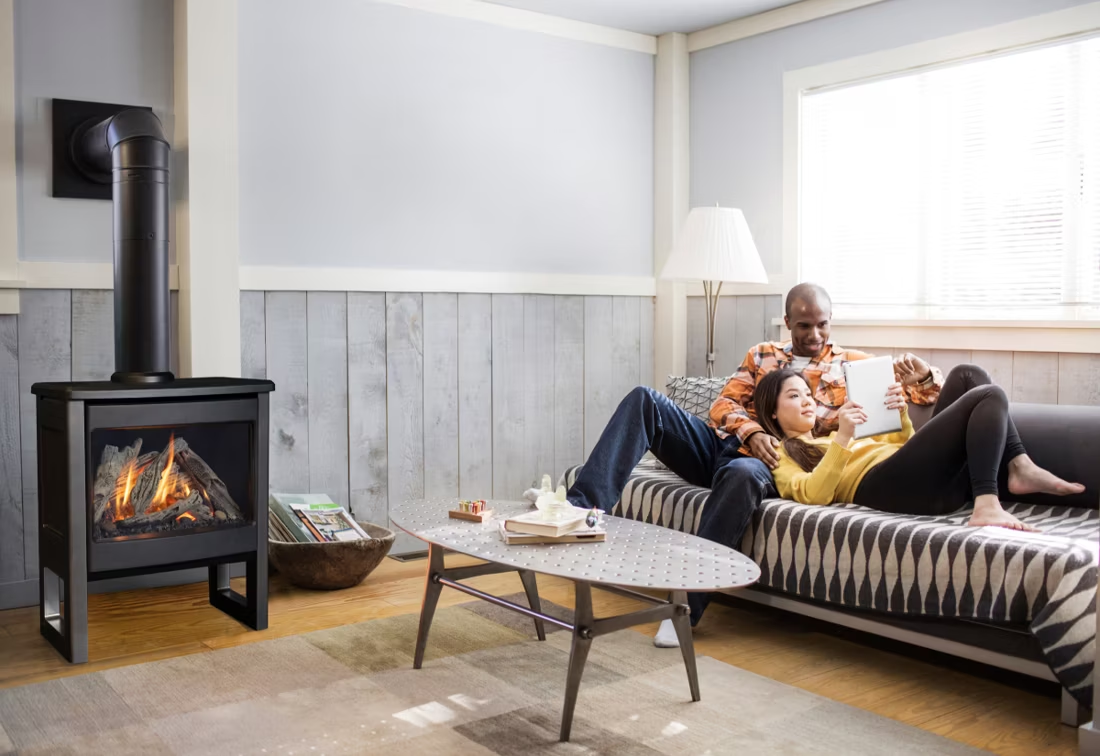
A gas fireplace is a fully built-in unit framed into a wall—the right choice for new construction or a full remodel in a Modesto or Turlock subdivision home. A gas insert is built to slide into an existing masonry firebox, which suits the many Stanislaus County homes with older brick fireplaces that were designed for oak or douglas fir cordwood. A gas stove is a freestanding cabinet-style unit that sits on the floor like a wood stove but runs on gas, useful in rooms without an existing fireplace opening. For most county homeowners upgrading an existing hearth, the insert is the simplest and most cost-effective path.
Do I need a permit to install a gas fireplace in Stanislaus County?
Yes. Within Modesto, Turlock, Ceres, and the county's other incorporated cities, permits are issued by that city's building division; in unincorporated areas, the Stanislaus County Building Permits Division handles it. Every new gas fireplace installation also requires a gas line permit, and that portion of the work has to be done by a licensed gas-fitter. Most established local hearth dealers coordinate the building permit, the gas line permit, and the final inspection as a package, so you're not left managing separate trades and separate paperwork.
What's the difference between vented and vent-free gas fireplaces?
Vented (direct-vent) gas fireplaces pull combustion air from outside and exhaust combustion byproducts back outside through a sealed vent pipe. Vent-free units burn without any outside venting, releasing water vapor and small amounts of combustion byproducts directly into the room. California allows vent-free units, but they come with strict room-sizing and oxygen-depletion-sensor requirements, and Title 24 efficiency standards factor into what a builder can install in new construction. Given that Stanislaus County already deals with non-attainment air quality and periodic wildfire smoke intrusion, most local dealers steer homeowners toward direct-vent units—they don't add anything to the indoor air on days when outdoor air quality is already a problem.
How often should my gas fireplace be serviced?
Plan on an annual inspection, ideally before the tule fog and inversion season sets in each fall. A technician checks the burner, pilot assembly, venting, and any gas connections, and cleans the glass and firebox interior. It's a lighter service than sweeping a wood chimney, but it matters just as much for safety—most Stanislaus County gas appliance service providers charge in the $150 to $250 range for a standard annual visit.
Gas vs. wood—which is right for my Stanislaus County home?
Wood delivers strong heat output and lower fuel costs, especially if you're cutting your own oak, madrone, or douglas fir under a Stanislaus National Forest permit (roughly $5 to $20 per cord, May through October). But wood burning in this county is subject to the San Joaquin Valley Air Pollution Control District's Check Before You Burn curtailments—on advisory days, uncertified stoves and open fireplaces legally can't be used. Gas sidesteps that entirely: instant on-off operation, no ash, no smoke, and no curtailment days. For most county homeowners who want dependable heat every winter night regardless of air quality advisories, gas is the more reliable daily-use choice, with wood often kept as a secondary or backup option.
Why is a fireplace insert so efficient?
An insert does two things: it seals the chimney completely, so you stop losing air you already paid to heat, and it radiates warmth into the room through the firebox and glass. Most add a heat-exchange fan that pulls cool room air underneath, wraps it around the hot firebox, and pushes it back out warm. Your home is more efficient before you've even lit the first fire.
Why is my open fireplace making my house colder?
Open fireplaces suck—literally. As the fire burns, it consumes air your furnace already paid to heat and pulls it out through the chimney, so the house is actually colder after the fire goes out than before you lit it. An insert fixes this: it seals the chimney, puts fixed glass across the front, and turns that hole in your house into a real heat source.
How much should I budget for a fireplace?
For an average home—covering the fireplace, the vent pipe, and basic installation—a budget between $3,900 and $5,500 gives you a lot of options across wood, gas, and pellet. By the time you add finish work, gas line, and electrical, the average complete installation lands between $5,000 and $12,000 all-in. In a remodel or new build, a good rule is to put about 2.5% of the total project cost toward the fireplace.
What is an in-home preview and do I need one?
It's a visit where a hearth professional measures your space, confirms the model you picked actually works in your home, and walks the specs—framing, gas line, venting, finish work—before anything is ordered. Some details you just can't know until you see the house. Never make a down payment without one; it's the single most-skipped step that burns buyers.
Stove and Fireplace Dealers in Stanislaus County
Find your gas fireplace in Stanislaus County.
Tell us about your home and we'll match you with a trusted local dealer and send over your free Project Guide & Parts List—the exact fireplace or insert, vent kit, and installation plan for your Stanislaus County home.
Find Your Fireplace →