
Find the right gas fireplace for your Keyes home.
Instant, clean-burning warmth for foggy Central Valley evenings—sized right and installed by a local pro you can trust.
Every Project Starts From One of These Five Situations
Warmth that fits Keyes' mild Central Valley winters.
Keyes sits at just 98 feet elevation in the San Joaquin Valley, between Modesto and Turlock, where winter lows average a mild 39°F and the overall winter heating need is modest—a fraction of what a place like Bozeman, Montana sees in a single cold snap. That means most Keyes homes don't need a wood-heavy, all-night-burn heating strategy. A gas fireplace fits the local climate well: instant heat on the cold, tule-fog mornings and evenings that roll through the valley from November through February, without the ongoing commitment of tending a fire for a season that's short by comparison to the mountains and high desert.
Most homes in and around Keyes get electric service from either Pacific Gas & Electric or Turlock Irrigation District depending on the block, and PG&E is the natural gas provider across most of this part of Stanislaus County—if your home already has a gas water heater or range, adding a fireplace is usually a straightforward tie-in. Air quality is also part of the equation here: Stanislaus County sits inside a federal non-attainment area for particulate matter, and the valley's winter inversions trap smoke close to the ground, on top of periodic wildfire smoke in late summer and fall. A sealed, direct-vent gas fireplace burns cleaner than an open wood fireplace and doesn't add to those wintertime air quality issues, which is one reason gas has become the default choice for many newer and remodeled homes in this part of the valley.
Three steps. No salesperson until you're ready.
Tell us about your project
Your zip code, your situation, and the fuel you're leaning toward—or let the answers point you to one.
See what's actually available
The brands dealers within 100 miles genuinely carry—real options, never a catalog mirage.
Get your dealer & Project Guide
A trusted local dealer, plus the free Project Guide & Parts List that names every component of the job.
Frequently Asked Questions
How much does a gas fireplace installation cost in Keyes?
Most gas fireplace installations in the Keyes and Turlock area run roughly $3,500 to $8,500, depending on the unit, whether you're converting an existing masonry fireplace or building new, and how much gas line work is involved. Homes already served by PG&E gas with a line reasonably close to the install point sit at the lower end. Projects that need a longer gas line run, new framing for a built-in unit, or electrical work for a blower fan push toward the higher end. A local installer will confirm the number after seeing your home and your existing gas service.
Can I convert my existing wood fireplace to gas?
Yes, and it's a common upgrade in older Keyes and Turlock-area homes that still have a builder-grade masonry fireplace. A gas insert slides into the existing firebox and vents through the existing chimney with a stainless liner, so you keep the look of your current hearth while gaining push-button heat. Given the valley's non-attainment air quality status, converting an open wood fireplace that gets occasional or seasonal use to a sealed gas unit is also one of the simpler ways to cut down on particulate smoke from your own chimney during winter inversion days.
Do I need natural gas, or should I plan for propane?
Most homes within Keyes proper are within PG&E's natural gas service territory, so if you already have gas appliances—a water heater or range—a fireplace hookup is typically a simple extension of existing service. Rural properties on the outskirts of town or along county roads outside PG&E's gas footprint sometimes rely on propane instead, with a tank installed and serviced by a regional propane supplier. Nearly all gas fireplace models can be configured for either fuel; your installer sets the correct orifice and regulator for whichever one you have.
Will my gas fireplace still work if the power goes out?
Most modern gas fireplaces will, as long as they use standing pilot or IPI (intermittent pilot ignition) with a battery backup—a handful of AA batteries built into the unit take over automatically when PG&E or Turlock Irrigation District power drops, and the fireplace lights and runs normally. Valor units skip batteries entirely, generating their own electricity from the pilot's thermocouple. Since Keyes doesn't see the multi-day winter power outages that colder, storm-heavy regions do, this matters less here than it might in the Sierra foothills, but it's still worth asking your installer which ignition system a given model uses.
What's the difference between a gas fireplace, gas insert, and gas stove?
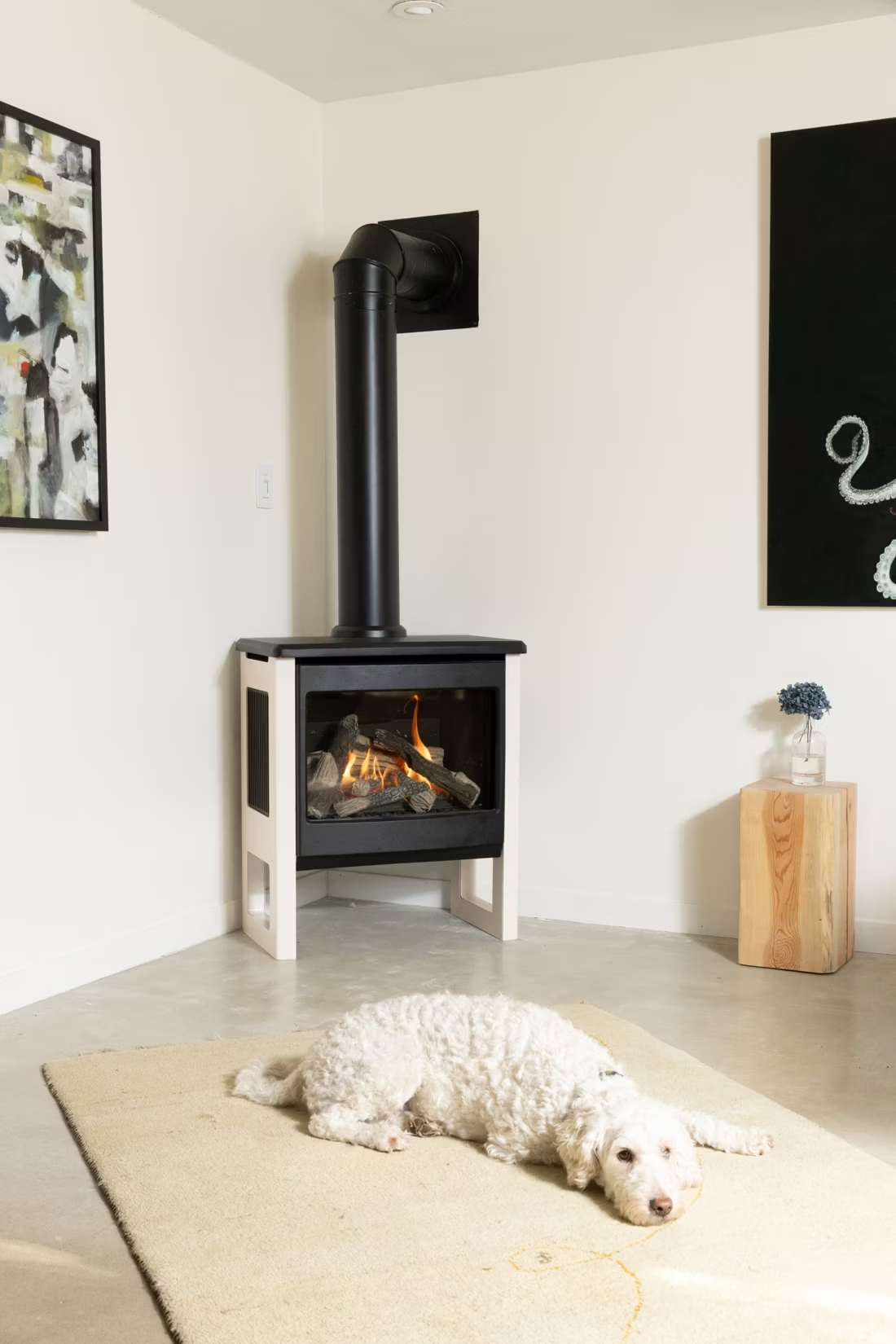
A gas fireplace is a fully built-in unit, framed into a wall—the standard choice for new construction or a remodel in a Keyes home that doesn't already have a hearth. A gas insert drops into an existing masonry firebox and uses the existing chimney to vent, which is the common route for older homes in town with a fireplace that's rarely used. A gas stove is a freestanding cast-iron or steel unit that sits on the floor, similar in footprint to a wood stove but running on gas—a good fit for a room without an existing chimney where you don't want to frame in a full fireplace.
Do I need a permit to install a gas fireplace in Keyes?
Yes. Since Keyes is unincorporated, permits for gas fireplace installations go through the Stanislaus County Building Permits Division, and the gas line work itself requires a licensed gas-fitter. Most hearth retailers and installers pull the permit as part of the job and schedule the inspection, so you're not coordinating separate trades yourself—that coordination is one of the main reasons to use a certified local installer rather than a handyman for gas work.
Are vent-free gas fireplaces allowed in Keyes?
California permits vent-free (unvented) gas fireplaces under specific conditions—minimum room size, an oxygen depletion sensor, and restrictions on installing them in bedrooms—but they release combustion byproducts directly into the living space. Given that Stanislaus County already sits in a federal non-attainment area for particulate matter and sees regular winter inversions that trap air near the ground, most local installers steer Keyes homeowners toward sealed, direct-vent units instead. Direct-vent fireplaces draw combustion air from outside and exhaust it back outside, so they don't add anything to indoor or local air quality—and they're the more common choice in this part of the valley regardless of code minimums.
How often does a gas fireplace need to be serviced?
Plan on an annual inspection, ideally before the foggy season starts in November. A technician checks the burner, pilot assembly, venting, and gas connections, and cleans the glass and interior—a much lighter job than wood chimney sweeping, but still important since a dirty burner or degraded gasket is a common cause of poor flame quality or nuisance shutoffs. Local gas appliance technicians typically charge $150 to $250 for this visit.
Gas vs. wood—which makes more sense for a Keyes home?
Wood is still available locally—oak, madrone, and Douglas fir are the common species, and cutting permits through Stanislaus National Forest run $5 to $20 per cord (May through October) with BLM California permits around $10 per cord (April through October). But with Keyes having a fairly light winter heating need overall and winter lows rarely dropping much below freezing, most households don't need wood as a primary heat source the way a mountain or high-desert home would. Add in the valley's non-attainment air status and winter inversions that trap wood smoke close to the ground, and gas is usually the more practical everyday choice here—clean, instant, and low-maintenance—while a wood option still appeals to homeowners who want the ambiance or a backup heat source that doesn't depend on gas or electric service.
What's the difference between an insert and a zero-clearance fireplace?
An insert is a fireplace that slides into a pre-existing wood-burning fireplace—if you don't have one, there's nothing to insert it into. A zero-clearance fireplace is built into a framed wall, which makes it the answer for remodels and new construction. Simple test: existing masonry fireplace means insert; blank or framed wall means zero-clearance.
Is my gas fireplace wasting gas?
If it was installed more than 15 years ago, probably. Older gas fireplaces keep a standing pilot light burning all the time, and that little flame can cost a couple hundred dollars a year. Newer models use pilot-on-demand ignition—the pilot lights only when you use the fireplace and goes out when you turn it off.
Can a fireplace actually lower my heating bill?
Yes—by creating a comfort zone. A furnace heats every square foot of the house just to warm the one room you're in; a gas fireplace on low burns roughly a sixth of the gas a typical furnace does. Set the furnace around 55–60 degrees as a baseline, then heat the rooms your family actually uses. Families who heat this way commonly save $20–$60 a month.
Does a fireplace add value to my home?
On average, a fireplace adds back to the home about the same amount you spent installing it. Add the monthly savings from heating the rooms you actually use instead of the whole house—often hundreds of dollars a year—and the value case is strong before you even count what a fire does for how your family uses the room.
Nearby Dealers
Hearth shops serving Keyes and the surrounding area. Every listing shows whether it is a WhyFire partner, a dealer we have verified as authorized for the brands we recommend, or a local business carrying hearth products. No manufacturer pays for placement. How we verify dealers →
We’ve paused dealer listings for this connection today. Enter your zip or postal code above to find dealers near you, or come back tomorrow.
Popular Gas Brands
Where each brand came from, what's inside it today, and every current model. No brand pays to be here. Not every dealer carries every brand, so enter your zip code to see what's sold near Keyes.
Kozy Heat
Kozy Heat was founded in 1976 by Dudley Hussong in Lakefield, Minnesota, and incorporated as Hussong Manufacturing Co., Inc. in 1978.
28 gas models →Fireplace Xtrordinair
Fireplace Xtrordinair, now often called FireplaceX, is the fireplace brand of Travis Industries, Inc., of Mukilteo, Washington.
25 gas models →Town & Country
Town & Country Fireplaces is the luxury gas fireplace brand of Pacific Energy Fireplace Products Ltd., of Duncan, British Columbia.
14 gas models →Lopi
Lopi is a wood, pellet, and gas stove brand founded by Kurt Rumens in Bellevue, Washington, in 1979.
7 gas models →Forge & Flame
Forge & Flame is the stove brand Hearth & Home Technologies introduced in August 2023 to bring Vermont Castings, Harman, and Quadra-Fire under one name.
6 gas models →Vermont Castings
Vermont Castings was founded in 1975 by Duncan Syme, the designer, and his brother-in-law Murray Howell, the business partner, in Randolph, Vermont.
6 gas models →Find your gas fireplace in Keyes.
Tell us about your home and we'll put together a free Project Guide & Parts List—the right gas fireplace or insert, the vent kit it needs, and a trusted local dealer in the Keyes area to install it.
Find Your Fireplace →