
Reliable warmth for Sanger's mild winters—without the smoke.
Gas heat built for San Joaquin Valley homes, where winters are mild but air quality rules are strict. Find the right unit and connect with a trusted local dealer.
Every Project Starts From One of These Five Situations
Gas heat for a valley that takes its air seriously.
Sanger sits at 365 feet in the San Joaquin Valley, where winter lows average a mild 38°F and the region logs only about 1,858 heating degree days a year—a fraction of what a place like Bozeman, Montana sees. That's not a climate that demands a wood-burning heat source to survive January. But it is a climate defined by tule fog inversions that trap particulate matter close to the ground, and Fresno County sits in a federal non-attainment area for fine particulates. Add regular wildfire smoke drifting down from the Sierra foothills each fall, and it's easy to see why the San Joaquin Valley Air Pollution Control District treats wood smoke as a serious public health issue, not a cozy inconvenience.
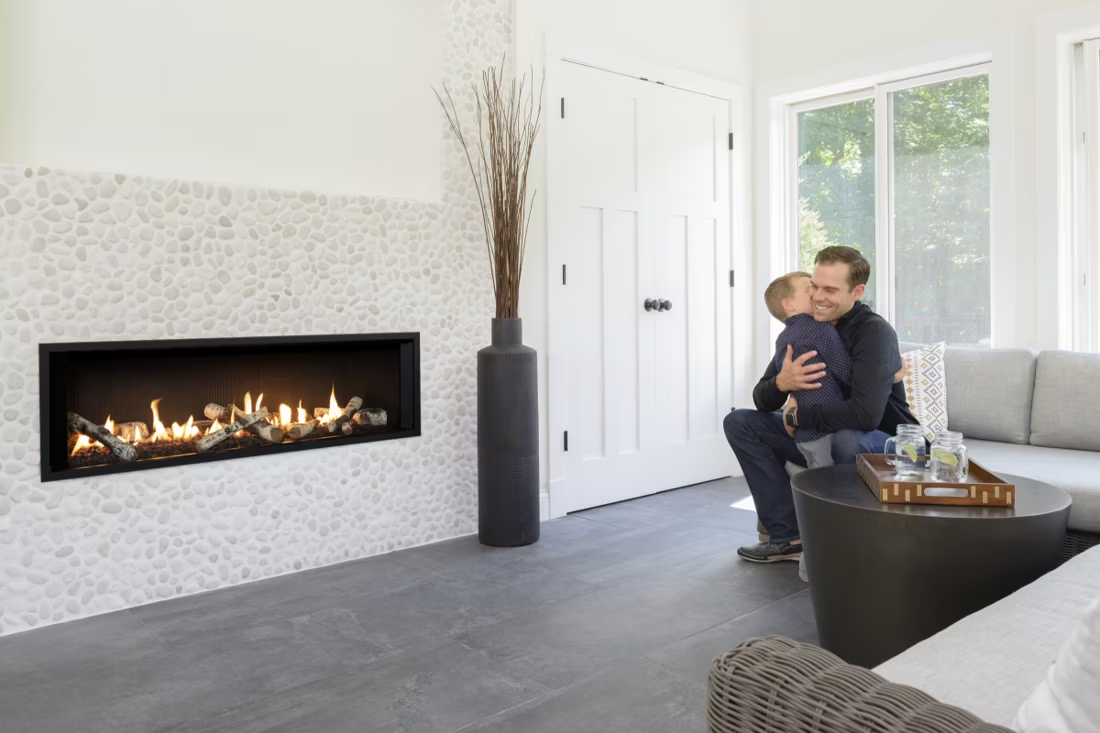
That combination—mild heating need plus a valley-wide air quality mandate—is exactly why gas has become the standard heat source in Sanger while wood and pellet appliances have largely fallen out of use here. Pacific Gas & Electric provides both electric and natural gas service to most of the city, and gas fireplaces and inserts are exempt from the district's winter burn restrictions, so they work every day of the season regardless of air quality alerts. For homes just outside the PG&E gas main footprint, toward the Sierra foothills and rural Fresno County, propane fills the gap. Either way, a properly sized gas insert or fireplace delivers instant, even heat with none of the smoke that triggers a Check Before You Burn advisory.
Three steps. No salesperson until you're ready.
Tell us about your project
Your zip code, your situation, and the fuel you're leaning toward—or let the answers point you to one.
See what's actually available
The brands dealers within 100 miles genuinely carry—real options, never a catalog mirage.
Get your dealer & Project Guide
A trusted local dealer, plus the free Project Guide & Parts List that names every component of the job.
Frequently Asked Questions
How much does a gas fireplace installation cost in Sanger?
Most gas fireplace installations in Sanger run $4,000 to $9,500, depending on the unit, the venting path, and whether new gas line work is needed. Because Sanger's mild winters mean most homes don't need a large-BTU appliance, many installs land toward the lower end of that range compared to colder-climate markets. A direct-vent insert going into an existing masonry fireplace with gas already run to the hearth is the cheapest path; a new built-in unit requiring framing and a fresh gas line from the meter runs higher. Local dealers will confirm a firm number after seeing your home and your existing gas service.
Can I still install a wood-burning fireplace in Sanger?
Technically yes, but it's an uphill climb, and most homeowners and builders choose gas instead. The San Joaquin Valley Air Pollution Control District enforces a mandatory Check Before You Burn program every winter (typically November through February), which bans wood burning on forecasted high-pollution days across Fresno County, including Sanger. New wood stoves also face strict EPA and district certification requirements, and older uncertified units are increasingly restricted at resale. Gas fireplaces and inserts are exempt from Check Before You Burn curtailment entirely, which is the single biggest reason gas has become the default choice here even though oak, madrone, and Douglas fir are all available from nearby Sierra and Sequoia National Forest cutting permits.
Do I need natural gas service, or can I use propane?
Either works, and which one applies depends on where your home sits. Most of Sanger proper is served by Pacific Gas & Electric's natural gas mains, so if you already have a gas water heater, range, or furnace, adding a fireplace typically just means tapping into existing service. Homes on the edges of town or out toward the Sierra foothills that fall outside PG&E's gas main footprint typically run on propane, delivered and stored in a tank on the property. Nearly every gas fireplace and insert sold by local dealers can be configured for either fuel—your installer sets the correct orifice and regulator for whichever service you have.
Will my gas fireplace work during a PG&E power shutoff?
It can, if you choose the right ignition system. PG&E conducts Public Safety Power Shutoffs (PSPS) during high fire-risk conditions, and Fresno County has been affected by these events in past wildfire seasons. Standard IPI (intermittent pilot ignition) gas fireplaces run on AA battery backup that kicks in automatically when grid power drops, so the unit still lights on demand—as long as the batteries are fresh. Valor's gas fireplaces go a step further: their pilot assembly generates its own electricity through the thermocouple, so there's no battery to remember at all. For a valley where extended outages are now a real possibility during fire season, ask your local dealer specifically about the ignition system before you buy.
What's the difference between a gas fireplace, gas insert, and gas stove?
A gas fireplace is a fully built-in unit framed into a wall, typically chosen for new construction or a remodel. A gas insert slides into an existing masonry firebox, sealing it up and venting through the existing chimney with a liner—this is the most common project for older Sanger homes that already have a traditional fireplace they no longer use for wood. A gas stove is a freestanding, cast-iron-style unit that sits on the floor and vents through a wall or existing flue, often chosen for rooms without an existing fireplace. For most Sanger homeowners converting an old wood firebox, an insert is the straightforward answer.
Do I need a permit to install a gas fireplace in Sanger?
Yes. Gas fireplace installations require a building permit and a gas line permit, issued through the City of Sanger Building Division for in-city addresses or the Fresno County Department of Public Works, Planning and Building Division for county parcels just outside city limits. The gas line portion has to be done by a licensed gas-fitter, which is one of the main reasons to go through a certified hearth dealer rather than a handyman—they coordinate the gas work, venting, and inspection sign-off as one job instead of leaving you to manage separate trades and permits yourself.
Are vent-free gas fireplaces allowed in Sanger?
Vent-free (unvented) gas units are legal in California but come with tight restrictions—minimum room size requirements, an oxygen depletion sensor, and adequate fresh-air exchange. Given that Fresno County already sits in a federal non-attainment area for particulate matter and deals with winter tule fog inversions that trap pollutants close to the ground, most local dealers steer homeowners toward direct-vent units instead, which draw combustion air from outside and exhaust it back outside through sealed venting. Direct-vent fireplaces are the standard recommendation in Sanger—they deliver real heat and a clean look without adding anything to indoor or outdoor air.
What size gas fireplace do I actually need in Sanger's climate?
Less than you'd think. With winter lows averaging 38°F and roughly 1,858 heating degree days a year, Sanger doesn't demand the high-BTU, all-night-burn appliances that cold-climate markets need. Most homes here do well with a mid-size direct-vent fireplace or insert used for zone heating in a main living area, rather than a whole-home heat source. Oversizing is a common and avoidable mistake—a unit sized for a Sierra Nevada mountain cabin will run too hot and cycle constantly in a Sanger living room. A local dealer can size the right BTU output after seeing your square footage and layout.
Gas vs. electric fireplace—which makes more sense in Sanger?
It depends on what you're solving for. Electric fireplaces cost far less upfront (often $400–$1,200 installed), need no venting or gas line, and plug into a standard outlet—a good fit for supplemental ambiance or a bedroom. But PG&E's residential electric rate in this area runs around $0.317 per kWh, among the highest in the country, which makes electric resistance heat expensive to run for real, sustained warmth. Gas costs more to install but delivers stronger, cheaper heat output over time and isn't subject to PG&E rate swings the same way. For a room you'll actually heat regularly, gas tends to win on cost per BTU in Sanger; for occasional ambiance with zero installation hassle, electric is hard to beat.
Why is my open fireplace making my house colder?
Open fireplaces suck—literally. As the fire burns, it consumes air your furnace already paid to heat and pulls it out through the chimney, so the house is actually colder after the fire goes out than before you lit it. An insert fixes this: it seals the chimney, puts fixed glass across the front, and turns that hole in your house into a real heat source.
Is my gas fireplace wasting gas?
If it was installed more than 15 years ago, probably. Older gas fireplaces keep a standing pilot light burning all the time, and that little flame can cost a couple hundred dollars a year. Newer models use pilot-on-demand ignition—the pilot lights only when you use the fireplace and goes out when you turn it off.
Can I install a fireplace myself?
If you're putting a fire in your house on purpose, it's best to work with an expert. Unless you're genuinely experienced in framing, gas line, vent pipe, and the national code on clearances to combustibles, have a professional do it—and ideally the same company that sells you the fireplace, so warranty, service, and liability all live under one roof.
Can a fireplace actually lower my heating bill?
Yes—by creating a comfort zone. A furnace heats every square foot of the house just to warm the one room you're in; a gas fireplace on low burns roughly a sixth of the gas a typical furnace does. Set the furnace around 55–60 degrees as a baseline, then heat the rooms your family actually uses. Families who heat this way commonly save $20–$60 a month.
Nearby Dealers
Hearth shops serving Sanger and the surrounding area.
Find your gas fireplace in Sanger.
Tell us a bit about your home and we'll match you with a trusted local dealer and send over your free Project Guide & Parts List—the exact fireplace or insert, venting, and parts recommended for your Sanger project.
Find Your Fireplace →