
Zone heat that skips the smoke and the gas line.
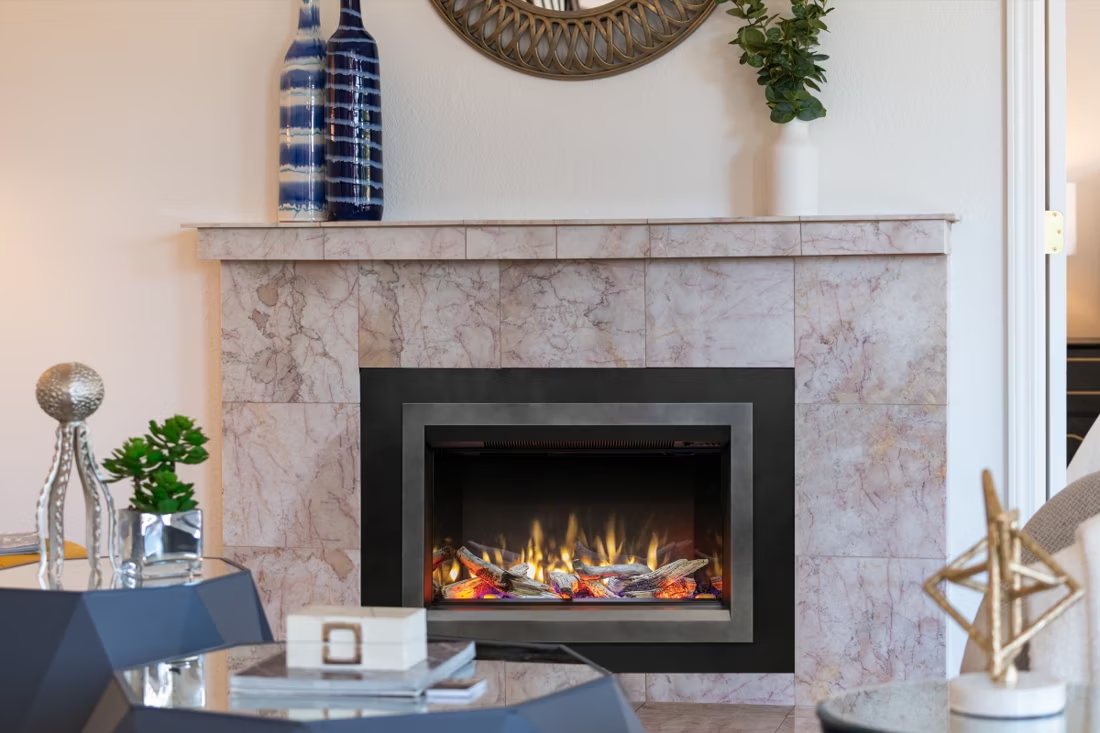
With no natural gas utility serving this stretch of Tulare County and Valley air rules that can shut down wood burning overnight, an electric fireplace is often the simplest way to add real warmth to a Poplar-Cotton Center home. Find the right unit and find a local dealer.
Every Project Starts From One of These Five Situations
Mild winters, real air quality rules, and no gas line in sight.
Poplar-Cotton Center sits in the flat farmland of southern Tulare County at just 364 feet elevation. Winters here are mild by any national measure—average lows hover around 40°F, and the community sees a comparatively light winter heating load, a fraction of what a place like Bismarck, ND racks up in the same stretch. That changes the math on a fireplace purchase: most households here need supplemental zone heat for the cold snaps of December and January, not a primary system built to carry a whole house through a hard northern winter.
There's no natural gas utility serving this unincorporated part of Tulare County—Southern California Edison is the electric provider, and outside of trucked-in propane, that's the infrastructure homeowners actually have to work with. At the same time, the San Joaquin Valley Air Basin is a federal non-attainment area, and winter inversions trap both wildfire smoke and wood smoke close to the ground. The San Joaquin Valley Air Pollution Control District's winter 'Check Before You Burn' program can restrict or ban wood-burning appliances on the worst air days. An electric fireplace or insert sidesteps both issues entirely: no gas line to trench, no curtailment notices to check, and heat on demand any night of the year.
Three steps. No salesperson until you're ready.
Tell us about your project
Your zip code, your situation, and the fuel you're leaning toward—or let the answers point you to one.
See what's actually available
The brands dealers within 100 miles genuinely carry—real options, never a catalog mirage.
Get your dealer & Project Guide
A trusted local dealer, plus the free Project Guide & Parts List that names every component of the job.
Frequently Asked Questions
How much does an electric fireplace installation cost in Poplar-Cotton Center?
A plug-in electric fireplace or freestanding stove that runs on a standard 120V outlet typically costs $300 to $900 for the unit with little to no installation cost beyond mounting. A built-in electric fireplace or insert that requires a dedicated 20-amp or 240V circuit, wall framing, or a mantel surround usually runs $1,200 to $2,800 once an electrician is involved. Because this is unincorporated Tulare County, any hardwired unit needs an electrical permit through the Tulare County Resource Management Agency's Building Division rather than a city office—a local dealer familiar with county permitting can usually fold that into the install.
Is natural gas available in Poplar-Cotton Center, or is electric really my only option besides propane?
There's no natural gas utility serving this community—Southern California Edison provides electricity, and homes that want a fossil-fuel appliance rely on trucked-in propane with an above-ground or buried tank. That makes electric fireplaces genuinely practical here rather than a fallback: there's no gas line to trench across a field or driveway, no propane delivery contract to manage, and a built-in electric insert or linear fireplace can go into almost any wall with an available circuit.
What does it cost to run an electric fireplace with SCE's rates?
Southern California Edison's residential rate runs about $0.2825 per kWh in this area, which is higher than the national average. A typical 1,500-watt electric fireplace heater running on high costs roughly $0.42 per hour, or about $4 for a 10-hour evening of use. Most owners run the heater function only during genuinely cold stretches—Poplar-Cotton Center's mild 40°F average winter low means many nights the flame effect alone (using only 30-100 watts) is enough for ambiance without the heating element running at all, which keeps costs low most of the season.
Do wood-burning restrictions in the Valley affect electric fireplaces?
No, and that's a real advantage here. The San Joaquin Valley Air Pollution Control District issues winter 'Check Before You Burn' advisories that can restrict or fully ban wood-burning devices—including EPA-certified stoves in some tiers—on days when the Valley's inversion layer traps smoke close to the ground. Electric fireplaces and inserts produce no combustion byproducts and aren't subject to any curtailment notice, so they can run on the worst air-quality days of the year without restriction.
Do I need a permit to install an electric fireplace in Poplar-Cotton Center?
A plug-in unit that simply connects to an existing outlet generally doesn't require a permit. A built-in or wall-mounted electric fireplace that needs new wiring, a dedicated circuit, or wall framing does require an electrical permit, and because Poplar-Cotton Center is unincorporated, that permit goes through the Tulare County Resource Management Agency rather than a city building department. Most hearth dealers who install built-in electric units in this area handle the county permit application as part of the job.
What size electric fireplace do I need for a Poplar-Cotton Center home?
Because winter lows here average around 40°F, most homes are looking for zone heat for a living room or bedroom rather than whole-house heating capacity. A unit rated for 400-600 square feet (typically 4,600-5,200 BTU) comfortably supplements a family room on a cold January evening, while larger open-concept spaces may call for a model rated to 1,000 square feet or a linear built-in with a higher-wattage heating element. Given the mild climate, oversizing is rarely the problem it is in colder regions—the bigger consideration is usually matching the fireplace's visual scale to the wall it's going on.
Can I convert an existing wood-burning fireplace to electric?
Yes, and it's a common project in areas affected by the Valley's non-attainment status and periodic burn restrictions. An electric insert slides into an existing masonry firebox and plugs into a nearby outlet or a newly run circuit, with no venting, chimney liner, or gas line required. It's often the simplest fix for a homeowner who has an old, rarely-used wood fireplace and wants reliable supplemental heat without worrying about curtailment days or maintaining a chimney.
Electric vs. wood or pellet—which makes more sense here?
Wood is still workable in this area—oak, madrone, and douglas fir are common regional species, and cutting permits through Sequoia National Forest or Sierra National Forest run $5 to $20 per cord during the May-through-October season. Pellet stoves using regional brands like Bear Mountain, Lignetics, or Pacific Pellet are another option and burn cleaner than cordwood. But both are subject to the Valley Air District's winter burn restrictions on inversion days, while electric is not. For a mild-winter home that mainly wants supplemental warmth and zero exposure to air-quality curtailment, electric is usually the lower-hassle choice; wood or pellet make more sense for households that want a hedge against power outages or already have a wood supply.
How much maintenance does an electric fireplace need?
Very little compared to a wood or gas unit—there's no chimney to sweep, no gas line to inspect, and no combustion byproducts to manage. Maintenance is mostly dusting the interior, occasionally wiping the glass front, and checking that the fan or blower runs quietly. LED light components typically last well over a decade, and the heating element itself usually runs 10+ years with normal use before it needs replacement. There's no annual inspection requirement the way there is for a wood stove or gas appliance in this area.
Can I put a TV above my fireplace?
Yes—with an asterisk. Fireplaces are hot and TVs don't like heat. Either put a mantel between them to deflect rising warmth, or choose a fireplace with heat-management technology that creates a cool zone on the wall above—the wall stays around 125 degrees, barely warm, while the room still gets full heat. If you like clean lines and don't want a mantel, heat management is the answer.
Do electric fireplaces actually produce heat?
Yes—most put out around 4,800–5,000 BTUs from a standard outlet, which comfortably warms a bedroom, office, or den as a comfort-zone heater. What they won't do is carry a whole house the way wood, gas, or pellet can. Think of electric as ambiance-first with honest supplemental heat: flames on with no heat in July, flames plus warmth in January.
Does a fireplace add value to my home?
On average, a fireplace adds back to the home about the same amount you spent installing it. Add the monthly savings from heating the rooms you actually use instead of the whole house—often hundreds of dollars a year—and the value case is strong before you even count what a fire does for how your family uses the room.
What is an in-home preview and do I need one?
It's a visit where a hearth professional measures your space, confirms the model you picked actually works in your home, and walks the specs—framing, gas line, venting, finish work—before anything is ordered. Some details you just can't know until you see the house. Never make a down payment without one; it's the single most-skipped step that burns buyers.
Nearby Dealers
Hearth shops serving Poplar-Cotton Center and the surrounding area. Every listing shows whether it is a WhyFire partner, a dealer we have verified as authorized for the brands we recommend, or a local business carrying hearth products. No manufacturer pays for placement. How we verify dealers →
We’ve paused dealer listings for this connection today. Enter your zip or postal code above to find dealers near you, or come back tomorrow.
Popular Electric Brands
Where each brand came from, what's inside it today, and every current model. No brand pays to be here. Not every dealer carries every brand, so enter your zip code to see what's sold near Poplar-Cotton Center.
Fireplace Xtrordinair
Fireplace Xtrordinair, now often called FireplaceX, is the fireplace brand of Travis Industries, Inc., of Mukilteo, Washington.
5 electric models →DaVinci
DaVinci Custom Fireplaces is a brand of Travis Industries, Inc., of Mukilteo, Washington, the company behind Lopi and Fireplace Xtrordinair.
5 electric models →Kozy Heat
Kozy Heat was founded in 1976 by Dudley Hussong in Lakefield, Minnesota, and incorporated as Hussong Manufacturing Co., Inc. in 1978.
3 electric models →Forge & Flame
Forge & Flame is the stove brand Hearth & Home Technologies introduced in August 2023 to bring Vermont Castings, Harman, and Quadra-Fire under one name.
1 electric model →Electric Service in Poplar-Cotton Center
An electric fireplace's heater draws about 1,500 watts—pennies per hour at local rates.
Southern California Edison Co
Find your electric fireplace in Poplar-Cotton Center.
Tell us a bit about your home and we'll put together a free Project Guide & Parts List for your electric fireplace or insert project—then help you find a trusted local dealer who can install it right.
Find Your Fireplace →