
Real Warmth for the High Desert's Cold Nights.
Palmdale days can be mild, but clear Antelope Valley skies mean fast heat loss after sunset. A gas fireplace gives you instant, on-demand warmth without wood smoke or air-district headaches—matched with a trusted local dealer.
Every Project Starts From One of These Five Situations
Mild days, sharp desert nights, and an air district that says no to wood smoke.
Palmdale sits at roughly 2,600 feet in the western Mojave, and its climate reads nothing like a true cold-winter town—winter lows average around 35°F and the city logs about 2,520 heating degree days a year, a fraction of what a place like Duluth, MN racks up. But desert radiational cooling is real: clear skies pull heat out of the ground fast after dark, and Antelope Valley homeowners routinely see 30–40 degree swings between afternoon highs and overnight lows in December and January.
That's one reason gas has become the default hearth fuel here. The other is air quality: Palmdale falls within the Antelope Valley Air Quality Management District's non-attainment area, and between PM2.5 rules and seasonal wildfire smoke, new wood-burning stoves and pellet appliances are largely discouraged or restricted at the building-permit stage—which is why we rate both as not-applicable for this market. A direct-vent gas fireplace or insert sidesteps all of that: no curtailment days, no smoke complaints from neighbors in a subdivision, and heat the moment you flip a switch.
Three steps. No salesperson until you're ready.
Tell us about your project
Your zip code, your situation, and the fuel you're leaning toward—or let the answers point you to one.
See what's actually available
The brands dealers within 100 miles genuinely carry—real options, never a catalog mirage.
Get your dealer & Project Guide
A trusted local dealer, plus the free Project Guide & Parts List that names every component of the job.
Frequently Asked Questions
How much does a gas fireplace installation cost in Palmdale?
Local dealers in the Antelope Valley typically quote gas inserts into an existing masonry fireplace in the $4,500–$9,500 range, and new built-in direct-vent fireplaces—common in Palmdale's newer tract subdivisions around Rancho Vista and the Anaverde area—from about $6,000 to $12,000 depending on the framing, venting run, and whether a gas line needs to be extended. Homes already plumbed for natural gas (a gas range or water heater already installed) tend to land on the lower end since the fuel supply is already in place.
Can I install a wood-burning fireplace or stove in Palmdale instead of gas?
It's uncommon, and for most Palmdale homes we don't recommend it. The Antelope Valley Air Quality Management District classifies the region as a non-attainment area, and new wood-burning appliance installations face real restrictions under local air-quality rules, on top of wildfire-smoke season adding further burn limitations most winters. Pellet stoves face the same headwind. If you're on a larger rural parcel near the Angeles National Forest boundary and still want to cut your own firewood—oak, madrone, and douglas fir are the common species available through Forest Service permits (roughly $5–$20 per cord, May through October season)—that firewood is more realistically used at a cabin or property outside city limits than installed as a primary heat appliance inside Palmdale proper.
Is natural gas available throughout Palmdale, or do some homes need propane?
Most of incorporated Palmdale—including the zip codes around the 93550/93551 corridor—is served by natural gas through Southern California Gas Company, so if your home already has a gas range or water heater, adding a fireplace is a straightforward tie-in. Some of the more rural, unincorporated Antelope Valley parcels near 93591 and 93599 sit outside the gas main and rely on propane tanks instead. Either fuel works in most modern gas fireplace models—your installer sets the correct orifice and regulator for whichever you have.
Will my gas fireplace still work if Southern California Edison shuts off power?
Yes, in most cases. Public Safety Power Shutoffs (PSPS) are a real consideration in SCE's high-desert service territory during red-flag wind and fire-weather days, and a gas fireplace with intermittent pilot ignition (IPI) keeps working through an outage using its onboard battery backup. Valor fireplaces go a step further—their pilot assembly generates its own electricity through the thermocouple, so there's no battery to remember to replace. Given how common PSPS events have become for Antelope Valley homeowners, ask your local dealer which ignition system a given unit uses before you buy.
What's the difference between a gas fireplace, gas insert, and gas stove?
A gas fireplace is a fully built-in unit framed into a wall—the standard choice in Palmdale's newer construction where there's no existing masonry chimney to work with. A gas insert drops into an existing wood-burning fireplace opening and uses the chimney as its vent chase, which is the common upgrade path for the city's older 1980s and 90s tract homes that came with a builder-grade masonry fireplace nobody uses. A gas stove is a freestanding cast-iron or steel unit that sits on the floor, useful in a room with no fireplace opening at all. Most Palmdale homeowners we hear from are converting an existing fireplace, which points toward an insert.
Do I need a permit to install a gas fireplace in Palmdale?
Yes. Homes within Palmdale city limits go through the City of Palmdale Building and Safety Division for both the building permit and the gas line permit; homes on unincorporated Antelope Valley parcels (including some 93591 addresses) go through Los Angeles County Public Works Building and Safety instead. Either way, the gas line work requires a licensed gas-fitter, and most established hearth retailers coordinate the permit, the gas line, and the final inspection as one package rather than leaving you to juggle separate trades.
Should I get a vented or vent-free gas fireplace in Palmdale?
Vented direct-vent units—which draw combustion air from outside and exhaust it back outside through a sealed pipe—are the standard, code-friendly recommendation almost everywhere, and that's doubly true in a non-attainment air district like the Antelope Valley's. Vent-free gas fireplaces are technically legal in California with room-sizing minimums and an oxygen-depletion sensor, but given local air-quality sensitivities and the fact that vent-free units release combustion byproducts into the living space, most Palmdale dealers steer homeowners toward direct-vent models by default.
How often does a gas fireplace need to be serviced?
Plan on an annual inspection, typically before the fall heating season starts. A certified technician checks the burner, pilot assembly, venting, and gas connections, and cleans the glass—this runs about $150–$250 in most Southern California markets. It's a much smaller job than a wood-stove chimney sweep, but skipping it is still the most common cause of ignition or venting problems down the line, especially in a dusty high-desert environment where blowing sand and grit can work into vent terminations over time.
Gas vs. electric fireplace—which makes more sense in Palmdale?
This is a closer call here than in most markets, because Southern California Edison's residential rate runs about $0.2825 per kWh—one of the higher electric rates in the country—which makes electric-resistance heat expensive to run for anything beyond occasional ambiance. Electric fireplaces are cheaper to install (often $400–$1,200 with no venting required) and plug into a standard outlet, which makes them a fit for renters, condos in the Rancho Vista area, or bedrooms where a gas line isn't practical. But for a room you actually want to heat on a cold desert evening, a natural gas unit typically costs less per hour to run than electric resistance heat at SCE's current rates, on top of surviving a PSPS outage that would leave a plug-in electric unit dark.
Is my gas fireplace wasting gas?
If it was installed more than 15 years ago, probably. Older gas fireplaces keep a standing pilot light burning all the time, and that little flame can cost a couple hundred dollars a year. Newer models use pilot-on-demand ignition—the pilot lights only when you use the fireplace and goes out when you turn it off.
Can I put a TV above my fireplace?
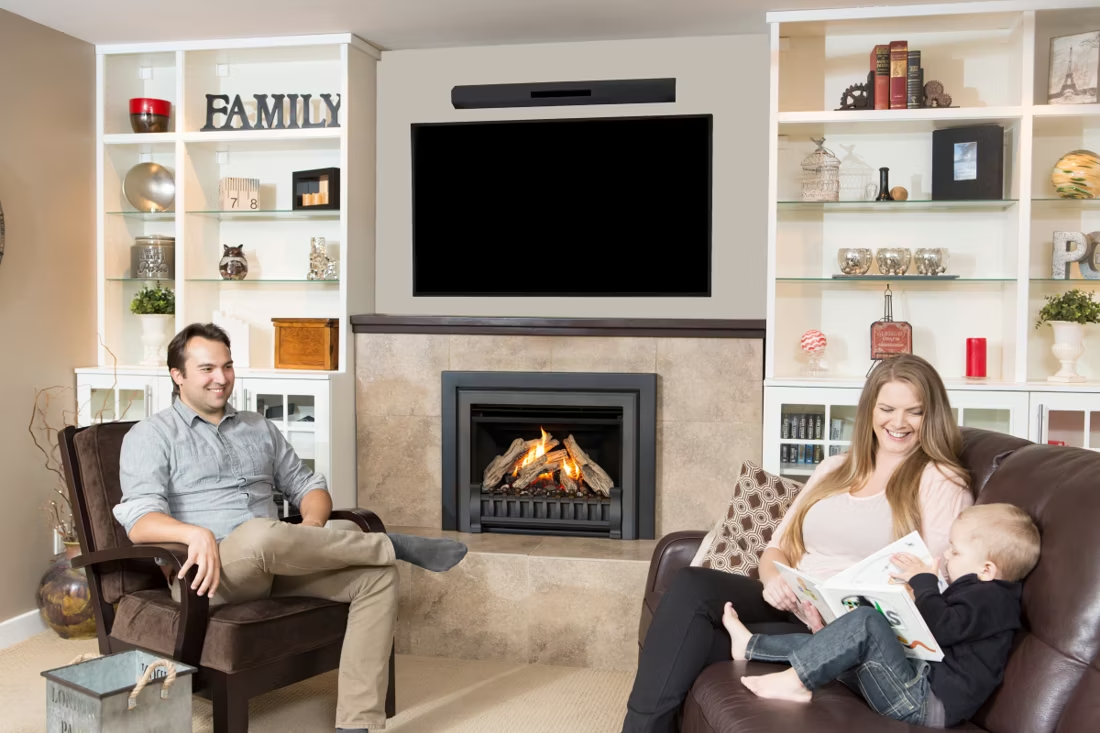
Yes—with an asterisk. Fireplaces are hot and TVs don't like heat. Either put a mantel between them to deflect rising warmth, or choose a fireplace with heat-management technology that creates a cool zone on the wall above—the wall stays around 125 degrees, barely warm, while the room still gets full heat. If you like clean lines and don't want a mantel, heat management is the answer.
Does a fireplace add value to my home?
On average, a fireplace adds back to the home about the same amount you spent installing it. Add the monthly savings from heating the rooms you actually use instead of the whole house—often hundreds of dollars a year—and the value case is strong before you even count what a fire does for how your family uses the room.
Can a fireplace actually lower my heating bill?
Yes—by creating a comfort zone. A furnace heats every square foot of the house just to warm the one room you're in; a gas fireplace on low burns roughly a sixth of the gas a typical furnace does. Set the furnace around 55–60 degrees as a baseline, then heat the rooms your family actually uses. Families who heat this way commonly save $20–$60 a month.
Nearby Dealers
Hearth shops serving Palmdale and the surrounding area.
All Valley Distrib. Dba Marco Distrib
The Heat Source (Burrico) - Lancaster
Tropicana Outdoor Living
Find your gas fireplace in Palmdale.
Tell us about your home and we'll put together a free Project Guide & Parts List—the right unit, the vent kit, and a trusted local Palmdale dealer who can pull the permit and install it correctly.
Find Your Fireplace →