
Warm Up Fast, Without a Flame, in Colusa County.
With winter lows averaging just 38°F and only 2,587 heating degree days a year, most Colusa County homes need a quick, clean way to take the edge off a Valley fog morning—not a full wood-burning setup. Find the right electric fireplace or insert and connect with a trusted local dealer.
Every Project Starts From One of These Five Situations
Mild winters, smoke-season smarts, and a growing case for electric.
Colusa County sits in the flat farmland of the Sacramento Valley—rice and almond country stretching from the county seat of Colusa through Williams, Arbuckle, Maxwell, Princeton, and Stonyford, with a population of roughly 17,500 spread across a mostly rural landscape. In climate zone 3B, winters are short and mild by California standards: average lows sit around 38°F and the county logs only about 2,587 heating degree days a year, a fraction of what colder Northern California mountain towns or a place like Bozeman, MT would see in a single hard winter. Because whole-house heating demand is modest here, most Colusa County homes lean on central heat pumps or furnaces for the bulk of the season and add an electric fireplace or insert to a living room, den, or bonus room for supplemental zone heat and ambiance on the coldest nights.
Wildfire smoke is the county's real air quality challenge, with late-summer and fall smoke events from nearby Mendocino National Forest and surrounding wildland areas periodically triggering advisories through the Colusa County Air Pollution Control District. An electric fireplace produces zero combustion byproducts—no smoke, no particulate matter, no chimney to maintain—which makes it a practical choice for households near open agricultural land, older manufactured homes, or anyone who wants supplemental heat without adding to the smoke load during a bad fire season. It's also the simplest retrofit available: no gas line, no venting, no masonry work, just a circuit and a wall.
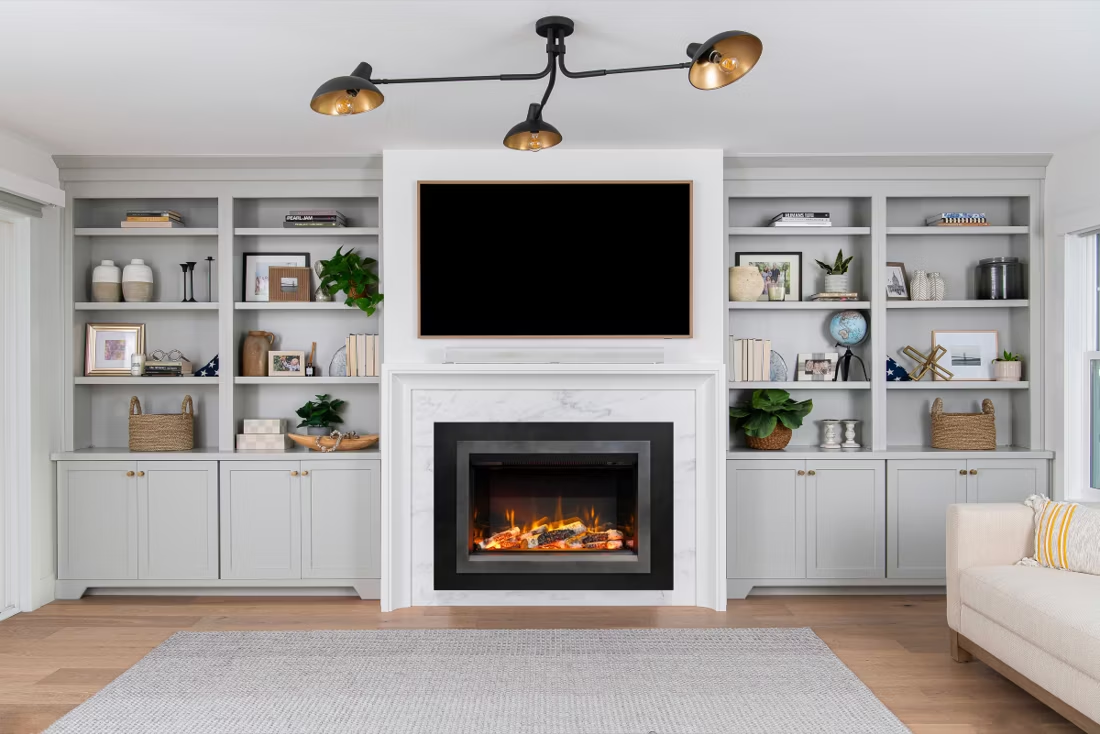
Three steps. No salesperson until you're ready.
Tell us about your project
Your zip code, your situation, and the fuel you're leaning toward—or let the answers point you to one.
See what's actually available
The brands dealers within 100 miles genuinely carry—real options, never a catalog mirage.
Get your dealer & Project Guide
A trusted local dealer, plus the free Project Guide & Parts List that names every component of the job.
Frequently Asked Questions
How much does an electric fireplace installation cost in Colusa County?
Plug-in freestanding or wall-mount electric fireplaces are the least expensive route, typically running $200 to $600 for the unit itself with no electrician needed since they plug into a standard 120V outlet. Built-in electric inserts or mantel packages usually need a dedicated 240V circuit run by a licensed electrician, plus finish carpentry around the surround, and typically land between $1,500 and $3,500 installed depending on the unit and how much wall or cabinetry work is involved. Given how spread out Colusa County is—from Colusa proper out to Stonyford or Princeton—expect a small trip charge from installers on rural jobs.
Will an electric fireplace actually heat a room, or is it just for looks?
Most electric fireplaces put out somewhere between 4,600 and 9,000 BTUs of supplemental heat, which is enough to comfortably warm a single room of 300 to 400 square feet—plenty for the kind of shoulder-season chill Colusa County sees given its mild 2,587 heating-degree-day climate. They won't replace a central heat pump or furnace on a genuinely cold night, but for the county's short winter, an electric unit in the main living space often covers the gap between 'central system running' and 'comfortable' without firing up the whole-house system.
Can an electric fireplace be my primary heat source in Colusa County?
For most homes here, no—and most homeowners don't need it to be. With average winter lows around 38°F and a relatively light heating load compared to colder parts of Northern California, Colusa County homes are generally built around central heat pumps or furnaces for whole-house heating, with an electric fireplace used as zone heat in one room. The exception is small spaces—a converted garage, an ADU, a single-room rental unit in Williams or Arbuckle—where a properly sized 240V electric insert can realistically serve as the only heat source.
Do I need a permit to install an electric fireplace in Colusa County?
A plug-in unit that draws from an existing outlet generally doesn't require a permit. If your installer is running a new dedicated circuit for a built-in insert—which is standard for most 240V units—that electrical work requires a permit through the Colusa County Building Department. Most hearth dealers who handle electric installs coordinate this permit as part of the job, so it's rarely something you have to manage yourself.
Electric vs. gas fireplace—which makes more sense for a Colusa County home?
Gas fireplaces put out more heat and give you the visual of a real flame, but they require either a natural gas line or a propane tank plus venting work, which adds cost and complexity—particularly out toward Maxwell or Princeton where gas infrastructure is thinner. Electric units skip all of that: no venting, no gas line, no propane deliveries, just a circuit. For a primary living space where you want serious heat and a fire-like flame, gas is usually the better fit. For a bedroom, den, or secondary living area where supplemental warmth and simplicity matter more, electric is often the more practical and less expensive choice.
Is electric heat a good option during wildfire smoke season?
Yes—this is one of the clearer advantages electric has in Colusa County. During late-summer and fall smoke events tied to fires near Mendocino National Forest, running a wood stove or even a gas unit adds combustion byproducts to air that's already compromised, and some jurisdictions issue burn advisories during those stretches. An electric fireplace produces no smoke and no indoor combustion at all, so it's a reasonable way to keep a room comfortable without adding to anyone's smoke sensitivity, especially in households with respiratory concerns.
What does it cost to run an electric fireplace in Colusa County?
Most electric fireplaces draw between 1,200 and 1,500 watts on the heat setting. At typical PG&E residential rates, which run roughly $0.30 to $0.45 per kWh in this region, running a unit on high for a few hours an evening costs somewhere in the range of $0.40 to $0.70 per hour. Given the county's mild winter—only 2,587 heating degree days—most households use their electric fireplace intermittently rather than continuously, so the seasonal cost tends to stay modest compared to running a full central heating system.
Electric fireplace vs. wood-burning insert—which is right for my Colusa County home?
Wood-burning is still common in the county—oak, madrone, and Douglas fir are the local go-to species, and cutting permits through Mendocino National Forest and the BLM California State Office run $5 to $20 per cord during the May-to-October season. Wood gives you real radiant heat and works without power, which matters during PG&E outages. But it also means chimney maintenance, ash cleanup, and smoke output at a time when the county already deals with wildfire smoke several weeks a year. Electric skips all of that—no chimney, no ash, no smoke—at the cost of lower total heat output and dependence on grid power. For a mild-winter Valley home used mainly for ambiance and spot heat, electric is often the lower-hassle choice; for backup heat during outages or a home already set up for wood, an insert still makes sense.
Where can I see electric fireplaces in person near Colusa County?
Because Colusa County is rural and spread across towns like Colusa, Williams, and Arbuckle, most homeowners end up driving toward Yuba City, Woodland, or Sacramento to see units in a showroom. Rather than guessing which retailer actually stocks and installs what's realistic for your specific wall, circuit, and space, tell us a bit about your home and we'll match you with a trusted local dealer who can walk you through options that are genuinely available and installable near you—not just whatever a big-box store happens to have on the floor.
Do electric fireplaces actually produce heat?
Yes—most put out around 4,800–5,000 BTUs from a standard outlet, which comfortably warms a bedroom, office, or den as a comfort-zone heater. What they won't do is carry a whole house the way wood, gas, or pellet can. Think of electric as ambiance-first with honest supplemental heat: flames on with no heat in July, flames plus warmth in January.
Does an electric fireplace need a vent or chimney?
No—that's its superpower. An electric fireplace needs a wall and an outlet, period. No vent pipe, no gas line, no clearances to design around, which is why it works in bedrooms, offices, apartments, and walls where venting a gas or wood unit would be impractical or impossible. Installation is typically the simplest and least expensive of any fireplace type.
Does a fireplace add value to my home?
On average, a fireplace adds back to the home about the same amount you spent installing it. Add the monthly savings from heating the rooms you actually use instead of the whole house—often hundreds of dollars a year—and the value case is strong before you even count what a fire does for how your family uses the room.
How much should I budget for a fireplace?
For an average home—covering the fireplace, the vent pipe, and basic installation—a budget between $3,900 and $5,500 gives you a lot of options across wood, gas, and pellet. By the time you add finish work, gas line, and electrical, the average complete installation lands between $5,000 and $12,000 all-in. In a remodel or new build, a good rule is to put about 2.5% of the total project cost toward the fireplace.
Find your electric fireplace in Colusa County.
Tell us a bit about your home and we'll match you with a trusted local dealer and send over a free Project Guide & Parts List—a clear plan for your electric fireplace project in Colusa County, including the exact parts and a recommended local installer.
Find Your Fireplace →