
Gas fireplace warmth built for the Central Coast fog.
Mild days and cool marine-layer nights call for a fireplace that turns on instantly, not a cord of firewood. Find the right gas unit and find a trusted local dealer near campus.
Every Project Starts From One of These Five Situations
Mild days, cool foggy nights—heat without the hassle.
Cal Poly's campus sits at just 324 feet elevation on California's Central Coast, where winter lows average a mild 44°F and the area logs only a light winter heating load each year—a fraction of what a place like Bozeman, MT or Duluth, MN sees. That's not cold-climate territory, which is why wood stoves, pellet stoves, and built-in electric fireplace inserts are essentially absent from the housing stock around campus. Between the mild winter heating needs, the San Luis Obispo Air Pollution Control District's attention to air quality during wildfire-smoke season, and a neighborhood full of dorms, Greek housing, and student rentals where solid-fuel appliances aren't practical or permitted, gas is the fuel that actually gets installed here.
The single-family homes, faculty residences, and off-campus rentals scattered through the 93401, 93405, and 93407 zips are mostly served by Southern California Gas Company, with propane filling in for the handful of outlying properties near Cal Poly's agricultural land where gas lines don't reach. PG&E's residential electric rate—a steep $0.317 per kWh—makes electric heat an expensive fallback, which is another reason gas fireplaces remain the go-to for anyone who wants real ambiance and quick zone heat on a foggy Central Coast evening without running up the power bill.
Three steps. No salesperson until you're ready.
Tell us about your project
Your zip code, your situation, and the fuel you're leaning toward—or let the answers point you to one.
See what's actually available
The brands dealers within 100 miles genuinely carry—real options, never a catalog mirage.
Get your dealer & Project Guide
A trusted local dealer, plus the free Project Guide & Parts List that names every component of the job.
Frequently Asked Questions
How much does a gas fireplace installation cost near Cal Poly and San Luis Obispo?
A typical gas fireplace or insert installation in the neighborhoods around campus runs $5,000 to $11,500, depending on the unit, the venting path, and whether new gas line work is needed. A direct-vent insert going into an existing masonry firebox in one of SLO's older craftsman or bungalow homes near Foothill Boulevard tends to land on the lower end. A new direct-vent fireplace in a remodel or a student rental that needs a fresh gas line run pushes toward the higher end—coastal California labor and permitting costs are part of that too. A local dealer will give you a firm number after an in-home walkthrough.
Can I convert an old wood-burning fireplace to gas in one of the older homes near campus?
Yes, and it's a common project in San Luis Obispo's older housing stock—plenty of the craftsman and bungalow homes surrounding Cal Poly were built with open masonry wood fireboxes decades before gas service reached the neighborhood. A gas insert typically drops into that existing firebox using a stainless liner run through the original chimney, and the project usually runs $4,800 to $9,500 depending on whether natural gas or propane is used and whether new gas line work is required. Given how often wildfire smoke pushes air quality advisories through the Central Coast in late summer and fall, a lot of homeowners appreciate not having to think about wood smoke on top of it.
Is natural gas available near Cal Poly, or do I need propane?
Most of the City of San Luis Obispo, including the neighborhoods that ring the Cal Poly campus, is served by Southern California Gas Company, so homes already plumbed for a gas water heater or range are usually a straightforward hookup. Propane fills the gap for the outlying edges of the area, including some of Cal Poly's own agricultural and ranch land along Highway 1, where a gas main doesn't reach. Most gas fireplace models can be configured for either fuel—your installer sets the correct orifice and regulator for whichever you have.
Will my gas fireplace still work if PG&E shuts off power during a wildfire-risk event?
In most cases, yes. PG&E runs Public Safety Power Shutoffs across the Central Coast during high-wind, high fire-risk conditions, sometimes for a day or more, and a gas fireplace with IPI (intermittent pilot ignition) has a battery backup built in that keeps the unit lighting on demand through the outage—you just have to keep fresh batteries in it. Valor's fireplaces take a different approach: the pilot's thermocouple generates its own electricity, so there's no battery to remember at all. For a neighborhood that sees planned outages timed with the same red-flag wind events that raise wildfire-smoke concerns, that's worth asking your local dealer about.
What's the difference between a gas fireplace, gas insert, and gas stove?
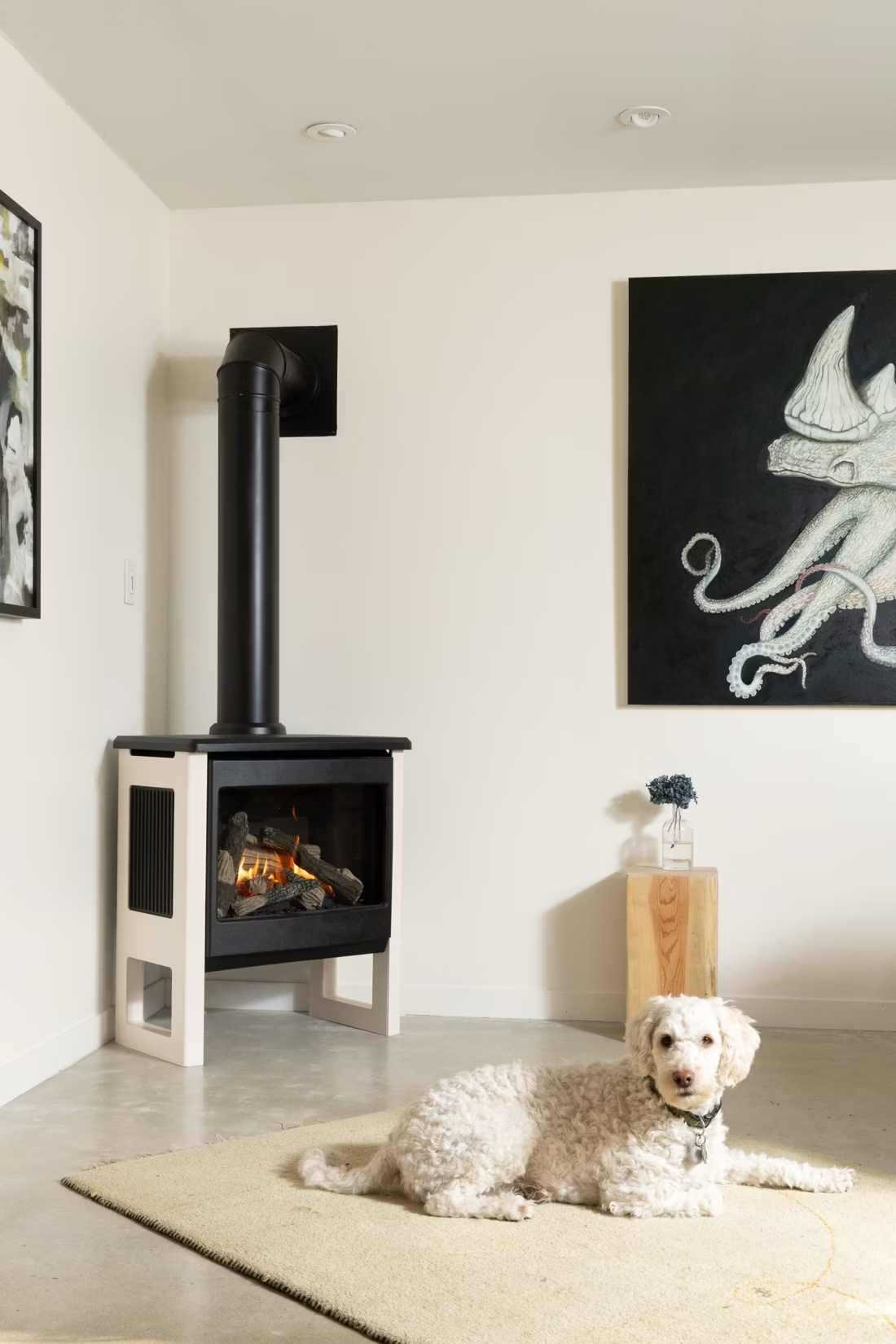
A gas fireplace is a fully built-in unit framed into a wall—the standard choice for new construction or a larger remodel. A gas insert is sized to slide into an existing masonry firebox, which is common in San Luis Obispo's older homes near campus that already have a wood-burning fireplace. A gas stove is a freestanding cabinet-style unit that sits on the floor like a wood stove but runs on gas, which works well in smaller rentals or converted garages where there's no existing masonry opening. Most homeowners near Cal Poly with an existing fireplace opt for an insert; new builds usually go with a built-in fireplace.
Do I need a permit to install a gas fireplace near Cal Poly?
It depends on the property. For homes in the surrounding neighborhoods, the City of San Luis Obispo Community Development Department requires a building permit plus a gas line permit pulled by a licensed gas-fitter, and most local installers handle that paperwork as part of the job. For structures on the Cal Poly campus itself—fraternity and sorority houses, university-owned housing, or any campus facility—permitting runs through Cal Poly's own Facilities Planning & Capital Projects office and the State Fire Marshal's requirements for CSU property, rather than the city. It's worth confirming which category your project falls into before you get a quote.
What's the difference between vented and vent-free gas fireplaces, and which is used near Cal Poly?
Vented (direct-vent) gas fireplaces draw combustion air from outside and exhaust it back outside through a sealed pipe. Vent-free units burn directly into the room without external venting. California law permits vent-free units with restrictions on room size and ventilation, but given how much attention the San Luis Obispo Air Pollution Control District already pays to indoor and outdoor air quality during wildfire-smoke season, most local retailers steer homeowners toward direct-vent, sealed-combustion units instead. They're the more common install in this area and the one most inspectors are used to signing off on.
How often should my gas fireplace be serviced?
An annual inspection is recommended for any gas appliance, and a direct-vent fireplace or insert is no exception. A technician checks the burner, pilot assembly, venting, gas connections, and any battery-backup ignition components, and cleans the glass and interior. Given how mild winters are here, some homes near Cal Poly only run the fireplace occasionally for ambiance rather than daily heat—but infrequent use is actually a reason to keep the annual service, since spiders and debris can nest in an idle vent over the summer. Expect to pay $150 to $250 for the visit.
Why is gas so much more common near Cal Poly than wood, pellet, or electric fireplaces?
It comes down to climate and housing stock. With winter lows averaging 44°F and only a light winter heating load each year, this isn't a place that needs a wood stove or pellet stove to survive winter the way Fargo, ND or Caribou, ME does—and the wildfire-smoke advisories that hit the Central Coast most falls make solid-fuel burning even less appealing. A lot of the housing near campus is also dorms, Greek housing, and student rentals, which aren't set up for permanent wood or electric-insert installations the way a single-family home is. Add PG&E's $0.317 per kWh residential rate, which makes electric heat expensive to run, and gas ends up being the fuel that actually shows up in the homes here that do install a fireplace—for ambiance most of the year and real zone heat on the coldest, foggiest nights.
Why is my open fireplace making my house colder?
Open fireplaces suck—literally. As the fire burns, it consumes air your furnace already paid to heat and pulls it out through the chimney, so the house is actually colder after the fire goes out than before you lit it. An insert fixes this: it seals the chimney, puts fixed glass across the front, and turns that hole in your house into a real heat source.
What do I measure to size a fireplace insert?
Four numbers tell you what fits: the front width, the front height, the back width, and the overall depth of your existing fireplace opening. Grab a tape measure, jot those down, and snap a photo of the wall—those two things do more to move your project forward than anything else you can do today.
Does a fireplace add value to my home?
On average, a fireplace adds back to the home about the same amount you spent installing it. Add the monthly savings from heating the rooms you actually use instead of the whole house—often hundreds of dollars a year—and the value case is strong before you even count what a fire does for how your family uses the room.
Can a fireplace actually lower my heating bill?
Yes—by creating a comfort zone. A furnace heats every square foot of the house just to warm the one room you're in; a gas fireplace on low burns roughly a sixth of the gas a typical furnace does. Set the furnace around 55–60 degrees as a baseline, then heat the rooms your family actually uses. Families who heat this way commonly save $20–$60 a month.
Nearby Dealers
Hearth shops serving California Polytechnic State University and the surrounding area. Every listing shows whether it is a WhyFire partner, a dealer we have verified as authorized for the brands we recommend, or a local business carrying hearth products. No manufacturer pays for placement. How we verify dealers →
We’ve paused dealer listings for this connection today. Enter your zip or postal code above to find dealers near you, or come back tomorrow.
Popular Gas Brands
Where each brand came from, what's inside it today, and every current model. No brand pays to be here. Not every dealer carries every brand, so enter your zip code to see what's sold near California Polytechnic State University.
Kozy Heat
Kozy Heat was founded in 1976 by Dudley Hussong in Lakefield, Minnesota, and incorporated as Hussong Manufacturing Co., Inc. in 1978.
28 gas models →Fireplace Xtrordinair
Fireplace Xtrordinair, now often called FireplaceX, is the fireplace brand of Travis Industries, Inc., of Mukilteo, Washington.
25 gas models →Town & Country
Town & Country Fireplaces is the luxury gas fireplace brand of Pacific Energy Fireplace Products Ltd., of Duncan, British Columbia.
14 gas models →Lopi
Lopi is a wood, pellet, and gas stove brand founded by Kurt Rumens in Bellevue, Washington, in 1979.
7 gas models →Forge & Flame
Forge & Flame is the stove brand Hearth & Home Technologies introduced in August 2023 to bring Vermont Castings, Harman, and Quadra-Fire under one name.
6 gas models →Vermont Castings
Vermont Castings was founded in 1975 by Duncan Syme, the designer, and his brother-in-law Murray Howell, the business partner, in Randolph, Vermont.
6 gas models →Find your gas fireplace near Cal Poly.
Tell us a bit about your home or property near campus and we'll put together a free Project Guide & Parts List—the right gas fireplace or insert, the exact venting parts, and a trusted local dealer to install it.
Find Your Fireplace →