
Find your pellet stove in Calaveras County.
Steady, low-maintenance heat for the Sierra foothills—from San Andreas to Murphys to Copperopolis. Get matched with a trusted local dealer who knows what actually vents and installs in your home.
Every Project Starts From One of These Five Situations
Mild winters, real smoke concerns—pellet fits the middle ground.
Calaveras County sits in the Sierra foothills at climate zone 4B, with an average winter low around 40°F and a mild heating season overall—just a fraction of what a place like Bozeman, Montana sees, but enough that homes at higher elevations toward Murphys, Arnold, and the Ebbetts Pass corridor still need real, sustained heat through the winter months. Wood has deep roots here thanks to oak, madrone, and Douglas fir standing timber and nearby cutting permits through Stanislaus National Forest and Eldorado National Forest. But wildfire smoke is a recurring seasonal reality in this part of the Sierra, and pellet stoves give homeowners a cleaner-burning option that doesn't add another layer of smoke to an already smoke-heavy summer and fall.
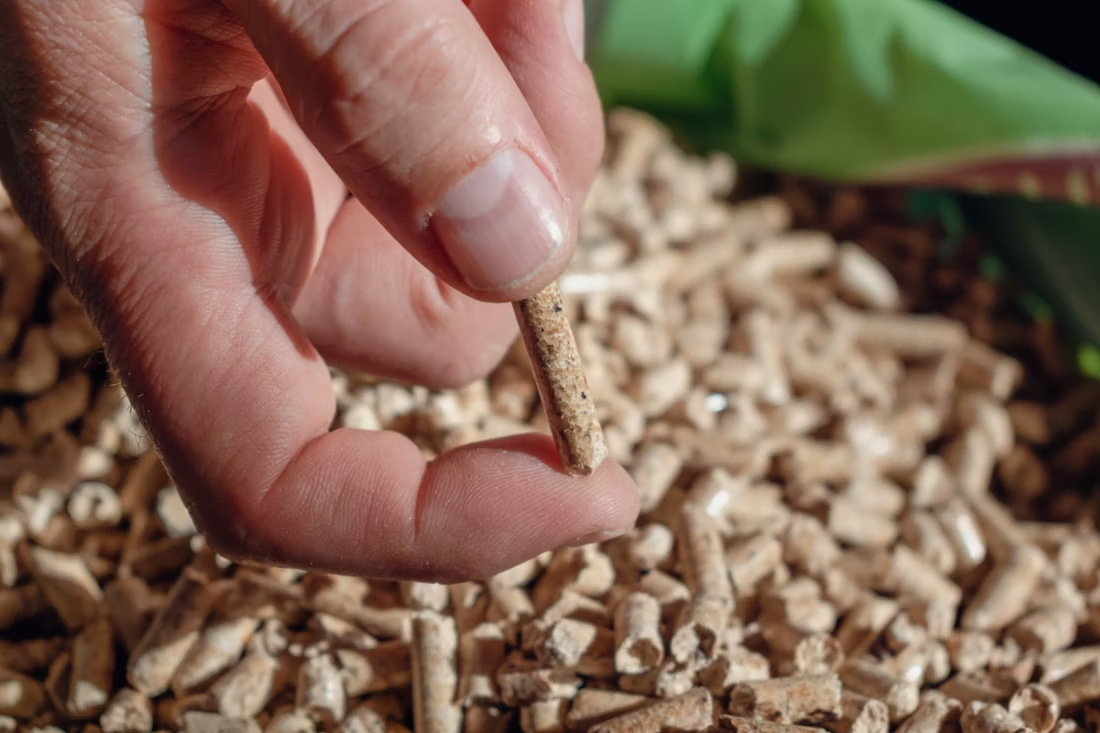
Pellet stoves also solve a practical problem for county residents: no felling, splitting, or seasoning wood, no chimney sweep visits on the same schedule as a wood-burning setup, and a hopper that can run 24 to 60 hours on a single load depending on the model and burn rate. Regional brands like Bear Mountain, Lignetics, and Pacific Pellet are readily available throughout the foothills, which keeps fuel sourcing simple whether you're in San Andreas proper or out toward Wilseyville or Rail Road Flat. A trusted local dealer can size the unit to your square footage and elevation, pull the right permits, and make sure the vent kit is correct for your install—no big-box guesswork.
Three steps. No salesperson until you're ready.
Tell us about your project
Your zip code, your situation, and the fuel you're leaning toward—or let the answers point you to one.
See what's actually available
The brands dealers within 100 miles genuinely carry—real options, never a catalog mirage.
Get your dealer & Project Guide
A trusted local dealer, plus the free Project Guide & Parts List that names every component of the job.
Frequently Asked Questions
How much does a pellet stove installation cost in Calaveras County?
Pellet stove installations in Calaveras County typically run in line with regional Sierra foothill pricing, generally landing in the $3,000 to $6,500 range depending on the unit, whether venting already exists, and how much wall or floor work is needed to run the vent kit through an exterior wall. Homes at higher elevation near Arnold or along Highway 4 sometimes see modestly higher costs due to travel time for installers based closer to San Andreas or Angels Camp. A local dealer will give you a firm number after seeing your home in person.
Do pellet stoves make sense in a mild climate like Calaveras County?
Yes, though the case is different than in a harsher climate. With winter lows averaging around 40°F and a fairly mild heating season overall, Calaveras County doesn't demand the kind of 20-hour overnight burns you'd see in a place like Duluth, Minnesota. Instead, pellet stoves here are popular as efficient zone heat for a main living area, supplemental heat for homes with older or underpowered central systems, and a cleaner-burning alternative to open wood burning during wildfire smoke season. A smaller or mid-size pellet stove is often plenty for most foothill homes.
Where can I buy pellet fuel in Calaveras County?
Regional brands including Bear Mountain, Lignetics, and Pacific Pellet are commonly stocked at hearth retailers and hardware stores throughout the Sierra foothills, including outlets serving San Andreas, Angels Camp, and Murphys. Pricing fluctuates with wildfire season demand and regional supply, so buying a season's worth of bags early—typically late summer before smoke season ramps up demand for cleaner-burning heat options—tends to save money versus buying bag by bag through winter.
What's the difference between a pellet stove and a pellet insert?
A pellet stove is a freestanding unit that sits on its own base and vents through a wall or existing chimney chase—it works in homes with or without an existing fireplace. A pellet insert is built to slide into an existing masonry or zero-clearance wood fireplace, using the existing opening while venting through the chimney with a proper liner. For Calaveras County homes with older wood fireplaces that see little use, an insert is often the more cost-effective path since it reuses the existing opening rather than requiring new wall penetration.
Do I need a permit to install a pellet stove in Calaveras County?
Yes—pellet stove installations in Calaveras County require a building permit, and most local installers handle the paperwork as part of the install so homeowners don't have to navigate it themselves. Because pellet stoves burn cleaner and more consistently than open wood fires, they're generally treated more favorably than wood stoves under state air-quality guidance, and they're commonly exempt from the kind of burn curtailment restrictions that apply to wood-burning appliances during poor air-quality days.
Will a pellet stove work during a power outage?
This is worth planning around. Pellet stoves require electricity to run the auger that feeds fuel and the blower that circulates heat, so a standard unit will not operate during an outage. For Calaveras County homeowners concerned about PG&E-related outages or wildfire-season Public Safety Power Shutoffs, a battery backup or small generator sized for the stove's low wattage draw is a common workaround, and some homeowners in outage-prone areas opt for a wood stove as a backup heat source specifically because it needs no power at all. Ask a local dealer about backup options if outage resilience matters to you.
How often does a pellet stove need to be serviced?
Pellet stoves need more frequent attention than a once-a-year chimney sweep, but the work is lighter. Plan on cleaning the burn pot and ash area every few days to weekly during regular use, a deeper cleaning of the venting and hopper monthly during heavy-use months, and a full professional service annually—typically before the start of wildfire smoke season when many Calaveras County homeowners lean on the stove more for clean indoor heat. The hearth retailers serving San Andreas and Angels Camp typically offer this annual service.
What size pellet stove do I need for my Calaveras County home?
Sizing depends on square footage, insulation, and elevation more than anything else. Foothill homes in the 4,000-foot-plus range near Arnold and Dorrington run colder overnight than lower-elevation homes near Valley Springs or Copperopolis, so the same square footage can call for a larger unit at higher elevation. As a general guide, smaller stoves handle up to around 1,000 square feet, mid-size units cover 1,000 to 2,000 square feet, and larger stoves suit bigger or less-insulated homes. A local dealer will size your specific home rather than relying on square footage alone.
Pellet stove vs. wood stove—which is right for me?
Wood stoves work without electricity, pair with self-cut firewood from nearby Stanislaus and Eldorado National Forest permits, and deliver the traditional fire experience—but they add more smoke output at a time when wildfire smoke is already a seasonal concern in Calaveras County. Pellet stoves burn cleaner, need less hands-on tending, and are generally viewed more favorably under state air-quality rules, but they need electricity to run and won't operate in an outage without backup power. For homes prioritizing clean-burning convenience, pellet is usually the better fit. For homes wanting a no-power backup heat source, wood remains a strong option. A local dealer can walk you through both.
How often does a pellet stove need cleaning?
A clean pellet stove is a happy pellet stove. Plan on cleaning the burn pot about once a week when you're burning regularly—ash and clinkers gum up the air holes just like a pellet barbecue. Most pellet stove problems trace back to skipped cleaning that nobody explained up front. Some designs make it easy with a trapdoor burn pot: pull a lever and the gunk drops into the ash pan.
Why is my open fireplace making my house colder?
Open fireplaces suck—literally. As the fire burns, it consumes air your furnace already paid to heat and pulls it out through the chimney, so the house is actually colder after the fire goes out than before you lit it. An insert fixes this: it seals the chimney, puts fixed glass across the front, and turns that hole in your house into a real heat source.
Can a fireplace actually lower my heating bill?
Yes—by creating a comfort zone. A furnace heats every square foot of the house just to warm the one room you're in; a gas fireplace on low burns roughly a sixth of the gas a typical furnace does. Set the furnace around 55–60 degrees as a baseline, then heat the rooms your family actually uses. Families who heat this way commonly save $20–$60 a month.
How much should I budget for a fireplace?
For an average home—covering the fireplace, the vent pipe, and basic installation—a budget between $3,900 and $5,500 gives you a lot of options across wood, gas, and pellet. By the time you add finish work, gas line, and electrical, the average complete installation lands between $5,000 and $12,000 all-in. In a remodel or new build, a good rule is to put about 2.5% of the total project cost toward the fireplace.
Stove and Fireplace Dealers in Calaveras County
Pellet Brands Stocked Around Calaveras County
Manufacturers will point you to the nearest stocking dealer.
Get your free Pellet Project Guide & Parts List.
Tell us about your home in Calaveras County and we'll match you with a trusted local dealer, plus a free Project Guide & Parts List with the exact parts—including the vent kit—for your pellet stove or insert project.
Find Your Fireplace →