
Electric warmth built for Arvin's short, mild winters.
Real supplemental heat for the handful of cold evenings Arvin gets each year—no smoke, no burn-ban days, no chimney. Find a local dealer who knows what actually works here.
Every Project Starts From One of These Five Situations
Mild winters, strict air rules—electric just works.
Arvin sits at 415 feet in the southern San Joaquin Valley, at the foot of the Sequoia National Forest range, where winters are short and mild by any national standard. Average lows hover around 39°F and the city has a short, mild heating season overall—a fraction of what a place like Fargo, ND racks up in a single cold snap. Most Arvin homes don't need a heating overhaul; they need reliable, on-demand warmth for the coldest stretches of December and January, and not much more than that.
Kern County also sits inside one of the most heavily regulated air basins in the country. The San Joaquin Valley Air Pollution Control District runs the Check Before You Burn program, which restricts wood-burning devices on high-pollution days all winter long, and the valley's PM2.5 non-attainment status makes new wood or pellet installs a tough sell to local building officials. Electric fireplaces and inserts sidestep all of that—no smoke, no burn-ban blackout nights, no combustion byproducts—while plugging into a grid Arvin residents already rely on through PG&E.
Three steps. No salesperson until you're ready.
Tell us about your project
Your zip code, your situation, and the fuel you're leaning toward—or let the answers point you to one.
See what's actually available
The brands dealers within 100 miles genuinely carry—real options, never a catalog mirage.
Get your dealer & Project Guide
A trusted local dealer, plus the free Project Guide & Parts List that names every component of the job.
Frequently Asked Questions
How much does an electric fireplace or insert cost to install in Arvin?
Electric fireplaces are the least invasive hearth project you can do—most wall-mount units and inserts run on a standard 120V outlet, so there's no gas line, no venting, and no masonry work involved. Basic plug-in models can be installed in an afternoon for a few hundred dollars in electrician time (if any rewiring is needed at all), while built-in electric fireplaces set into a wall or existing masonry opening, with trim work and a dedicated circuit, typically land higher. Because Arvin's climate doesn't demand a whole-home heating system, most homeowners here are shopping the lower end of that range—a local dealer can confirm exact pricing once they see your space and panel capacity.
Do I need a permit for an electric fireplace in Arvin or Kern County?
In most cases, no. Plug-in electric fireplaces and inserts that use existing outlets don't trigger a building permit. If your installer needs to run a new dedicated circuit or do any electrical panel work, that portion may require an electrical permit through the Kern County Building Inspection Division, but the fireplace itself isn't subject to the combustion-appliance rules that apply to wood and gas units. This is one of the reasons electric has become an easy recommendation in Arvin—there's no inspection tied to venting or clearances to a combustible wall the way there is with a wood stove.
Will an electric fireplace actually keep up, given PG&E's rates?
PG&E's residential rate in this area runs around $0.317 per kWh, which is high by national standards, so it's a fair question. The math works in Arvin's favor for two reasons: electric fireplaces are almost always used as supplemental zone heat rather than whole-house heat, and the region's heating season is short—a short, mild heating season overall, compared to a much longer, far colder season in a place like Duluth, MN. Running a 1,500-watt electric insert for a few hours on a cold evening costs a fraction of what running central heat for the same stretch would. Most Arvin homeowners use electric units to take the chill off a living room or bedroom, not to replace their furnace, which keeps the PG&E bill impact modest.
What's the difference between an electric fireplace, insert, and stove?
An electric fireplace is typically a wall-mount or built-in unit designed to look like a framed fireplace, often with a mantel or surround. An electric insert is sized to slide into an existing masonry fireplace opening, which is useful if Arvin's older homes have a wood-burning firebox that's no longer practical to use under Valley air rules. An electric stove is a freestanding cabinet-style unit that mimics a wood stove's look but plugs into a standard outlet. All three produce heat the same way—with a resistive or infrared heating element and a fan—so the choice mostly comes down to your room's layout and whether you're filling an existing opening or starting fresh.
Can I convert my existing wood-burning fireplace to electric?
Yes, and it's a common project for older Arvin homes built with a traditional masonry firebox. An electric insert slides into the existing opening, and because there's no venting or gas line involved, the conversion is far simpler than a gas retrofit—often just a matter of the insert fitting the opening and, if needed, an electrician adding a dedicated outlet inside the firebox. This is a popular route for homeowners who inherited a fireplace they rarely use because of local burn restrictions but still want the visual and the option of heat on cold nights.
Are wood or pellet stoves an option in Arvin?
They're technically possible but not a realistic recommendation here. Arvin sits inside a designated air quality non-attainment area, and the San Joaquin Valley Air Pollution Control District's Check Before You Burn program can prohibit wood burning on a majority of winter days when pollution levels spike. Local oak, madrone, and Douglas fir are available if you're cutting your own through a Sequoia National Forest permit (roughly $5–$20 per cord, May through October), but a wood stove installed in Arvin would sit unused on many of the coldest, highest-demand days of the year—exactly when local officials are most likely to call a burn ban. Pellet stoves face the same non-attainment scrutiny from local building departments, which is why most Arvin homeowners looking for hearth heat land on electric or gas instead.
How do Arvin's air quality rules actually affect my fireplace choice?
The San Joaquin Valley is one of the most heavily monitored air basins in the country for PM2.5, largely due to a combination of valley inversion patterns, agricultural activity, and wildfire smoke drifting in during dry months. Winter inversions trap smoke and particulates close to the ground, which is exactly why the Check Before You Burn program exists—to curb combustion emissions on the valley's worst air days. Electric fireplaces produce zero combustion byproducts, so they're never subject to burn curtailments, red-flag warnings, or the kind of home-sale disclosure requirements that apply to uncertified wood-burning appliances in parts of California.
Electric vs. gas—which is right for my Arvin home?
Gas fireplaces are also a standard option in Arvin and deliver higher heat output for larger or draftier rooms, plus the visual of a real flame. But gas requires a gas line, venting in most configurations, and periodic professional service. Electric fireplaces install in a fraction of the time, sidestep the Valley's combustion-related air rules entirely, and cost far less upfront since there's no venting or gas work. For a room that just needs supplemental warmth on Arvin's coldest nights—or for renters and homeowners who want zero maintenance—electric is usually the simpler, lower-cost answer. For a primary heat source in a larger room, gas is worth comparing.
What does the installation process actually look like?
For a plug-in electric fireplace or insert, installation is often same-day: the unit is set into place or mounted, plugged into an outlet, and leveled. If you want a built-in look with a custom surround, or need a dedicated circuit added for a larger unit, a local electrician handles that portion first, then the fireplace is set. There's no chimney sweep, no gas line pressure test, and no combustion-safety inspection required—which is part of why electric has become the low-friction choice for Arvin homeowners who want heat added quickly without navigating Valley air permitting.
Can I put a TV above my fireplace?
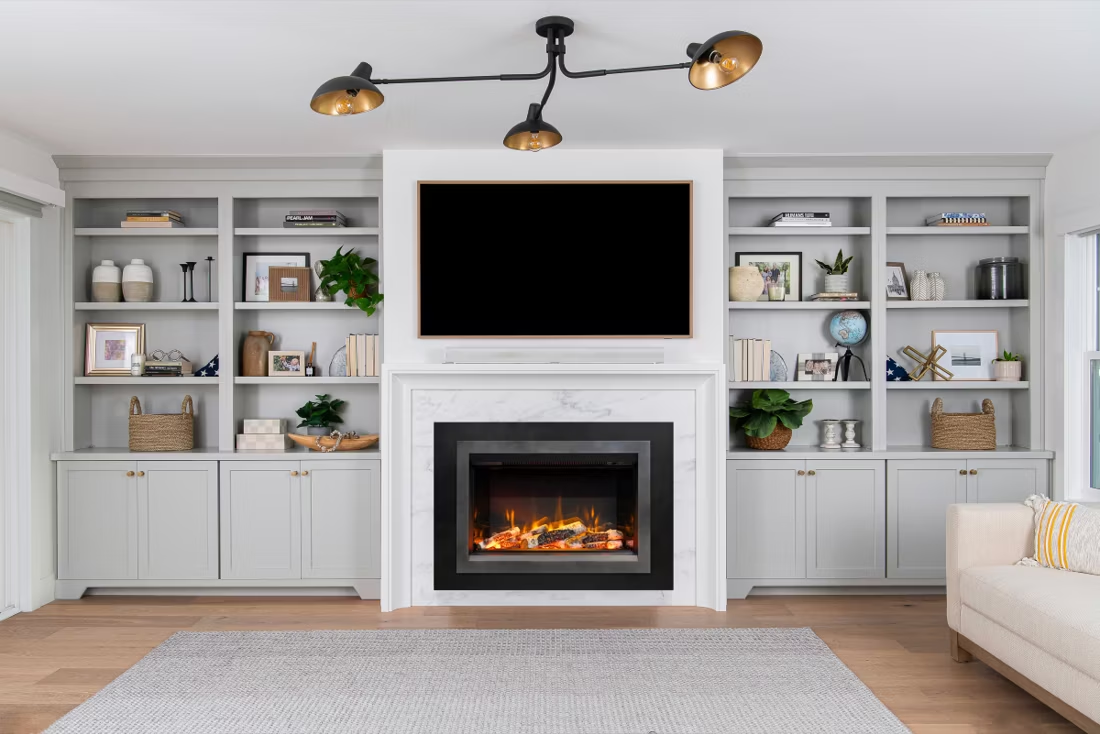
Yes—with an asterisk. Fireplaces are hot and TVs don't like heat. Either put a mantel between them to deflect rising warmth, or choose a fireplace with heat-management technology that creates a cool zone on the wall above—the wall stays around 125 degrees, barely warm, while the room still gets full heat. If you like clean lines and don't want a mantel, heat management is the answer.
Do electric fireplaces actually produce heat?
Yes—most put out around 4,800–5,000 BTUs from a standard outlet, which comfortably warms a bedroom, office, or den as a comfort-zone heater. What they won't do is carry a whole house the way wood, gas, or pellet can. Think of electric as ambiance-first with honest supplemental heat: flames on with no heat in July, flames plus warmth in January.
Can a fireplace actually lower my heating bill?
Yes—by creating a comfort zone. A furnace heats every square foot of the house just to warm the one room you're in; a gas fireplace on low burns roughly a sixth of the gas a typical furnace does. Set the furnace around 55–60 degrees as a baseline, then heat the rooms your family actually uses. Families who heat this way commonly save $20–$60 a month.
What is an in-home preview and do I need one?
It's a visit where a hearth professional measures your space, confirms the model you picked actually works in your home, and walks the specs—framing, gas line, venting, finish work—before anything is ordered. Some details you just can't know until you see the house. Never make a down payment without one; it's the single most-skipped step that burns buyers.
Nearby Dealers
Hearth shops serving Arvin and the surrounding area. Every listing shows whether it is a WhyFire partner, a dealer we have verified as authorized for the brands we recommend, or a local business carrying hearth products. No manufacturer pays for placement. How we verify dealers →
We’ve paused dealer listings for this connection today. Enter your zip or postal code above to find dealers near you, or come back tomorrow.
Popular Electric Brands
Where each brand came from, what's inside it today, and every current model. No brand pays to be here. Not every dealer carries every brand, so enter your zip code to see what's sold near Arvin.
Fireplace Xtrordinair
Fireplace Xtrordinair, now often called FireplaceX, is the fireplace brand of Travis Industries, Inc., of Mukilteo, Washington.
5 electric models →DaVinci
DaVinci Custom Fireplaces is a brand of Travis Industries, Inc., of Mukilteo, Washington, the company behind Lopi and Fireplace Xtrordinair.
5 electric models →Kozy Heat
Kozy Heat was founded in 1976 by Dudley Hussong in Lakefield, Minnesota, and incorporated as Hussong Manufacturing Co., Inc. in 1978.
3 electric models →Forge & Flame
Forge & Flame is the stove brand Hearth & Home Technologies introduced in August 2023 to bring Vermont Castings, Harman, and Quadra-Fire under one name.
1 electric model →Electric Service in Arvin
An electric fireplace's heater draws about 1,500 watts—pennies per hour at local rates.
Pacific Gas & Electric Co.
Find your electric fireplace in Arvin.
Tell us about your space and we'll help you find a trusted local dealer and send over a free Project Guide & Parts List—sized for your room, your panel, and Arvin's mild winters.
Find Your Fireplace →