
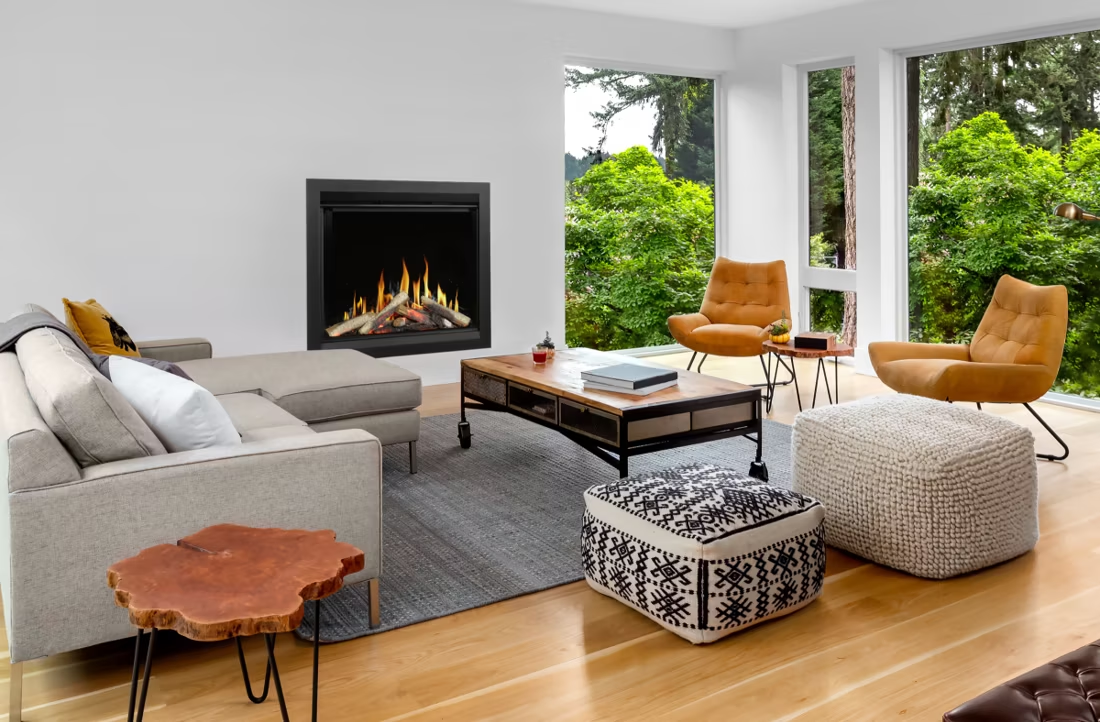
Real fireplace warmth for Conway County—no gas line, no chimney.
With winter lows averaging 29°F and just 3,359 heating degree days, Conway County doesn't need a wood-burning system to feel a real fire. Find the right electric fireplace or insert for your home and get matched with a trusted local dealer.
Every Project Starts From One of These Five Situations
Mild winters, flexible heat—no retrofit required.
Conway County sits in climate zone 3A, with Petit Jean Mountain and the Arkansas River running through a county anchored by Morrilton and stretching out to Plumerville and the smaller communities along Highway 9 and Highway 64. At 3,359 heating degree days and a 29°F average winter low, the heating season here is short and forgiving compared to places like Duluth, MN or Fargo, ND, where furnaces run around the clock for months. Most Conway County homes already have a central heat pump or gas furnace doing the heavy lifting, which is exactly the situation electric fireplaces are built for: supplemental zone heat in the room you actually live in, plus the look of a real fire without adding a flue, a hearth pad, or a wood supply to manage.
Electric service in the county runs through a mix of providers—Petit Jean Electric Cooperative covers much of rural Conway County, with First Electric Cooperative and municipal service filling in around Morrilton and the surrounding towns. Because electric units plug into a standard outlet or a dedicated 120V/240V circuit rather than a gas line or masonry chimney, they're often the fastest and least invasive fireplace project available—a plug-in insert can go into an existing masonry opening in an afternoon, while a built-in wall unit typically needs an electrician to run a dedicated circuit. Either way, a local dealer who knows the county's housing stock—older farmhouses near Petit Jean State Park, newer construction around Morrilton—will size the heater output and venting-free installation correctly the first time.
Three steps. No salesperson until you're ready.
Tell us about your project
Your zip code, your situation, and the fuel you're leaning toward—or let the answers point you to one.
See what's actually available
The brands dealers within 100 miles genuinely carry—real options, never a catalog mirage.
Get your dealer & Project Guide
A trusted local dealer, plus the free Project Guide & Parts List that names every component of the job.
Frequently Asked Questions
How much does an electric fireplace installation cost in Conway County?
A plug-in electric insert that drops into an existing masonry fireplace opening typically runs $500 to $1,500 installed, since no new wiring is usually required. A built-in wall unit or a linear electric fireplace in new construction runs higher—often $1,500 to $3,500—once you factor in a dedicated 240V circuit, framing, and finish work like a surround or mantel. Because Conway County doesn't have the venting or chimney costs that come with wood or gas, electric is consistently the least expensive fireplace category to install here. A local dealer can give you a firm number after seeing your existing fireplace opening or the wall you're planning to build into.
Do I need a permit to install an electric fireplace in Conway County?
A simple plug-in insert that uses an existing standard outlet generally doesn't require a permit—it's treated like any other appliance. If your installation needs a new dedicated circuit or panel work, though, that electrical work typically does require a permit and should be pulled by a licensed electrician, whether the job is inside Morrilton city limits or out in unincorporated Conway County. Most hearth dealers who handle built-in electric installs either employ a licensed electrician or coordinate directly with one, so the permitting gets handled as part of the project rather than left to you.
What's the best electric fireplace for Conway County's climate?
Given the mild winters here—a 29°F average low and just over 3,300 heating degree days—most Conway County homeowners don't need a high-output heater; they need good ambiance and enough supplemental warmth for one room. Mid-range electric inserts and linear units from brands like Dimplex and Napoleon typically put out 4,500 to 5,000 BTU, which comfortably takes the edge off a living room or den on the county's coldest nights without overworking the circuit. If you're using the unit mainly for ambiance in a home that already has strong central heat, you can size down and prioritize flame realism and finish options instead.
Can I convert an existing wood-burning fireplace to electric in Conway County?
Yes, and it's one of the more common projects for older homes around Morrilton and the rest of the county with an existing masonry fireplace that's gone unused or is difficult to keep up with Ozark oak and hickory firewood. An electric insert slides into the existing opening, uses the existing outlet or a new one run behind the surround, and requires no venting, chimney liner, or chimney sweep going forward. It's typically the fastest and least expensive conversion option compared to a gas or pellet retrofit, since there's no fuel line or flue work involved at all.
Will an electric fireplace heat my whole house?
No—electric fireplaces are zone heaters, not whole-home furnaces. A typical unit is rated to comfortably heat a single room in the 300 to 400 square foot range, which fits well with how most Conway County homes already use central heat pumps or gas furnaces for whole-home heating and want a fireplace for the room they spend the most time in. If you're hoping to offset a larger portion of your heating bill across the whole house, wood or a properly sized pellet stove will do more work—an electric fireplace's real strength here is comfort and ambiance in the space where you actually sit.
What's the difference between an electric fireplace, insert, and mantel package?
An electric fireplace insert is built to slide into an existing fireplace opening—the most common retrofit for Conway County's older masonry fireplaces. A built-in electric fireplace is framed directly into a wall, usually in new construction or a remodel, and often paired with a linear, widescreen design. A mantel package pairs a freestanding electric firebox with a surrounding cabinet or mantel shelf, requiring no framing or fireplace opening at all—it's the simplest option for a room that never had a fireplace to begin with. Local dealers carry all three; which one fits depends on whether you're working with an existing opening, a bare wall, or want something that can move with you.
How much does it cost to run an electric fireplace in Conway County?
Most electric fireplaces draw around 1,500 watts on the heater setting, which at typical Petit Jean Electric Cooperative and First Electric Cooperative residential rates works out to roughly 15 to 20 cents per hour of heater use. Running the flame effect alone, without the heater on, uses only a few watts and costs pennies over an evening. Compared to running a whole-house furnace longer to warm one room, most homeowners find the electric fireplace is a cheap way to add comfort to a single space during the county's shorter, milder heating season.
Will my electric fireplace work during a power outage?
No—electric fireplaces need power to run both the flame effect and the heater, so they'll go dark along with everything else in a power outage. This is worth weighing if you're in a part of the county prone to storm-related outages, since a wood stove or a battery-backed gas insert will keep working when the grid doesn't. Many Conway County homes end up with electric for daily-use ambiance in the main living space and a wood-burning fireplace or stove elsewhere in the house as backup heat for winter storms.
Electric vs. gas vs. wood—which is right for my Conway County home?
Wood is still a strong option here given the abundance of oak, hickory, and pine across the Ozark-St. Francis and Ouachita National Forests, with cutting permits running $10 to $20 per cord through the May-to-October season—a real cost advantage if you're willing to cut and haul your own firewood. Gas offers instant, consistent heat but depends on natural gas or propane availability, which varies across the county's rural areas. Electric is the simplest and least expensive to install, works well as supplemental zone heat given the county's mild 3,359-degree-day winters, and requires no fuel storage or venting—but it won't run without power and isn't meant to replace your primary heat source. Many homeowners here land on electric for the main living room and keep wood or propane as a backup option for harder winters.
Can I put a TV above my fireplace?
Yes—with an asterisk. Fireplaces are hot and TVs don't like heat. Either put a mantel between them to deflect rising warmth, or choose a fireplace with heat-management technology that creates a cool zone on the wall above—the wall stays around 125 degrees, barely warm, while the room still gets full heat. If you like clean lines and don't want a mantel, heat management is the answer.
Does an electric fireplace need a vent or chimney?
No—that's its superpower. An electric fireplace needs a wall and an outlet, period. No vent pipe, no gas line, no clearances to design around, which is why it works in bedrooms, offices, apartments, and walls where venting a gas or wood unit would be impractical or impossible. Installation is typically the simplest and least expensive of any fireplace type.
Can a fireplace actually lower my heating bill?
Yes—by creating a comfort zone. A furnace heats every square foot of the house just to warm the one room you're in; a gas fireplace on low burns roughly a sixth of the gas a typical furnace does. Set the furnace around 55–60 degrees as a baseline, then heat the rooms your family actually uses. Families who heat this way commonly save $20–$60 a month.
How much should I budget for a fireplace?
For an average home—covering the fireplace, the vent pipe, and basic installation—a budget between $3,900 and $5,500 gives you a lot of options across wood, gas, and pellet. By the time you add finish work, gas line, and electrical, the average complete installation lands between $5,000 and $12,000 all-in. In a remodel or new build, a good rule is to put about 2.5% of the total project cost toward the fireplace.
Find your electric fireplace in Conway County.
Tell us a bit about your home and we'll match you with the right electric fireplace, insert, or mantel package—plus a free Project Guide & Parts List and a trusted local Conway County dealer to install it.
Find Your Fireplace →