
Zone heat and instant ambiance for a town where winters hit -19.7°C.
Viking sits in the aspen parkland of Central Alberta, where long prairie winters push most homes onto a gas furnace for primary heat. An electric fireplace won't replace that furnace, but it adds no-venting warmth to a family room or basement in an afternoon. We'll help you find a trusted local dealer and a free plan for the room you actually want warmer.
Every Project Starts From One of These Five Situations
A supplemental heat source, not a substitute for the furnace.
With winter lows averaging -19.7°C and a heating season that stretches well past five months, Viking's climate sits in the same cold league as Saskatoon or Regina. Most homes here run a natural gas furnace through ATCO Gas or Apex Utilities as the backbone of their heating, which is exactly why electric fireplaces make sense as a second layer rather than a primary system. They're standard equipment in this market, but they're bought for a specific job: warming up a bedroom, a basement rec room, or a sunroom addition without opening a wall for gas line or running new venting through a roof already built for a -20°C climate.
The appeal for a town of just over a thousand people is practical as much as aesthetic. Many Viking homes are older builds without a spare masonry chimney, and adding a wood or gas appliance from scratch runs $6,000 to $15,000 once venting and gas line work are factored in. A plug-in or hardwired electric unit typically installs for $500 to $1,600 CAD, no permit wrangling with the municipal building department in most cases, and no WETT inspection to satisfy for insurance since there's no combustion involved. The one thing electric can't do is help during a power outage—a real consideration on the prairies, where ENMAX, EPCOR, and ATCO Electric all see winter storm outages from time to time. Homes that want heat regardless of grid status usually keep a wood stove burning local aspen poplar or lodgepole pine as backup alongside the electric unit for ambiance.
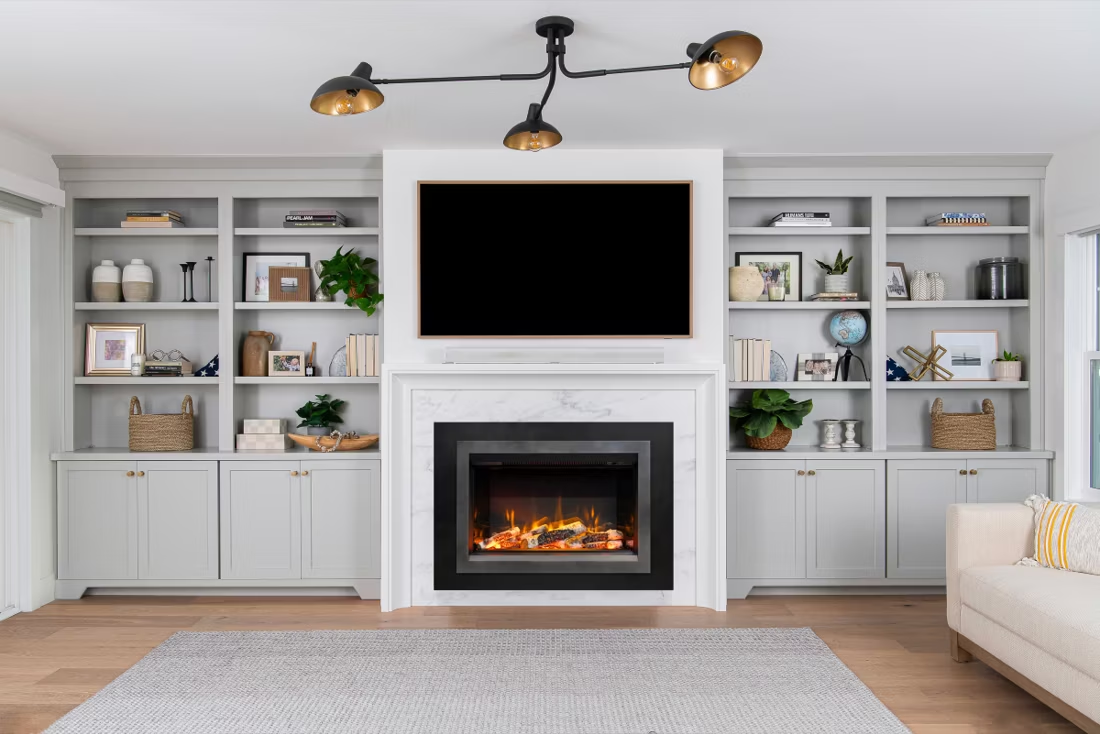
Three steps. No salesperson until you're ready.
Tell us about your project
Your postal code, your situation, and the fuel you're leaning toward—or let the answers point you to one.
See what's actually available
The brands dealers within 100 miles genuinely carry—real options, never a catalog mirage.
Get your dealer & Project Guide
A trusted local dealer, plus the free Project Guide & Parts List that names every component of the job.
Frequently Asked Questions
How much does an electric fireplace installation cost in Viking?
Most jobs run $500 to $1,600 CAD. A plug-in insert or wall-mount unit that uses an existing outlet sits at the low end and can often go in within a day. Costs move up when a unit needs a dedicated 240-volt circuit, which is common for larger built-in units meant to heat more than one room—that means an electrician pulling new wire from your panel, which your local dealer typically coordinates as part of the quote.
Will an electric fireplace actually heat a room in Viking's winters?
It will warm the room it's in, but it's not built to carry a whole house through a -19.7°C night the way a furnace does. Electric fireplaces are resistance heaters, and most models top out around 5,000 BTU of supplemental output—fine for a bedroom, den, or finished basement, but not a replacement for the ATCO Gas or Apex Utilities furnace already doing the heavy lifting in most Viking homes. Think of it as taking the chill off a specific room rather than heating the house.
Do I need a permit for an electric fireplace in Viking?
A simple plug-in unit generally doesn't require anything beyond an outlet, so most homeowners skip the permit process entirely. If you're adding a built-in unit that needs new wiring or a dedicated circuit, that electrical work typically needs a permit through the municipal building department, and it should be pulled by a licensed electrician regardless of the unit's size. Unlike wood appliances, electric units aren't subject to CSA B365 or WETT inspection requirements, which simplifies both the install and your insurance conversation.
What happens to my electric fireplace during a power outage?
It stops working, full stop—no battery backup, no pilot light, nothing to fall back on. That matters in a rural Central Alberta town where winter storms occasionally take down ENMAX, EPCOR, or ATCO Electric service for hours at a time. If outage resilience matters to your household, a lot of Viking homeowners pair an electric fireplace for everyday ambiance with a wood stove burning aspen poplar, paper birch, or lodgepole pine as a genuine backup heat source that doesn't care whether the grid is up.
Electric vs. gas fireplace—which makes more sense for a Viking home?
With ATCO Gas already serving Viking, gas is the more common choice for a primary or near-primary heat source, and a gas fireplace or insert typically runs $6,000 to $15,000 installed with venting and a gas line tie-in. Electric is a fraction of that cost at $500 to $1,600 and installs without touching your gas system, but it's built for supplemental warmth and mood lighting in one room rather than carrying real heating load. Plenty of homeowners here run both—gas or a furnace for the house, electric for the spare bedroom or basement.
Where does an electric fireplace fit best in an older Viking house?
Viking has a lot of smaller, older housing stock without a spare chimney chase, and that's exactly where electric units shine—they don't need venting of any kind, so a wall-mount or built-in model can go into a basement rec room, an addition, or a bedroom without opening up the exterior wall. That's a real advantage over a wood or gas retrofit, which in an older home without existing venting can push toward the top of the $6,000-plus install range once a chimney or vent run has to be built from scratch.
What will an electric fireplace cost me to run month to month?
At the local residential rate of roughly $0.13 per kWh through ENMAX, EPCOR, or ATCO Electric, a typical 1,500-watt electric fireplace running four hours an evening costs somewhere around $8 to $10 CAD a month in electricity—cheap compared to running a wood stove's cutting and hauling labour, though obviously not a substitute for the gas furnace handling the bulk of your heating load through a Central Alberta winter.
Do I need a WETT inspection for an electric fireplace for insurance purposes?
No. WETT inspections and CSA B365 installation code apply to wood-burning appliances, not electric units, since there's no combustion, chimney, or creosote risk to assess. That makes electric fireplaces one of the simplest appliances to add to a Viking home from an insurance standpoint—most providers just want confirmation the electrical work was done to code, which a licensed electrician's permit and inspection through the municipal building department already covers.
Electric fireplace vs. pellet stove—which is the better fit?
They serve different purposes. Pellet stoves using regional fuel from La Crete Sawmills or Vanderwell, at $400-$575 a tonne, put out real heat and can function as a primary or near-primary source, but the install runs $6,000 to $10,000 and the stove needs both venting and electricity to run its auger and blower. An electric fireplace costs a tenth of that to install, needs no venting, and works anywhere you have an outlet or circuit—but it's ambiance and zone heat, not a serious heating appliance. If you want a genuine wood-alternative heat source for the house, pellet is the closer match; if you want a low-cost way to warm one room, electric wins.
How much does an electric fireplace cost to run?
With the heater on, a typical unit draws about 1,500 watts—at average electric rates that's roughly 20 cents an hour. Run the flame effect alone and it costs pennies; the flames are LED-driven and use about as much power as a light bulb. There's no pilot light, no fuel delivery, and essentially no maintenance.
What fireplace styles should I know before shopping?
Four cover most of the market: screen-front traditional (mesh front, open feel, fits craftsman homes), traditional door set (the classic look you grew up with), modern linear (wide, low, the statement piece for entertaining), and clean face contemporary (no trim—your tile or stone runs right to the fire's edge). Walk in knowing those four terms and you're ahead of most buyers.
Do electric fireplaces actually produce heat?
Yes—most put out around 4,800–5,000 BTUs from a standard outlet, which comfortably warms a bedroom, office, or den as a comfort-zone heater. What they won't do is carry a whole house the way wood, gas, or pellet can. Think of electric as ambiance-first with honest supplemental heat: flames on with no heat in July, flames plus warmth in January.
Does an electric fireplace need a vent or chimney?
No—that's its superpower. An electric fireplace needs a wall and an outlet, period. No vent pipe, no gas line, no clearances to design around, which is why it works in bedrooms, offices, apartments, and walls where venting a gas or wood unit would be impractical or impossible. Installation is typically the simplest and least expensive of any fireplace type.
Nearby Dealers
Hearth shops serving Viking and the surrounding area. Every listing shows whether it is a WhyFire partner, a dealer we have verified as authorized for the brands we recommend, or a local business carrying hearth products. No manufacturer pays for placement. How we verify dealers →
Battle River Landscape
Spark Heating & Air Conditioning
Gemco Fireplaces & Wholesale Heating Products
Bob Jack’s Sheet Metal
Dal-Zan Plumbing Ltd
National Energy Equipment Inc.
Hayduk Lumbert Hardware Ltd
Electric Service in Viking
An electric fireplace's heater draws about 1,500 watts—pennies per hour at local rates.
Enmax
Epcor
Atco Electric
Get your free Project Guide & Parts List for a Viking electric fireplace.
Tell us about the room you want to warm and your home's electrical setup, and we'll help you find a trusted local dealer and send a free Project Guide & Parts List—sized right for the room, with the circuit and parts specified.
Find Your Fireplace →