
Electric heat that's honest about the edge of the Arctic Ocean.
No chimney, no fuel storage, no venting to fight through permafrost—just what electric heat can realistically do at 70° north, and what it can't.
Every Project Starts From One of These Five Situations
A supplemental role, not a whole-home solution.
Prudhoe Bay sits on the Beaufort Sea coast at 70.3° north, on flat tundra just 32 feet above sea level, in what building codes classify as Climate Zone 8—the coldest zone in the country. Winter lows average -22°F, and the area's winter heating need is nearly double that of even brutal Lower 48 benchmarks like International Falls, Minnesota, which already logs one of the coldest, longest heating seasons in the contiguous states. Most of the population here lives in modular camp housing and dorms tied to oil field operations rather than conventional single-family homes, and the surrounding land is treeless tundra—there's no local birch, spruce, or cottonwood to cut, unlike the forested interior hundreds of miles south past the Brooks Range.
Power on the North Slope comes from isolated microgrids—TDX North Slope Generating Co., North Slope Borough Power & Light, and Barrow Utilities & Electric Cooperative each serve their own pocket of the region, generating locally from diesel or associated natural gas rather than drawing off a larger interconnected grid. Prudhoe Bay itself doesn't have a published residential rate because it's overwhelmingly industrial camp infrastructure rather than an open residential market, but rural North Slope electric rates typically run well above the national average before Alaska's Power Cost Equalization program reduces the effective cost for qualifying residential customers. Given how long and severe the heating season is here, combined with generation costs like that, resistance electric heat isn't the primary heat source here—fuel oil and propane-fired systems carry that load. What electric fireplaces do well is add zone warmth and visual comfort in a dorm common room, break room, or the small number of family residences in Deadhorse and Prudhoe Bay housing, without adding a chimney, fuel tank, or wood supply chain to a place where every material already travels a long logistics chain to get here.
Three steps. No salesperson until you're ready.
Tell us about your project
Your zip code, your situation, and the fuel you're leaning toward—or let the answers point you to one.
See what's actually available
The brands dealers within 100 miles genuinely carry—real options, never a catalog mirage.
Get your dealer & Project Guide
A trusted local dealer, plus the free Project Guide & Parts List that names every component of the job.
Frequently Asked Questions
How much does it cost to install an electric fireplace in Prudhoe Bay?
A plug-in electric insert or wall-mount unit typically runs $200 to $600 for the unit itself, since it uses a standard outlet and needs no chimney or gas line. A built-in electric fireplace with a dedicated 240V circuit and a custom surround runs closer to $1,500 to $3,000. What changes the math in Prudhoe Bay is logistics, not labor: freight to Deadhorse via air cargo or the Dalton Highway ice road adds real cost and lead time to any built-in unit, so installers here typically bundle mobilization and shipping into the quote rather than pricing labor alone.
Is electric heat practical as a primary heat source in Prudhoe Bay?
No, and it's worth being straightforward about that. With one of the longest, coldest heating seasons of any inhabited place in North America, Prudhoe Bay carries one of the most extreme heating loads of any inhabited place in North America, and running resistance electric heat as a whole-home solution on an isolated diesel- or gas-fired microgrid would be cost-prohibitive for most households. Nearly every permanent structure on the North Slope relies on fuel oil or propane-fired boilers and furnaces, or waste-heat recovery from on-site generators, for primary heat. Electric fireplaces and stoves here work as supplemental zone heat or ambiance, not as the system carrying the house through an Arctic winter.
What kind of electric fireplace actually makes sense here?
Recessed or insert-style electric units with a realistic flame effect are popular for morale during the months of 24-hour winter darkness, sized as supplemental heat for a bedroom or common area rather than a whole floor—think 5,000 to 9,000 BTU output, not a furnace replacement. Because local structures run heat nearly year-round given how long and cold the season is here, look for units rated for continuous duty rather than occasional-use models built for a handful of chilly evenings a year.
Do I need a permit for an electric fireplace in Prudhoe Bay?
A standard plug-in unit on a 120V outlet generally doesn't trigger a permit. A built-in unit that needs a dedicated 240V circuit does require a licensed electrician and sign-off through North Slope Borough, since that's the governing jurisdiction here. Because electricians and inspectors often have to travel in from Utqiaġvik or Fairbanks to reach Deadhorse, it pays to schedule that work well ahead of your install date rather than assuming same-week availability.
Who actually installs or services electric fireplaces in a place like this?
Prudhoe Bay functions more like a company town tied to oil field operations than a typical retail market, so there isn't a hearth showroom on Main Street. Licensed electricians who work North Slope Borough jobs typically rotate between Utqiaġvik and the Deadhorse/Prudhoe Bay camps, and property managers overseeing camp housing usually coordinate the install, sourcing the unit itself via air cargo or, during the summer sealift season, by barge or the Dalton Highway.
What will an electric fireplace actually cost to run here?
Prudhoe Bay doesn't have a published residential kWh rate on file, largely because so little of the area is conventional residential housing. But rural North Slope rates served by isolated microgrid utilities like TDX North Slope Generating Co. commonly run well above the national average before Alaska's Power Cost Equalization program brings the effective residential rate down. A 1,500-watt electric fireplace run for ambiance a few hours a night costs noticeably more here than the same unit in the Lower 48—run continuously as supplemental heat through a winter this long and severe, the electric bill adds up fast, which is exactly why it isn't asked to carry the whole heating load.
Electric vs. fuel oil or propane—which makes sense in Prudhoe Bay?
Most homes and camp buildings on the North Slope run on fuel oil or propane, delivered via sealift, ice road, or pipeline-adjacent logistics, because that combustion heat can deliver the steady BTU output a winter this long and severe demands at a cost the isolated electric grid can't match. Electric fireplaces fill a different job: instant ambiance, zone warmth in one room, no fuel tank or venting to maintain. Most residents lean on electricity for lighting and appliances and combustion fuel for actual heat—and an electric fireplace complements that split rather than replacing it.
Can an electric fireplace work as backup heat during an outage?
No—and this is worth knowing before you rely on one. An electric fireplace only works when the local generating utility, whether TDX North Slope Generating Co., North Slope Borough Power & Light, or Barrow Utilities & Electric Cooperative, is actually producing power. On an isolated microgrid, a generation outage takes down everything electric at once, including any electric fireplace. That's why permanent structures here pair backup diesel generation with fuel-oil heat as the actual resilience plan. If outage-proof backup heat matters to your household, a propane or fuel-oil unit is the safer call, not electric.
With a climate this extreme, why install an electric fireplace at all?
Because the appeal here isn't heat output, it's morale and simplicity. Prudhoe Bay sits on treeless tundra with no local birch, spruce, or cottonwood to burn, and winter brings weeks of near-total darkness. An electric fireplace gives a dorm common room, break room, or one of the area's few family residences visual warmth and light without a fuel supply chain, a chimney, or venting to fight through permafrost foundations. It's a small comfort layered on top of the fuel-oil or propane system actually carrying the house through winter, not a replacement for it.
Can I put a TV above my fireplace?
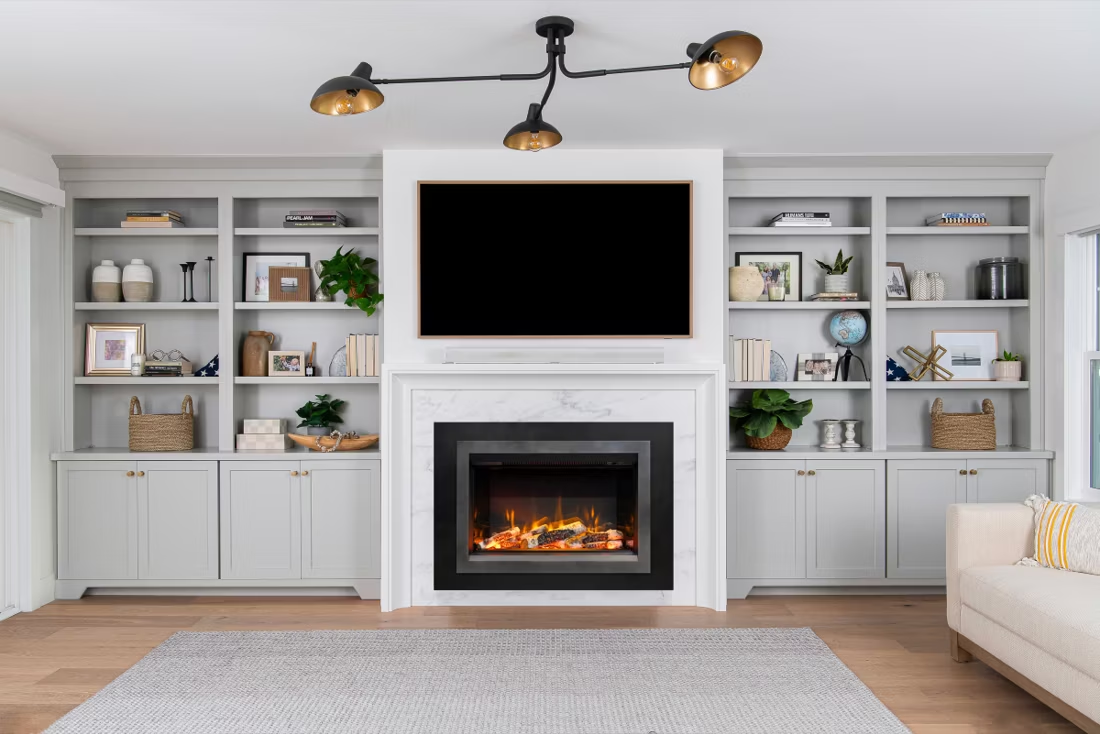
Yes—with an asterisk. Fireplaces are hot and TVs don't like heat. Either put a mantel between them to deflect rising warmth, or choose a fireplace with heat-management technology that creates a cool zone on the wall above—the wall stays around 125 degrees, barely warm, while the room still gets full heat. If you like clean lines and don't want a mantel, heat management is the answer.
Do electric fireplaces actually produce heat?
Yes—most put out around 4,800–5,000 BTUs from a standard outlet, which comfortably warms a bedroom, office, or den as a comfort-zone heater. What they won't do is carry a whole house the way wood, gas, or pellet can. Think of electric as ambiance-first with honest supplemental heat: flames on with no heat in July, flames plus warmth in January.
How much should I budget for a fireplace?
For an average home—covering the fireplace, the vent pipe, and basic installation—a budget between $3,900 and $5,500 gives you a lot of options across wood, gas, and pellet. By the time you add finish work, gas line, and electrical, the average complete installation lands between $5,000 and $12,000 all-in. In a remodel or new build, a good rule is to put about 2.5% of the total project cost toward the fireplace.
Does a fireplace add value to my home?
On average, a fireplace adds back to the home about the same amount you spent installing it. Add the monthly savings from heating the rooms you actually use instead of the whole house—often hundreds of dollars a year—and the value case is strong before you even count what a fire does for how your family uses the room.
Popular Electric Brands
Where each brand came from, what's inside it today, and every current model. No brand pays to be here. Not every dealer carries every brand, so enter your zip code to see what's sold near Prudhoe Bay.
Fireplace Xtrordinair
Fireplace Xtrordinair, now often called FireplaceX, is the fireplace brand of Travis Industries, Inc., of Mukilteo, Washington.
5 electric models →DaVinci
DaVinci Custom Fireplaces is a brand of Travis Industries, Inc., of Mukilteo, Washington, the company behind Lopi and Fireplace Xtrordinair.
5 electric models →Kozy Heat
Kozy Heat was founded in 1976 by Dudley Hussong in Lakefield, Minnesota, and incorporated as Hussong Manufacturing Co., Inc. in 1978.
3 electric models →Forge & Flame
Forge & Flame is the stove brand Hearth & Home Technologies introduced in August 2023 to bring Vermont Castings, Harman, and Quadra-Fire under one name.
1 electric model →Electric Service in Prudhoe Bay
An electric fireplace's heater draws about 1,500 watts—pennies per hour at local rates.
Tdx North Slope Generating Co
Barrow Utils & Elec Coop, Inc
North Slope Borough Power & Light
Find your electric fireplace in Prudhoe Bay.
Tell us about your space and how you plan to use it, and we'll help you find a local installer familiar with North Slope logistics—plus a free Project Guide & Parts List covering the exact unit, circuit requirements, and install plan for your project.
Find Your Fireplace →