
Add Clean, Instant Heat to Your Nikiski Home.
Electric fireplaces bring flip-a-switch warmth and ambiance to Cook Inlet winters—as a smart complement to wood heat, not a replacement for it. Find the right unit and connect with a trusted local dealer.
Every Project Starts From One of These Five Situations
Electric heat plays a supporting role on the Kenai Peninsula.
Nikiski sits in climate zone 7 at the edge of Cook Inlet, and the numbers back up what anyone who's wintered here already knows: a winter heating load in the same league as Fargo ND or International Falls MN puts this stretch of the Kenai Peninsula among the coldest in the country, with average winter lows around 8°F. Wood—mostly birch, spruce, and cottonwood cut under free Chugach National Forest permits from May through September—remains the backbone of home heating for a lot of Nikiski households, often paired with an oil or propane furnace for whole-house coverage.
Two regional providers serve the area: Homer Electric Association at roughly 29.8 cents per kWh and Chugach Electric Association at roughly 21.2 cents per kWh—both well above the national average, which makes electric resistance heat an expensive way to warm an entire house here. That's exactly why electric fireplaces earn their keep as something else: instant, no-mess ambiance in a living room or primary bedroom, supplemental zone heat on shoulder-season evenings when firing up the wood stove feels like overkill, and a low-maintenance option for rentals, additions, or cabins where running a chimney isn't practical.
Three steps. No salesperson until you're ready.
Tell us about your project
Your zip code, your situation, and the fuel you're leaning toward—or let the answers point you to one.
See what's actually available
The brands dealers within 100 miles genuinely carry—real options, never a catalog mirage.
Get your dealer & Project Guide
A trusted local dealer, plus the free Project Guide & Parts List that names every component of the job.
Frequently Asked Questions
How much does an electric fireplace installation cost in Nikiski?
Plug-in electric fireplace inserts and mantel units are the least expensive option, typically $200 to $600 installed, since they run on a standard household outlet and need no electrician or venting. Built-in electric fireplaces or larger wall units that require a dedicated circuit generally run $800 to $2,500 once you factor in a licensed electrician to run new wiring—a real consideration in Nikiski, where Homer Electric Association's rates run close to 30 cents per kWh, so it's worth asking your dealer about the unit's actual wattage draw before you commit to a larger model.
Can an electric fireplace heat my whole Nikiski home?
Not realistically. With a winter heating load among the heaviest in the country and winter lows around 8°F, Nikiski's heating needs are extreme, and most electric fireplaces are rated for zone heating—a single room, not a whole house. Given local electric rates of roughly 21 to 30 cents per kWh depending on whether you're served by Chugach Electric or Homer Electric, running resistance heat as a primary source would also be costly. Most Nikiski homeowners use an electric fireplace to take the edge off a specific room while wood, oil, or propane handles the rest of the house.
Which electric utility serves Nikiski, and does it affect my fireplace choice?
Homer Electric Association serves most of the Kenai Peninsula including Nikiski, with Chugach Electric Association covering parts of the broader Southcentral grid. Rates run about 29.8 cents per kWh for HEA and 21.2 cents for Chugach—both noticeably higher than the national average. That price gap doesn't change what fireplace fits your room, but it's worth having your local dealer walk through the wattage and estimated hours-of-use for any model you're considering, since a 1,500-watt unit run for hours each evening adds up faster here than in lower-cost-of-power regions.
Should I get an electric fireplace or a wood stove in Nikiski?
Wood remains the traditional workhorse here—birch, spruce, and cottonwood are all locally abundant, cutting permits through Chugach National Forest are free from May to September, and a wood stove keeps working through a power outage, which matters when winter storms off Cook Inlet knock out lines. Electric fireplaces can't run without grid power and cost more per hour of heat given local kWh rates, but they require no chimney, no ash cleanup, and no wood stacking—a real advantage for a den, bedroom, or rental unit where convenience and clean operation matter more than raw heat output. Many Nikiski households end up with both: wood for primary heat and resilience, electric for ambiance in a secondary room.
Will my electric fireplace work during a power outage?
No—electric fireplaces need grid power or a generator to run, so they go dark exactly when winter storm outages hit the Kenai Peninsula hardest. If backup heat during an outage is a priority for your household, a wood stove or a propane unit with a standing pilot is the more dependable choice for that role. An electric fireplace is best thought of as a daily-use comfort feature rather than emergency heat in Nikiski's climate.
What's the difference between an electric insert, a wall-mount unit, and a freestanding electric fireplace?
An electric insert drops into an existing fireplace opening—masonry or zero-clearance—and is a popular way to convert an old wood-burning fireplace you no longer want to maintain into something that runs at the flip of a switch. A wall-mount unit hangs like a flat-screen TV and works well in a room without any existing fireplace. A freestanding electric stove or mantel unit sits on the floor and can be relocated, which suits renters or anyone not ready to commit to a built-in. All three plug in or hardwire depending on wattage, and a local dealer can tell you which fits your specific opening or wall.
Do I need a permit to install an electric fireplace in Nikiski?
A simple plug-in electric fireplace generally doesn't require a permit. If your unit needs a new dedicated circuit or any electrical panel work, that wiring falls under the Kenai Peninsula Borough's electrical permitting requirements and should be pulled by a licensed electrician. There's no chimney or venting inspection involved the way there is with wood or gas—one of the appeals of going electric in the first place.
What's the best use case for an electric fireplace in a Nikiski home?
Given the local kWh rates and the sheer heating load this climate demands, electric fireplaces perform best here as a supplemental or ambiance feature—think a primary bedroom, a home office, a converted garage den, or a rental unit where you want visual warmth and a bit of heat without running a chimney. They're also a practical fit for camps or seasonal cabins near Cook Inlet where a full wood-burning setup isn't worth the investment for occasional use.
Electric vs. pellet stove—which makes more sense in Nikiski?
A pellet stove burning bags from regional suppliers like Superior Pellet Fuels or Lignetics can put out real heat for a room or two and, unlike an electric fireplace, doesn't rely on Homer Electric or Chugach Electric's per-kWh rates to run—though it still needs a small amount of power for the auger and blower. An electric fireplace wins on simplicity: no venting, no pellet storage, no hopper to load, just a switch. If you want genuine supplemental heat output for the price, pellet usually wins in this climate; if you want zero-maintenance ambiance with occasional warmth, electric is the easier day-to-day choice.
Can I put a TV above my fireplace?
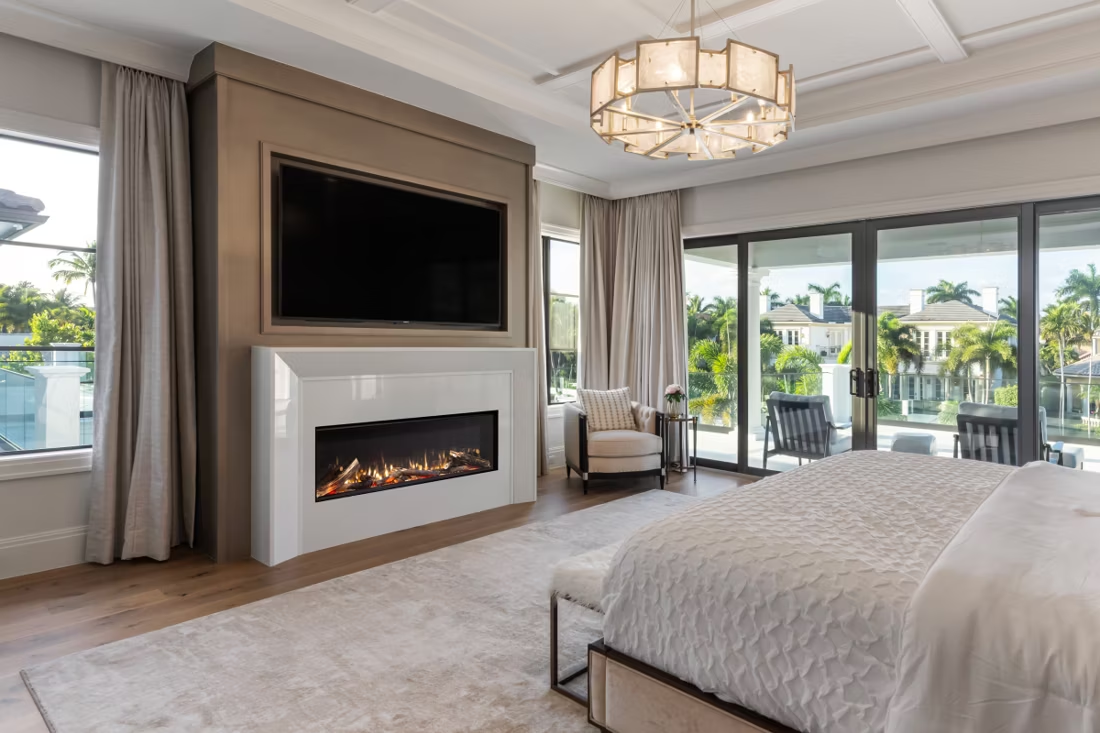
Yes—with an asterisk. Fireplaces are hot and TVs don't like heat. Either put a mantel between them to deflect rising warmth, or choose a fireplace with heat-management technology that creates a cool zone on the wall above—the wall stays around 125 degrees, barely warm, while the room still gets full heat. If you like clean lines and don't want a mantel, heat management is the answer.
Do electric fireplaces actually produce heat?
Yes—most put out around 4,800–5,000 BTUs from a standard outlet, which comfortably warms a bedroom, office, or den as a comfort-zone heater. What they won't do is carry a whole house the way wood, gas, or pellet can. Think of electric as ambiance-first with honest supplemental heat: flames on with no heat in July, flames plus warmth in January.
Can a fireplace actually lower my heating bill?
Yes—by creating a comfort zone. A furnace heats every square foot of the house just to warm the one room you're in; a gas fireplace on low burns roughly a sixth of the gas a typical furnace does. Set the furnace around 55–60 degrees as a baseline, then heat the rooms your family actually uses. Families who heat this way commonly save $20–$60 a month.
How much should I budget for a fireplace?
For an average home—covering the fireplace, the vent pipe, and basic installation—a budget between $3,900 and $5,500 gives you a lot of options across wood, gas, and pellet. By the time you add finish work, gas line, and electrical, the average complete installation lands between $5,000 and $12,000 all-in. In a remodel or new build, a good rule is to put about 2.5% of the total project cost toward the fireplace.
Nearby Dealers
Hearth shops serving Nikiski and the surrounding area. Every listing shows whether it is a WhyFire partner, a dealer we have verified as authorized for the brands we recommend, or a local business carrying hearth products. No manufacturer pays for placement. How we verify dealers →
Electric Service in Nikiski
An electric fireplace's heater draws about 1,500 watts—pennies per hour at local rates.
Homer Electric Assn Inc
Chugach Electric Assn Inc
Find your electric fireplace in Nikiski.
Tell us about your room and how you plan to use it, and we'll match you with a trusted local Nikiski dealer and send over a free Project Guide & Parts List—the exact parts and install plan for your space, no big-box guesswork.
Find Your Fireplace →