
Steady heat for Wyoming's wind-scoured high plains.
At 6,702 feet with 7,958 heating degree days and near-constant wind off the Great Divide Basin, Rawlins homes need heat that starts instantly and doesn't rely on a woodpile in a whiteout. I'll match you with a trusted local dealer who knows the altitude derating and the venting a Carbon County winter demands.
Every Project Starts From One of These Five Situations
Convenience that holds up against the wind.
Rawlins sits along the I-80 corridor at nearly 6,700 feet, and its heating degree day count—almost 8,000 a year—puts it in the same company as Fargo or Bismarck rather than a typical Rocky Mountain town. Winter lows average 15°F, but the wind that gives this stretch of Wyoming its reputation drives the effective cold much lower on a routine basis. Plenty of longtime residents still burn lodgepole pine, aspen, or ponderosa pine in a wood stove, but a growing number of homeowners—especially in newer construction and homes near downtown that want heat without tending a fire during a ground blizzard—are choosing gas as their primary or supplemental source.
Whether a given address runs on piped natural gas or propane varies block by block in a town this size, so most Rawlins installs end up on one or the other depending on what's already run to the house; a local dealer will confirm which applies to yours before quoting parts. Elevation matters more here than in most places we work—gas appliances need a high-altitude orifice kit above roughly 4,500 to 5,000 feet to burn correctly, and at 6,702 feet, skipping that step means an undersized, sooty flame no matter how good the fireplace is. Combine that with PacifiCorp's residential electric rate of about 12.5 cents per kWh and the real chance of a wind-related power blip, and a sealed direct-vent gas unit with battery-backed ignition covers both the everyday convenience case and the emergency-heat case at once.
Three steps. No salesperson until you're ready.
Tell us about your project
Your zip code, your situation, and the fuel you're leaning toward—or let the answers point you to one.
See what's actually available
The brands dealers within 100 miles genuinely carry—real options, never a catalog mirage.
Get your dealer & Project Guide
A trusted local dealer, plus the free Project Guide & Parts List that names every component of the job.
Frequently Asked Questions
How much does a gas fireplace installation cost in Rawlins?
Plan on roughly $4,500 to $11,500 depending on the unit and the scope of work. A direct-vent insert dropped into an existing masonry firebox with a gas line already nearby sits at the low end. A new built-in unit for a remodel or addition—with fresh gas line run, wall or roof penetration, and a high-altitude orifice kit for our 6,702-foot elevation—lands toward the top. If your address runs on a propane tank rather than piped gas, factor in tank setup or a line extension on top of that. A local dealer will confirm your fuel source and give you a firm number after seeing the space.
Can I convert my existing wood fireplace to gas?
Yes, and it's a common request in Rawlins' older neighborhoods where homes were originally built around a masonry fireplace meant for lodgepole pine or aspen. A gas insert typically drops into that existing firebox using a stainless liner run through the current chimney, which keeps the visible masonry and swaps out the fuel source. Costs usually run $4,500 to $9,500 depending on whether you're on piped gas or need a propane hookup, and whether new gas line work is required. It's a popular upgrade for homeowners who like the look of their existing hearth but are tired of splitting and hauling wood through a Carbon County winter.
Is Rawlins on natural gas or propane?
It depends on the address. Parts of Rawlins have piped natural gas service, but coverage isn't universal, and a fair number of homes—particularly on the edges of town and out in unincorporated Carbon County—run on propane tanks instead. If your water heater or range already runs on gas, a fireplace addition is usually a simple tie-in. If not, propane with a new or existing tank is the standard fallback, and most gas fireplace models can be configured for either fuel by your installer. Confirming which one applies to your house is the first thing a local dealer will do before recommending equipment.
Will my gas fireplace still work if the power goes out?
Most modern gas fireplaces will, which is worth planning around given how often high wind events knock out power along the I-80 corridor near Rawlins. Units with IPI (intermittent pilot ignition) run on AA battery backup that kicks in automatically the moment the power drops. Valor fireplaces handle it differently—the pilot's thermocouple generates its own small electrical current, so there's no battery to remember at all. If you want a heat source that keeps working through a multi-hour wind-driven outage, ask your dealer which ignition system is on the model you're considering.
What's the difference between a gas fireplace, insert, and stove?
A gas fireplace is a built-in unit framed into a wall during new construction or a remodel. A gas insert fits inside an existing masonry firebox, which is the more common retrofit in Rawlins' older housing stock that started out burning ponderosa pine or lodgepole pine. A gas stove is freestanding on a hearth pad, similar in footprint to a wood stove but running on a gas line or propane instead of cordwood—a good option for a home without any existing chimney or fireplace opening. Most homeowners here with an existing masonry fireplace find the insert the simplest and least invasive upgrade.
Do I need a permit to install a gas fireplace in Rawlins?
Yes. You'll need a building permit through the City of Rawlins or Carbon County, depending on your address, plus a separate gas line permit since any new gas work requires a licensed gas-fitter. Most established hearth dealers coordinate the building permit, the gas line work, and the final inspection as part of the installation, which saves you from juggling two jurisdictions and two trades on your own.
Should I get a vented or vent-free gas fireplace given how windy it gets here?
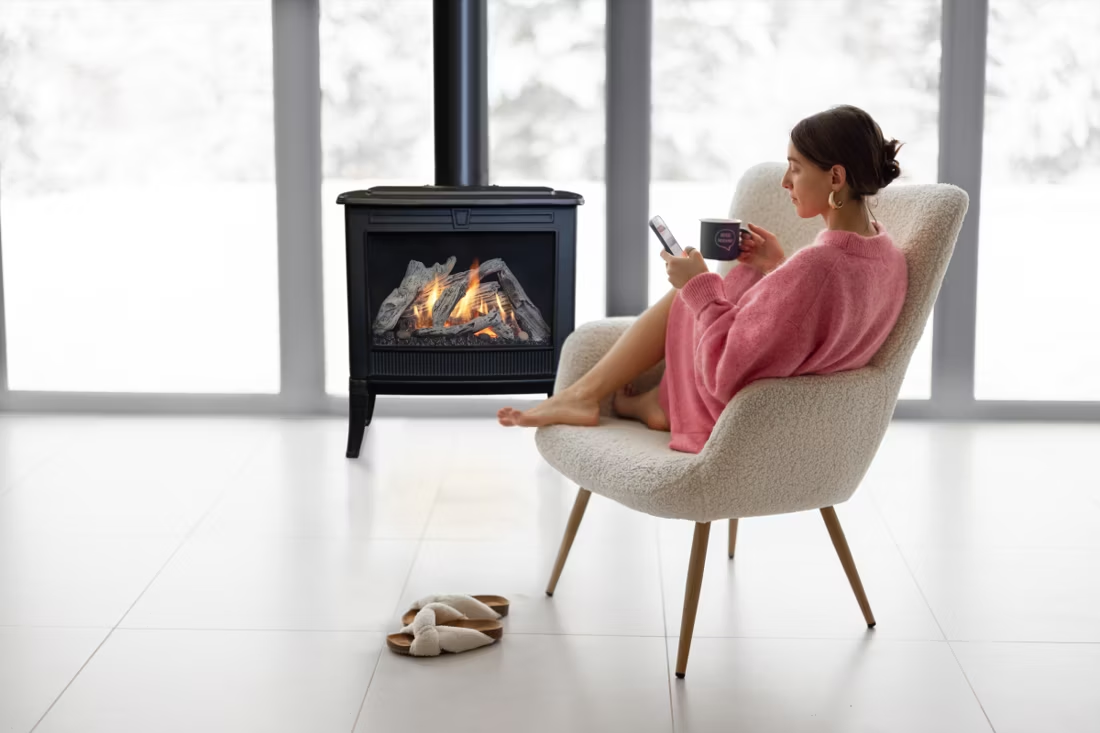
Direct-vent (sealed combustion) units are the right call for Rawlins. They draw combustion air from outside and exhaust directly outside through a sealed pipe, which matters in a town known for sustained high winds that can otherwise cause backdrafting in a poorly sealed system. Vent-free units are legal in Wyoming but burn directly into the room and carry stricter sizing rules; most local dealers steer homeowners toward direct-vent for that reason, and it also means the fireplace adds nothing to indoor air during wildfire smoke season, when you'd rather not introduce more combustion byproducts into the house.
Does elevation affect how my gas fireplace performs in Rawlins?
It does. Gas appliances are calibrated at sea level, and above roughly 4,500 to 5,000 feet they need a high-altitude orifice kit to burn cleanly and hit their rated BTU output. At 6,702 feet, Rawlins is well past that threshold, so any fireplace installed here needs the correct kit—skipping it typically shows up as a weak, lazy flame or soot on the glass. A local dealer familiar with high-elevation installs will spec this automatically; it's one of the details that makes buying through a generic online retailer risky in a town at this altitude.
Gas vs. wood—which makes more sense for a Rawlins home?
Wood—typically lodgepole pine, aspen, or ponderosa pine—still has a following here because it works without electricity, which matters during a wind-driven outage on the high plains. Gas wins on convenience: no hauling, no ash, instant heat on a night when wind chill makes stepping outside to split kindling unappealing, and no added smoke during wildfire smoke advisories. A fair number of Rawlins households run gas in the main living space for daily use and keep a wood stove or insert elsewhere as backup heat for extended outages—the two fuels tend to complement rather than compete here.
Why is a fireplace insert so efficient?
An insert does two things: it seals the chimney completely, so you stop losing air you already paid to heat, and it radiates warmth into the room through the firebox and glass. Most add a heat-exchange fan that pulls cool room air underneath, wraps it around the hot firebox, and pushes it back out warm. Your home is more efficient before you've even lit the first fire.
What's the difference between radiant and convective fireplace heat?
Most fireplaces are a thin metal box—they heat fine, but you rely on the fan to move the warmth into the room. Radiant models use a thick cast-ceramic firebox, about an inch and a quarter thick, that soaks up the fire's heat and radiates roughly 25–30% more warmth into the room with no fan running. If you watch TV in the same room or want heat in a power outage, radiant is worth asking about.
Can a fireplace actually lower my heating bill?
Yes—by creating a comfort zone. A furnace heats every square foot of the house just to warm the one room you're in; a gas fireplace on low burns roughly a sixth of the gas a typical furnace does. Set the furnace around 55–60 degrees as a baseline, then heat the rooms your family actually uses. Families who heat this way commonly save $20–$60 a month.
What is an in-home preview and do I need one?
It's a visit where a hearth professional measures your space, confirms the model you picked actually works in your home, and walks the specs—framing, gas line, venting, finish work—before anything is ordered. Some details you just can't know until you see the house. Never make a down payment without one; it's the single most-skipped step that burns buyers.
Nearby Dealers
Hearth shops serving Rawlins and the surrounding area. Every listing shows whether it is a WhyFire partner, a dealer we have verified as authorized for the brands we recommend, or a local business carrying hearth products. No manufacturer pays for placement. How we verify dealers →
A D Martin Lumber Company Inc
Saratoga Lumber And Supply
Get your free Project Guide & Parts List for a gas fireplace in Rawlins.
Tell me about your home, your fuel source—piped gas or propane—and I'll match you with a trusted local dealer and send a free Project Guide & Parts List with the exact vent kit and high-altitude parts your project needs at 6,702 feet.
Find Your Fireplace →