
Instant Heat for Shorewood's Coldest Lake-Effect Nights.
Shorewood's tight lots and century-old housing stock make gas the practical way to heat a home here—no woodpile, no ash, no clearance headaches. Find the right unit and connect with a trusted local dealer.
Every Project Starts From One of These Five Situations
A dense village built for gas, not woodpiles.
Shorewood is a compact, walkable village of about 13,700 people wedged between Milwaukee and Lake Michigan, with winter lows averaging 14°F and a heating season nearly as long and demanding as Green Bay's—cold enough that lake-effect wind off Michigan cuts through the Tudor and Craftsman-style homes that make up most of the housing stock here. Those homes were built in the 1920s and 1930s with masonry fireplaces, but the village's tight lots and narrow side yards leave almost no room for stacking cordwood, which is a big reason wood heat never really took hold in Shorewood the way it has in more rural parts of Wisconsin.
Natural gas service reaches virtually every block in the village through We Energies, the same utility (Wisconsin Electric Power Co.) that supplies electricity here—so most homes already have a gas line to the furnace or water heater, which makes adding a fireplace or converting an old masonry firebox to gas a relatively straightforward project. The result is a village where gas inserts and direct-vent fireplaces are the default upgrade: instant heat on the coldest lake nights, no wood storage problem to solve, and a fire you can start from a wall switch or remote.
Three steps. No salesperson until you're ready.
Tell us about your project
Your zip code, your situation, and the fuel you're leaning toward—or let the answers point you to one.
See what's actually available
The brands dealers within 100 miles genuinely carry—real options, never a catalog mirage.
Get your dealer & Project Guide
A trusted local dealer, plus the free Project Guide & Parts List that names every component of the job.
Frequently Asked Questions
How much does a gas fireplace installation cost in Shorewood?
Most gas fireplace and insert installations in Shorewood run $4,000 to $10,000. On the lower end are gas inserts dropped into an existing masonry firebox in one of the village's older Tudors or bungalows, where a gas line is already nearby. On the higher end are new direct-vent fireplaces in a remodeled family room or a home without an existing chimney, which requires framing, venting through an exterior wall, and sometimes a new gas line run from the meter. Because so many Shorewood lots are narrow with houses close together, exterior venting placement is something your installer will need to plan around setback and clearance rules.
Can I convert my home's existing wood fireplace to gas?
Yes, and it's one of the most common projects in Shorewood given how many homes still have their original 1920s and '30s masonry fireboxes that rarely, if ever, get used for actual wood fires. A gas insert with a stainless liner run up the existing flue typically costs $4,500 to $8,500 here, with the final number depending on chimney condition and whether the liner needs to be resized for the new unit. It's a popular upgrade because it keeps the original fireplace opening and mantel intact while turning a decorative, rarely-used firebox into a real heat source.
Is natural gas available throughout Shorewood, or do I need propane?
Natural gas is available on essentially every street in the village—Shorewood is small and fully built out, and We Energies runs gas mains throughout. This is one of the advantages of living in a dense inner-ring suburb rather than rural Milwaukee County: propane tanks and deliveries, which are common in outlying areas without gas infrastructure, are almost never necessary here. If your home already has a gas furnace or water heater, adding a fireplace usually just means tapping into the existing line rather than running new service from the street.
Will my gas fireplace still work if the power goes out?
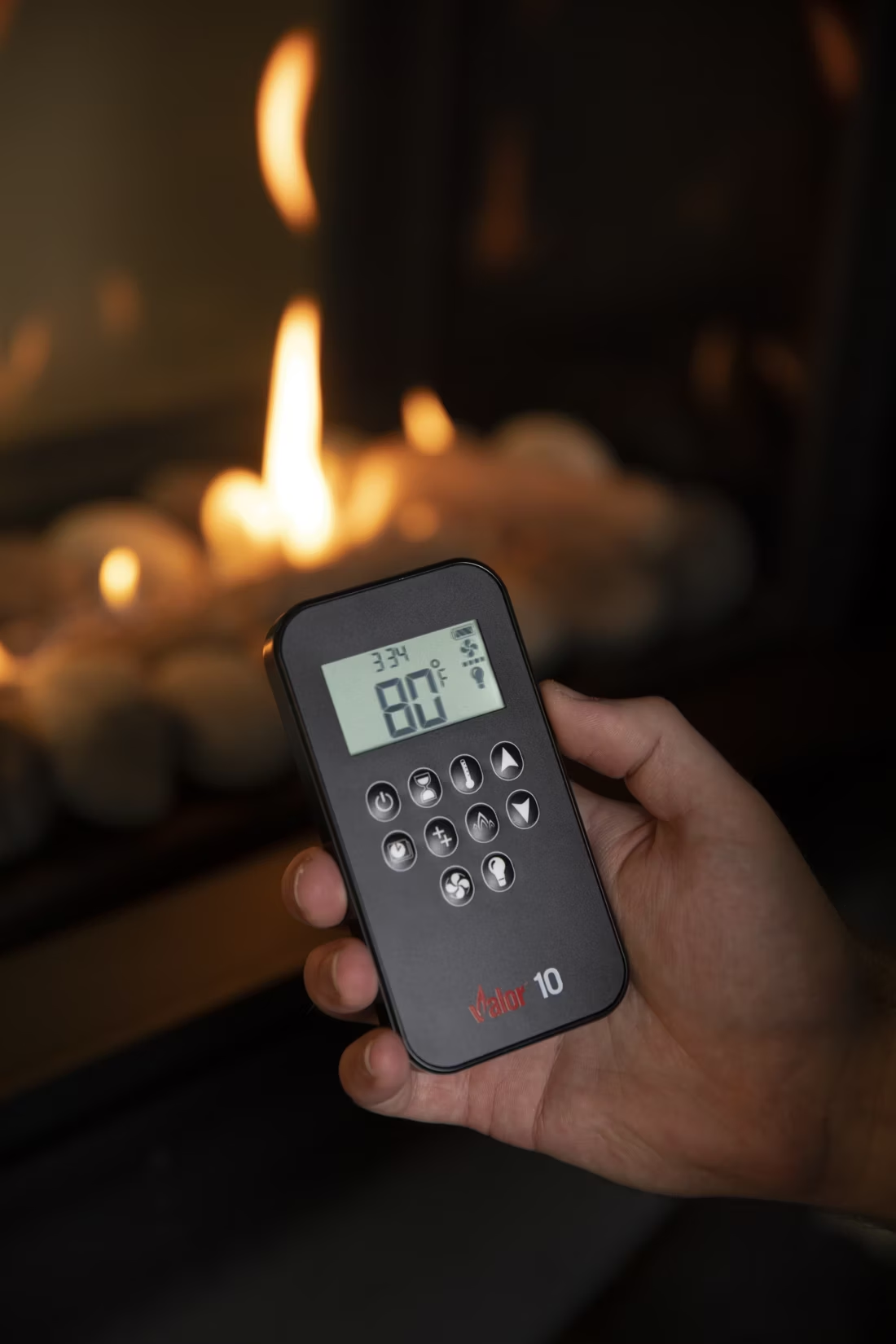
Most modern gas fireplaces with IPI (intermittent pilot ignition) run on a battery backup that kicks in automatically during an outage, so the fireplace still lights on demand even with the electricity off. That matters in Shorewood, where winter storms coming off Lake Michigan can knock out power for hours at a time along the lakefront and in the older, tree-lined parts of the village. Valor fireplaces take a different approach—their pilot generates its own electricity through a thermocouple, so there's no battery to remember to replace. Ask your local dealer which ignition system is in the unit you're considering.
Gas fireplace, insert, or stove—which fits my Shorewood home?
A gas insert is the right call for the many Shorewood homes with an existing masonry fireplace—it slides into that opening and uses the current chimney as a chase for venting. A built-in gas fireplace makes more sense for a room addition or a full remodel where there's no existing firebox to work with. A freestanding gas stove is worth considering in the village's smaller bungalows and Cape Cods, where floor space is tight but a stove can sit in a corner and vent straight out a nearby wall without the framing a built-in unit requires.
Do I need a permit to install a gas fireplace in Shorewood?
Yes. The Village of Shorewood Building Inspection Department requires a permit for gas fireplace installations, and any new or modified gas line needs to be run by a licensed gas fitter and inspected separately. Because Shorewood is a fully incorporated village rather than unincorporated county land, all permitting runs through the village office rather than Milwaukee County. Local hearth dealers who regularly work in Shorewood typically handle the permit application and inspection scheduling as part of the installation.
Should I get a vented or vent-free gas fireplace?
Vented (direct-vent) gas fireplaces draw combustion air from outside and exhaust it back outside through a sealed pipe, making them the safer and more universally recommended option—especially in a climate zone 6A location like Shorewood where homes are closed up tight for months at a time. Vent-free units are legal in Wisconsin with room-sizing and oxygen-sensor requirements, but they release some combustion byproducts into the living space, which is a tougher trade-off in a well-sealed older home with limited natural air exchange. Given the narrow lots and close-set houses typical of Shorewood, direct-vent units that exhaust through a side wall are usually the most practical fit.
How often does a gas fireplace need to be serviced?
An annual inspection is recommended for any gas fireplace or insert, and it's a quick visit compared to wood-stove chimney sweeping—a technician checks the burner, pilot assembly, venting, and gas connections, and cleans the glass. Local gas appliance service providers typically charge $150 to $250 for this visit. Given Shorewood's older housing stock, it's also worth having the technician check that the venting termination still has proper clearance if any exterior remodeling or landscaping has happened near the vent.
Gas vs. electric fireplace—which makes more sense for my Shorewood home?
Gas delivers real heat output—enough to actually warm a room on a 14°F January night—plus the look and sound of a genuine flame, and it can run during a power outage with battery-backup ignition. Electric fireplaces plug into a standard outlet, need no venting or gas line at all, and are the simplest option for a condo or an upper-floor room in one of Shorewood's older duplexes where running gas or venting isn't practical. With We Energies electric rates around 19 cents per kWh, electric units are cheaper to install but more expensive to run as a primary heat source. For a main living room, most Shorewood homeowners choose gas; for a bedroom, den, or rental unit, electric is often the easier fit. Wood-burning units, by contrast, are essentially a non-factor here—village lots simply don't have room for firewood storage.
Can I put a TV above my fireplace?
Yes—with an asterisk. Fireplaces are hot and TVs don't like heat. Either put a mantel between them to deflect rising warmth, or choose a fireplace with heat-management technology that creates a cool zone on the wall above—the wall stays around 125 degrees, barely warm, while the room still gets full heat. If you like clean lines and don't want a mantel, heat management is the answer.
Is my gas fireplace wasting gas?
If it was installed more than 15 years ago, probably. Older gas fireplaces keep a standing pilot light burning all the time, and that little flame can cost a couple hundred dollars a year. Newer models use pilot-on-demand ignition—the pilot lights only when you use the fireplace and goes out when you turn it off.
Can I install a fireplace myself?
If you're putting a fire in your house on purpose, it's best to work with an expert. Unless you're genuinely experienced in framing, gas line, vent pipe, and the national code on clearances to combustibles, have a professional do it—and ideally the same company that sells you the fireplace, so warranty, service, and liability all live under one roof.
Can a fireplace actually lower my heating bill?
Yes—by creating a comfort zone. A furnace heats every square foot of the house just to warm the one room you're in; a gas fireplace on low burns roughly a sixth of the gas a typical furnace does. Set the furnace around 55–60 degrees as a baseline, then heat the rooms your family actually uses. Families who heat this way commonly save $20–$60 a month.
Nearby Dealers
Hearth shops serving Shorewood and the surrounding area. Every listing shows whether it is a WhyFire partner, a dealer we have verified as authorized for the brands we recommend, or a local business carrying hearth products. No manufacturer pays for placement. How we verify dealers →
Chimney Doctors
Stonecraft Studios
David J. Frank Landscape Contracting, Inc.
Bbq Grills Of Wisconsin
The Fire Factory
Find your gas fireplace in Shorewood.
Tell us about your home and your existing fireplace, and we'll put together a free Project Guide & Parts List—the exact parts, including the vent kit, and a trusted local dealer to install it.
Find Your Fireplace →