
Heat That Keeps Up With a North Woods Winter.
Instant, reliable warmth for a town that logs 9,000+ heating degree days a year. Find the right gas fireplace or insert and connect with a trusted local dealer.
Every Project Starts From One of These Five Situations
In Oneida County, heating season isn't a season—it's most of the year.
Rhinelander sits in climate zone 7 at 1,631 feet, with an average winter low of just 2°F and roughly 9,051 heating degree days a year—putting it in the same cold-climate tier as International Falls, Minnesota. This is Hodag country, deep in Wisconsin's North Woods, where the old logging-era homes around town were built with masonry fireplaces long before anyone worried about efficiency. Those original fireboxes are lovely to look at and terrible at actually heating a room through a five-month winter.
Piped natural gas service is limited outside Rhinelander's core, so most gas fireplace installations in Oneida County run on propane rather than utility gas—Wisconsin Public Service Corp serves electric accounts here alongside Northern States Power, but a home-delivered propane tank is the more typical setup for a new hearth appliance. Either fuel gets you the same result: heat at the flip of a switch, no wood to split or haul, and a unit that can be sized to actually carry a room (or a whole floor) through a stretch of sub-zero nights without anyone tending a fire at 2 a.m.
Three steps. No salesperson until you're ready.
Tell us about your project
Your zip code, your situation, and the fuel you're leaning toward—or let the answers point you to one.
See what's actually available
The brands dealers within 100 miles genuinely carry—real options, never a catalog mirage.
Get your dealer & Project Guide
A trusted local dealer, plus the free Project Guide & Parts List that names every component of the job.
Frequently Asked Questions
How much does a gas fireplace installation cost in Rhinelander?
Most gas fireplace and insert installations in the Rhinelander area run $4,000 to $10,500, with the spread driven mainly by propane line work. A direct-vent insert going into an existing masonry fireplace with a propane tank already on the property lands on the lower end. New construction or a fireplace going into a room that's never had gas service—meaning a new propane tank set, a buried line run, and full venting—pushes toward the upper end. Homes near the WPS natural gas footprint closer to downtown sometimes skip the tank altogether, which simplifies both cost and future refills.
Can I convert one of Rhinelander's old masonry fireplaces to gas?
Yes, and it's a common project here given how many homes around Oneida County still have the original brick fireboxes from the logging era. A gas insert with a stainless liner run up your existing chimney is the standard approach, typically running $4,200 to $8,500 depending on the insert and whether propane service already reaches the house. The conversion keeps the mantel and masonry surround you already have while replacing a firebox that was likely losing more heat up the flue than it ever put into the room.
Do I need natural gas, or will propane work for my fireplace?
Propane is the more common choice outside Rhinelander's downtown core, since piped natural gas doesn't reach most of Oneida County's residential areas. If you're inside the Wisconsin Public Service natural gas footprint and already have a gas furnace or water heater, tying in a fireplace is straightforward and usually cheaper since there's no tank to install. Everyone else works with a local propane supplier—either an existing tank or a new above-ground or buried tank set as part of the install. Nearly every gas fireplace model sold by local dealers can be configured for either fuel; it's just a matter of the orifice and regulator your installer sets up.
Will my gas fireplace still work if the power goes out?
For the most part, yes—and that matters here, where ice storms and heavy lake-effect snow can knock out power for a day or more. Units with standing pilot or IPI (intermittent pilot ignition) systems run on battery backup, so the fireplace lights and heats the room even with the grid down; just keep fresh batteries in the unit each fall. Valor fireplaces go a step further—their pilot assembly generates its own electricity through the thermocouple, so there's no battery to remember at all. For a town where a January outage can mean single-digit temperatures inside within hours, that self-powering detail is worth asking your local dealer about.
What's the difference between a gas fireplace, insert, and stove?
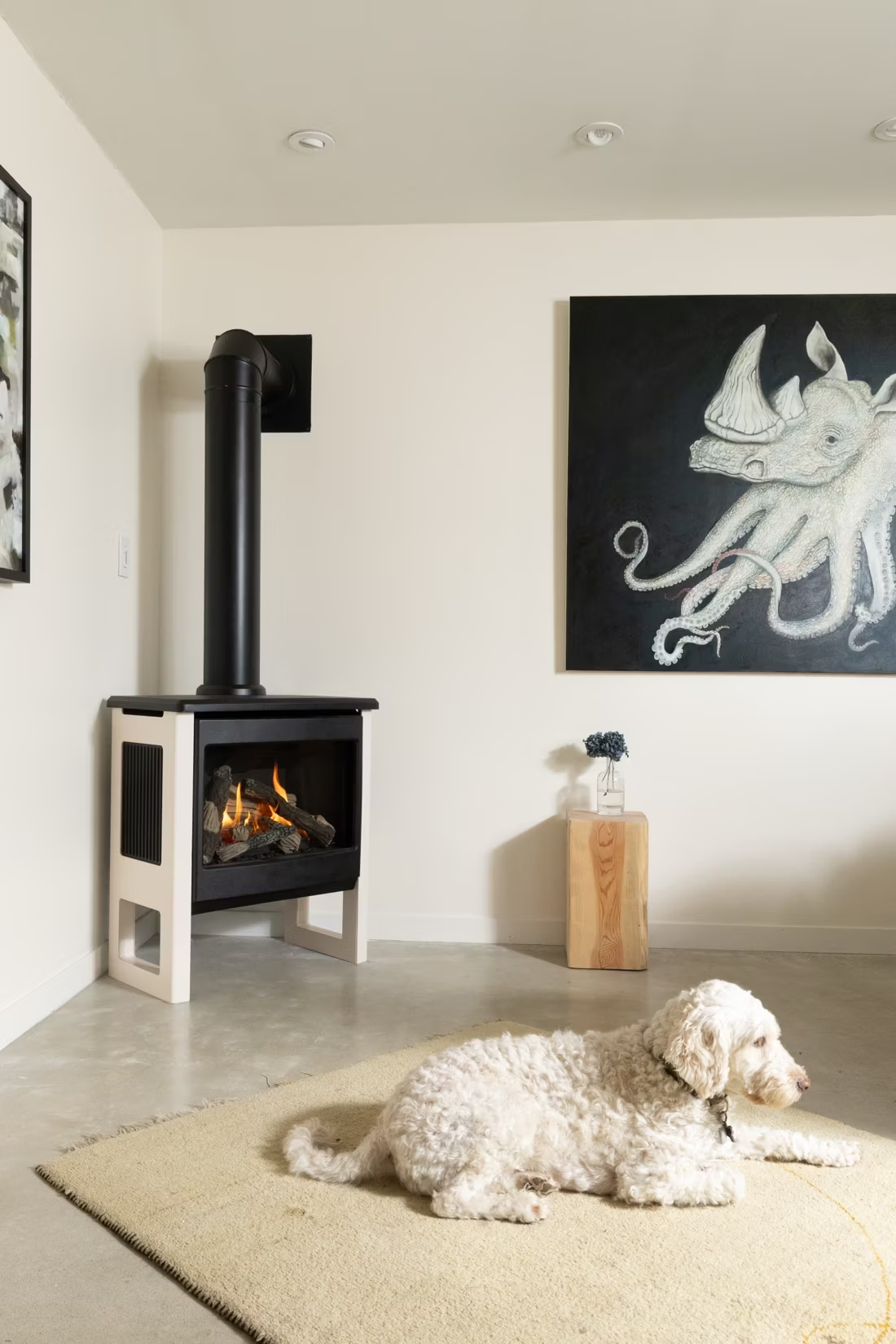
A gas fireplace is a fully built-in unit framed into a wall, typically chosen for new construction or a remodel. A gas insert slides into an existing masonry firebox—the right call for Rhinelander's older homes with an original wood-burning fireplace that needs a heat upgrade. A gas stove is a freestanding cabinet unit that sits on the floor like a wood stove but runs on gas or propane, often a good fit for a cabin or a room without any existing chimney. Most homeowners here with a legacy brick fireplace go the insert route; new builds usually go built-in.
What permits do I need to install a gas fireplace in Rhinelander?
You'll need a building permit through the City of Rhinelander's building inspection department, or through Oneida County if you're outside city limits, plus a gas or propane line permit pulled by a licensed installer. Unlike some parts of the country, this area has no wood-smoke curtailment periods or air-quality non-attainment restrictions to navigate, so gas permitting here is mostly about code compliance on clearances, venting, and the gas connection itself. Local hearth dealers who sell and install regularly handle all of this as part of the job.
Should I get a vented or vent-free gas fireplace for a Wisconsin winter?
Direct-vent units are the clear recommendation for a zone 7 climate like Rhinelander's. They draw combustion air from outside and exhaust it back outside through a sealed pipe, which keeps moisture and combustion byproducts out of a tightly built, well-insulated cold-climate home. Vent-free fireplaces are legal in Wisconsin but release water vapor directly into the room—in a house sealed up tight against 9,000+ heating degree days, that extra humidity can show up as window condensation or worse. Nearly every installer in this area defaults to direct-vent for exactly that reason.
How often does a gas fireplace need to be serviced here?
Plan on an annual inspection, ideally in early fall before the unit sees heavy winter use. A technician checks the burner, pilot assembly, venting, and gas connections, and cleans the glass and interior—usually $150 to $225 locally. Homes running the fireplace as near-daily supplemental heat through a long Oneida County winter should stick to that yearly schedule closely; units that only get occasional use can sometimes stretch it, but a gas line or venting issue is not something you want to discover mid-January.
Rhinelander has plenty of firewood—why do most new fireplaces here run on gas?
It's a fair question in a county surrounded by oak, maple, birch, and aspen, with cheap cutting permits available through the Chequamegon-Nicolet and Ottawa National Forests for $10 to $20 a cord. But at 9,051 heating degree days, a fireplace here often runs from October through April, and most homeowners installing new equipment today would rather not split, stack, and haul wood for six months straight. Gas and propane units light instantly, hold a steady temperature overnight, and don't need daily tending. Plenty of Rhinelander properties still keep a wood stove in a garage, cabin, or shop for backup heat or ambiance, but for a primary living-space fireplace, gas is what most local dealers install today.
Why is my open fireplace making my house colder?
Open fireplaces suck—literally. As the fire burns, it consumes air your furnace already paid to heat and pulls it out through the chimney, so the house is actually colder after the fire goes out than before you lit it. An insert fixes this: it seals the chimney, puts fixed glass across the front, and turns that hole in your house into a real heat source.
What's the difference between an insert and a zero-clearance fireplace?
An insert is a fireplace that slides into a pre-existing wood-burning fireplace—if you don't have one, there's nothing to insert it into. A zero-clearance fireplace is built into a framed wall, which makes it the answer for remodels and new construction. Simple test: existing masonry fireplace means insert; blank or framed wall means zero-clearance.
How much should I budget for a fireplace?
For an average home—covering the fireplace, the vent pipe, and basic installation—a budget between $3,900 and $5,500 gives you a lot of options across wood, gas, and pellet. By the time you add finish work, gas line, and electrical, the average complete installation lands between $5,000 and $12,000 all-in. In a remodel or new build, a good rule is to put about 2.5% of the total project cost toward the fireplace.
Can I install a fireplace myself?
If you're putting a fire in your house on purpose, it's best to work with an expert. Unless you're genuinely experienced in framing, gas line, vent pipe, and the national code on clearances to combustibles, have a professional do it—and ideally the same company that sells you the fireplace, so warranty, service, and liability all live under one roof.
Nearby Dealers
Hearth shops serving Rhinelander and the surrounding area. Every listing shows whether it is a WhyFire partner, a dealer we have verified as authorized for the brands we recommend, or a local business carrying hearth products. No manufacturer pays for placement. How we verify dealers →
Dahlquist Heating & Cooling
Hearth Xpressions
Fireside Hearth & Home Minocqua Dnm
Trappers Fireplace Gallery
Earth Sense Energy Systems - Sayner
Find your gas fireplace in Rhinelander.
Tell us about your home and heating goals, and we'll match you with a trusted local dealer and send you a free Project Guide & Parts List—the exact equipment, venting, and installation plan for your Rhinelander gas fireplace project.
Find Your Fireplace →