
Instant heat for Prescott's long winters—no chimney required.
Zone heat and real ambiance for a Mississippi River town where winter lows average 6°F. Find the right electric unit and connect with a trusted local dealer.
Every Project Starts From One of These Five Situations
Zone heat and ambiance for a river town with real winters.
Prescott sits where the St. Croix River meets the Mississippi, just downstream from the Twin Cities metro—and it shares that region's serious winters. At Climate Zone 6A with a long, demanding heating season comparable to Minneapolis and average winter lows around 6°F, this is Minneapolis-caliber cold. Most Prescott homes run on a propane or natural gas furnace, or increasingly a cold-climate heat pump, as their primary heat, with a fireplace added for zone heat and atmosphere in the room where people actually spend the evening.
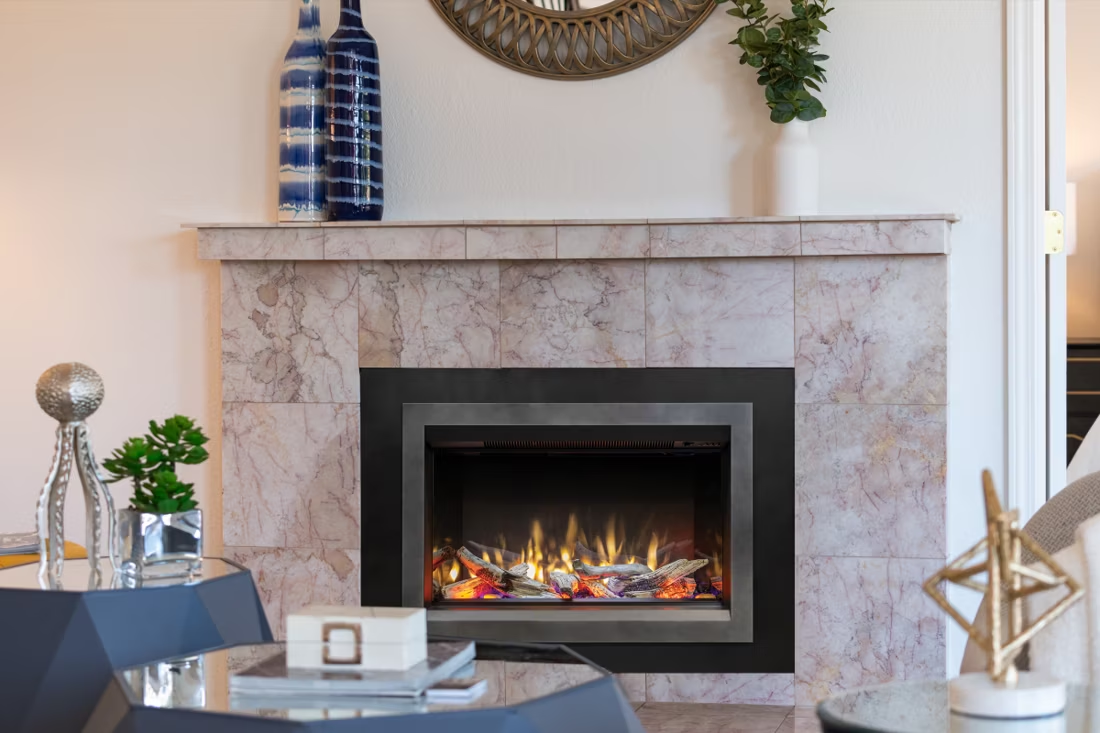
Electric fireplaces fit that role well here. There's no gas line to run, no chimney to maintain, and no wood to split or store—which matters in a small city where wood-burning setups are uncommon and largely absent from the local building stock. Whether you're on Northern States Power (Xcel Energy) service in town or Pierce-Pepin Cooperative Services out in the township, residential power runs about 15.8 cents per kWh, which keeps day-to-day operating costs modest for a unit that's doing supplemental heating rather than carrying the whole house through a Pierce County winter.
Three steps. No salesperson until you're ready.
Tell us about your project
Your zip code, your situation, and the fuel you're leaning toward—or let the answers point you to one.
See what's actually available
The brands dealers within 100 miles genuinely carry—real options, never a catalog mirage.
Get your dealer & Project Guide
A trusted local dealer, plus the free Project Guide & Parts List that names every component of the job.
Frequently Asked Questions
How much does an electric fireplace installation cost in Prescott?
Plug-in electric fireplace inserts and wall units generally run $300 to $1,200 installed when an existing outlet is nearby—most of that cost is the unit itself, plus a few hours of labor to mount it and finish any surround. If you're converting an existing masonry fireplace or want a built-in look with a dedicated 20-amp circuit run by an electrician, expect $1,500 to $3,000 depending on how far the wiring has to travel and whether any wall or mantel framing is involved. Local dealers can quote a firm number once they see your space.
Do I need a permit to install an electric fireplace in Prescott?
A simple plug-in unit on an existing standard outlet typically doesn't require a permit. If your installer needs to add a new dedicated circuit or run wiring inside a wall—common with built-in models—that electrical work needs to be pulled through the City of Prescott Building Department and performed by a licensed Wisconsin electrician. Most hearth dealers coordinate this as part of the install, so you're not left tracking down the paperwork yourself.
Will an electric fireplace actually heat my house?
Not on its own, and it's worth being upfront about that given Prescott's climate. Most electric fireplace inserts top out around 5,000-9,000 BTU (roughly the output of a 1,500-watt space heater), which is enough to comfortably warm a living room or bedroom but won't carry a whole home through a Pierce County winter with a long, demanding heating season like Minneapolis. Think of it as zone heat for the room you use most, layered on top of your propane furnace or heat pump—not a replacement for it.
What does it cost to run an electric fireplace day to day?
At the local residential rate of about 15.8 cents per kWh, a typical 1,500-watt electric fireplace running on its heater setting costs roughly 24 cents per hour to operate. Run it a few hours each evening through a Wisconsin winter and you're looking at somewhere around $15-$25 a month in added electric cost—noticeably cheaper than running a wood-burning setup with delivered firewood, and with no fuel to buy or haul in.
What happens to my electric fireplace during a power outage?
It shuts off, full stop—there's no battery backup or standing pilot to fall back on. That's a real consideration in Pierce County, where winter storms occasionally knock out Northern States Power or Pierce-Pepin Cooperative Services lines for hours at a time. If backup heat during outages matters to you, a propane fireplace with battery-backed ignition is the better fit as your primary hearth appliance, with an electric unit reserved for everyday ambiance and supplemental warmth when the grid is up.
Electric insert, built-in, or wall-mount—which should I choose for my home?
An electric insert is built to slide into an existing masonry fireplace opening, which is the right call if you have an old wood-burning firebox in a Prescott home you'd rather not use for wood or convert to gas. A built-in unit gets framed into a wall during a remodel or new construction and gives you the cleanest, most custom look. A wall-mount model hangs like a flat-screen TV and needs only a nearby outlet—the fastest and least invasive option if you're not touching existing masonry. Local dealers can tell you which fits your specific opening or wall.
Electric vs. gas fireplace—which makes more sense in Prescott?
Gas is the stronger choice if you want a unit that can genuinely help heat a room and keep working during a power outage—propane is widely available throughout rural Pierce County, and natural gas service reaches much of the city itself. Electric wins on install simplicity and cost: no gas line, no venting, and a unit that can go into almost any wall or fireplace opening for a few hundred dollars. Many Prescott homeowners choose electric specifically because they want the look and flicker of a fire without adding a new gas appliance to the house—it's an ambiance and light-supplemental-heat purchase more than a heating-system purchase.
Why isn't wood heat more common in Prescott, and is electric a real substitute?
Even though oak, maple, birch, and aspen are all readily available in this part of the St. Croix Valley, wood-burning fireplaces and stoves are uncommon in Prescott's housing stock—most homes here were built or renovated around gas and electric heat rather than wood, and there's little local wood-stove installer infrastructure to support new installs. An electric fireplace gives you a comparable visual and emotional payoff—flame effect, glowing logs, a focal point in the room—without needing a chimney, a cord of split wood, or an annual sweep. It's the practical stand-in for wood ambiance in a town where wood heat never really took hold.
What's the best type of electric fireplace for a cold-climate home like mine?
Look for a unit with a true heater rating (not just a decorative flame light) and a thermostat so it cycles instead of running full-blast constantly—brands like Dimplex and Napoleon build electric inserts and built-ins with this in mind. If you're placing it in a room that gets genuinely cold—a three-season porch conversion or a room over an unheated crawlspace, both common around Prescott's older river-town housing—make sure the model is rated for the square footage and ask your local dealer about supplemental circuit capacity before you buy.
Do electric fireplaces actually produce heat?
Yes—most put out around 4,800–5,000 BTUs from a standard outlet, which comfortably warms a bedroom, office, or den as a comfort-zone heater. What they won't do is carry a whole house the way wood, gas, or pellet can. Think of electric as ambiance-first with honest supplemental heat: flames on with no heat in July, flames plus warmth in January.
Can I put a TV above my fireplace?
Yes—with an asterisk. Fireplaces are hot and TVs don't like heat. Either put a mantel between them to deflect rising warmth, or choose a fireplace with heat-management technology that creates a cool zone on the wall above—the wall stays around 125 degrees, barely warm, while the room still gets full heat. If you like clean lines and don't want a mantel, heat management is the answer.
Can I install a fireplace myself?
If you're putting a fire in your house on purpose, it's best to work with an expert. Unless you're genuinely experienced in framing, gas line, vent pipe, and the national code on clearances to combustibles, have a professional do it—and ideally the same company that sells you the fireplace, so warranty, service, and liability all live under one roof.
What is an in-home preview and do I need one?
It's a visit where a hearth professional measures your space, confirms the model you picked actually works in your home, and walks the specs—framing, gas line, venting, finish work—before anything is ordered. Some details you just can't know until you see the house. Never make a down payment without one; it's the single most-skipped step that burns buyers.
Nearby Dealers
Hearth shops serving Prescott and the surrounding area. Every listing shows whether it is a WhyFire partner, a dealer we have verified as authorized for the brands we recommend, or a local business carrying hearth products. No manufacturer pays for placement. How we verify dealers →
Comfort By Design
Scotts Heating And Ac
Comfort By Design Inc.
The Chimney Pro’s Mn
Fireside Hearth & Home - Eagan
Minnesota Gas Grills & Fireplaces
Electric Service in Prescott
An electric fireplace's heater draws about 1,500 watts—pennies per hour at local rates.
Northern States Power Co
Pierce-Pepin Coop Services
Find your electric fireplace in Prescott.
Tell us a bit about your home and we'll match you with the right electric fireplace or insert, and hand you a free Project Guide & Parts List with the exact parts—including any electrical work needed—and your recommended local dealer.
Find Your Fireplace →