
Clean, Instant Heat for Mequon's Long Winters.
Direct-vent and freestanding gas fireplaces built for Ozaukee County's cold, humid winters—matched with a trusted local dealer who handles the gas line, venting, and permit work.
Every Project Starts From One of These Five Situations
Reliable heat without a woodpile in the yard.
Mequon sits along Lake Michigan in Ozaukee County, where climate zone 6A winters bring a long, cold heating season with lows that settle around 17°F. At 662 feet of elevation, the cold here isn't dramatic in the way it is in the mountain West, but it's persistent—closer in feel to Madison's long, gray winter stretch than to a quick cold snap. Homes on the bluff and along the North Shore corridor need heat that runs for months, not weeks.
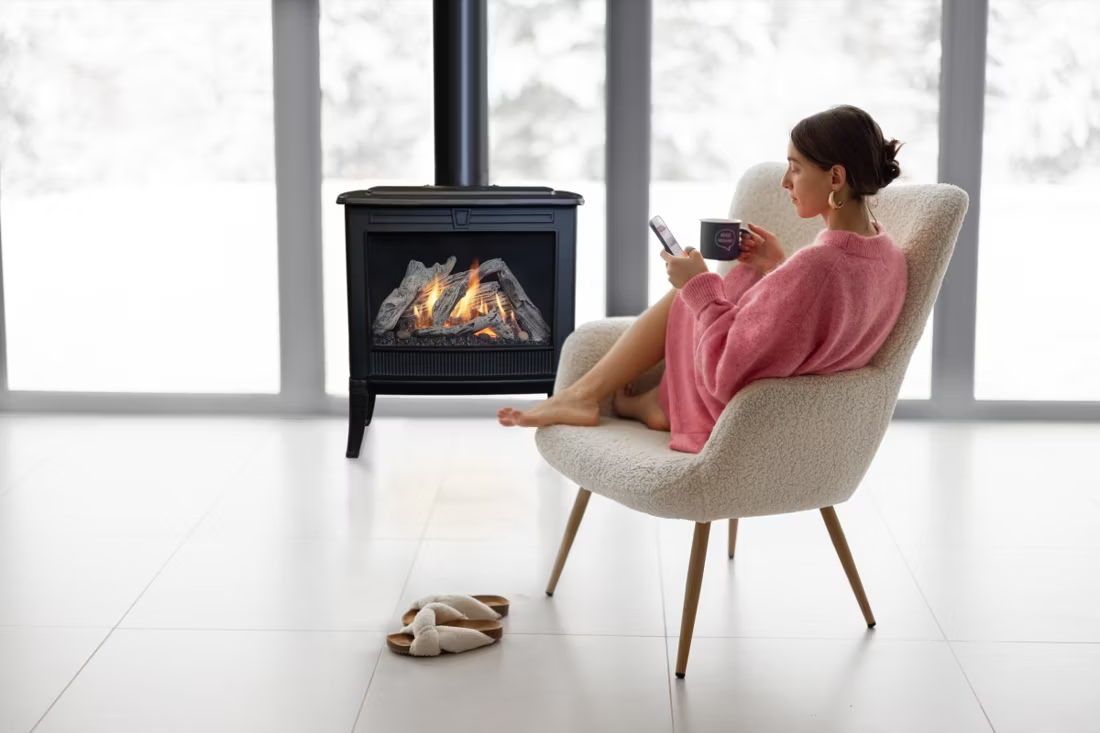
Unlike more rural parts of Wisconsin, Mequon doesn't have much of a wood-burning culture. There's no national forest cutting permit office nearby, most lots are established suburban parcels rather than acreage with standing timber, and air quality here isn't a limiting factor either way—it simply isn't necessary when natural gas service reaches most established Mequon neighborhoods. That makes gas the default choice for homeowners who want real heat output and the look of a fire without stacking oak, maple, or birch cordwood in the garage. A gas insert or built-in fireplace delivers warmth at the flip of a switch, works well as zone heat alongside central HVAC, and holds up to daily use through a Wisconsin winter that runs from November into April.
Three steps. No salesperson until you're ready.
Tell us about your project
Your zip code, your situation, and the fuel you're leaning toward—or let the answers point you to one.
See what's actually available
The brands dealers within 100 miles genuinely carry—real options, never a catalog mirage.
Get your dealer & Project Guide
A trusted local dealer, plus the free Project Guide & Parts List that names every component of the job.
Frequently Asked Questions
How much does a gas fireplace installation cost in Mequon?
Costs vary by project type. A direct-vent gas insert installed into an existing masonry fireplace—common in Mequon's older lake-bluff homes—is usually the most affordable option since it uses the existing chimney chase as the venting path. A new built-in gas fireplace for a remodel or addition costs more once framing, a fresh gas line run, and finish work are factored in. Homes without existing natural gas service, or projects that need a propane tank installed, land on the higher end. Most local hearth dealers will give you a firm number after seeing your home in person, since venting length and gas line distance drive the price more than the fireplace itself.
Can I convert my existing wood fireplace to gas?
Yes, and it's a common project in Mequon's established neighborhoods, where many homes built in the 1960s through 1980s have open masonry fireplaces that see little use. A gas insert slides into that existing firebox, uses a stainless liner run through your current chimney, and connects to a new gas line. The result keeps the look of your original fireplace but adds real, thermostatically controlled heat—a meaningful upgrade in a house that faces a long, demanding winter heating season.
Does my Mequon home have natural gas, or do I need propane?
Most established Mequon neighborhoods, particularly inside the older sections near Cedarburg Road and Mequon Road, are served by natural gas through Wisconsin Electric Power Company's distribution territory (branded We Energies). If you already run a gas furnace, water heater, or range, a gas fireplace is a straightforward tie-in. Some newer subdivisions and larger estate lots on the edges of Ozaukee County are outside the gas main and rely on propane instead—your local dealer can tell you which situation applies to your address and set the fireplace up for whichever fuel you have.
Will my gas fireplace still work if the power goes out?
Most will, with the right ignition system. Units with IPI (intermittent pilot ignition) run on battery backup, so the fireplace lights on demand even without utility power—useful in Mequon, where ice storms off Lake Michigan occasionally knock out Wisconsin Electric Power Co. service for a day or more. Valor fireplaces go a step further: their pilot assembly generates its own electricity through the thermocouple, so there's no battery to remember or replace. Ask your dealer about the ignition system on any model you're considering if outage performance matters to you.
What's the difference between a gas fireplace, insert, and stove?
A built-in gas fireplace is framed into a wall as part of new construction or a remodel. A gas insert is sized to slide into an existing masonry firebox, which is the more common Mequon project since so many homes already have a fireplace opening. A gas stove is a freestanding cabinet-style unit that sits on the floor and vents out through a wall or existing chimney—a good option for a room that never had a fireplace, like a finished basement or three-season porch. Your existing layout usually decides which makes sense.
Do I need a permit to install a gas fireplace in Mequon?
Yes. The City of Mequon requires a building permit for gas fireplace installations, and any new gas line work needs to be pulled by a licensed gas-fitter and inspected separately. Most established hearth dealers who work regularly in Ozaukee County handle this paperwork as part of the installation, coordinating the gas line, venting, and inspection so you're not managing multiple trades yourself.
Should I get a vented or vent-free gas fireplace?
Vented (direct-vent) units draw combustion air from outside and exhaust it back outside through a sealed pipe—they're the standard choice and the one most Mequon dealers install by default. Vent-free units burn without any outside venting and release some combustion byproducts into the room; Wisconsin permits them under specific room-size and ventilation rules, but with Ozaukee County winters keeping windows shut for months at a time, most homeowners here choose vented units for the better air quality and higher real heat output.
How often does a gas fireplace need service?
Plan on an annual inspection, ideally before the heating season starts each fall. A technician checks the burner, pilot assembly, gas connections, and any battery backup or ignition electronics, and cleans the glass. It's a lighter lift than chimney sweeping for a wood system—expect to pay somewhere in the $150 to $250 range for a standard inspection from a local service provider.
Gas vs. electric fireplace—which fits Mequon better?
Gas gives you real heat output—enough to meaningfully offset a furnace bill during a stretch of 17°F January nights—plus the option to keep working during a power outage with the right ignition system. Electric fireplaces plug into a standard outlet, need no gas line or venting, and install almost anywhere in an afternoon, but their heat output tops out around 5,000 BTU, more supplemental than primary. Wood and pellet stoves, by contrast, are genuinely rare in Mequon: there's no nearby cutting-permit land, most lots don't accommodate cordwood storage, and the regional pellet suppliers here—Indeck Energy Services, Lignetics, Somerset Pellet Fuel—sell mostly into industrial and rural markets rather than residential stoves. For most Mequon homes, the real choice is between gas for heat output and electric for a low-cost ambiance upgrade in a secondary room.
Is my gas fireplace wasting gas?
If it was installed more than 15 years ago, probably. Older gas fireplaces keep a standing pilot light burning all the time, and that little flame can cost a couple hundred dollars a year. Newer models use pilot-on-demand ignition—the pilot lights only when you use the fireplace and goes out when you turn it off.
What's the difference between an insert and a zero-clearance fireplace?
An insert is a fireplace that slides into a pre-existing wood-burning fireplace—if you don't have one, there's nothing to insert it into. A zero-clearance fireplace is built into a framed wall, which makes it the answer for remodels and new construction. Simple test: existing masonry fireplace means insert; blank or framed wall means zero-clearance.
Can a fireplace actually lower my heating bill?
Yes—by creating a comfort zone. A furnace heats every square foot of the house just to warm the one room you're in; a gas fireplace on low burns roughly a sixth of the gas a typical furnace does. Set the furnace around 55–60 degrees as a baseline, then heat the rooms your family actually uses. Families who heat this way commonly save $20–$60 a month.
How much should I budget for a fireplace?
For an average home—covering the fireplace, the vent pipe, and basic installation—a budget between $3,900 and $5,500 gives you a lot of options across wood, gas, and pellet. By the time you add finish work, gas line, and electrical, the average complete installation lands between $5,000 and $12,000 all-in. In a remodel or new build, a good rule is to put about 2.5% of the total project cost toward the fireplace.
Nearby Dealers
Hearth shops serving Mequon and the surrounding area.
The Fire Factory
Find your gas fireplace in Mequon.
Tell us about your home and we'll match you with a trusted local Mequon-area dealer and send over a free Project Guide & Parts List—the exact parts, vent kit, and installer recommendation for your gas fireplace project.
Find Your Fireplace →