
Find the right electric fireplace for your Tazewell County home.
Simple, no-vent heat and ambiance for homes across Tazewell County's ridges and hollows—from Tazewell and Richlands to Pounding Mill and Bluefield. Get matched with a trusted local dealer.
Every Project Starts From One of These Five Situations
Zero-clearance heat for a county built on mountains, not flat lots.
Tazewell County sits deep in Virginia's coalfield region, where winters bring an average low near 23°F and a meaningful winter heating load—comparable to a solid cold-climate season, though nowhere near what a place like Duluth or Fargo sees. Homes here range from older farmhouses with masonry chimneys already spoken for by wood heat to newer builds and manufactured housing on tight lots where running a flue or a gas line isn't practical. That's exactly the gap electric fireplaces fill.
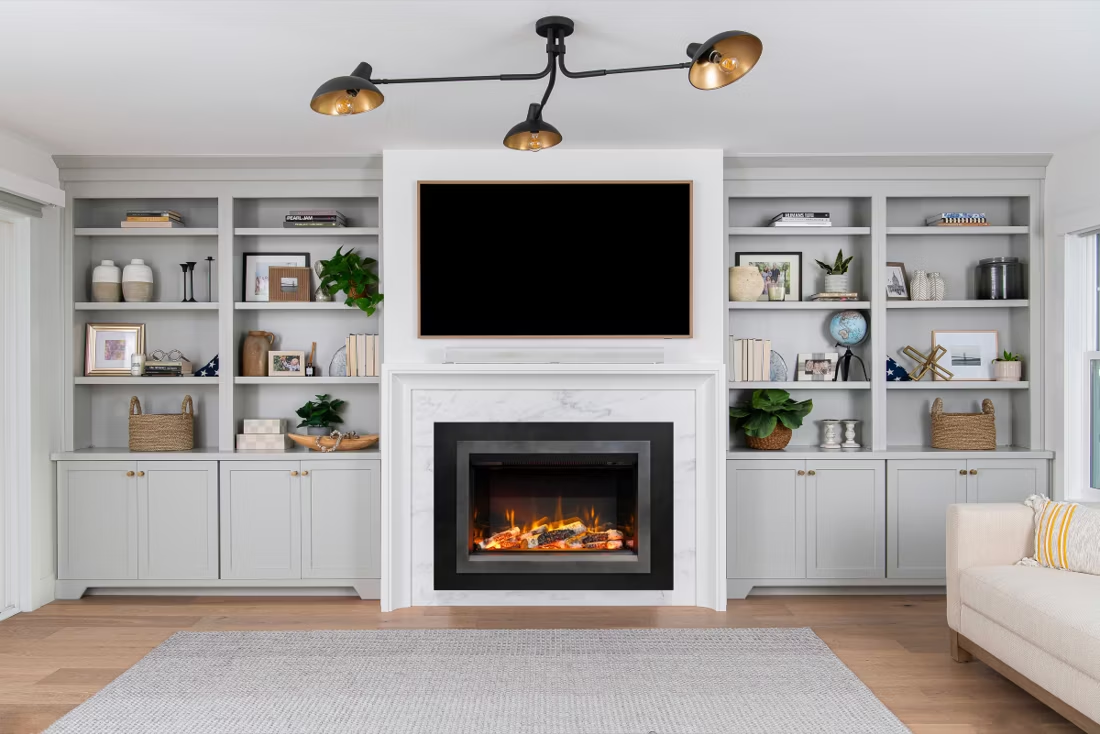
With no venting requirements and no combustion byproducts, an electric fireplace or insert can go into a basement rec room in Richlands, a bedroom in Tazewell, or a manufactured home outside Pounding Mill without touching the roofline or exterior wall. It won't replace a woodstove as primary heat on a sub-zero night, but as supplemental warmth in a specific room, or as a clean focal point where a real hearth isn't feasible, it's often the simplest and least expensive project on this list—typically installed in an afternoon by a local dealer, not a specialty crew.
Three steps. No salesperson until you're ready.
Tell us about your project
Your zip code, your situation, and the fuel you're leaning toward—or let the answers point you to one.
See what's actually available
The brands dealers within 100 miles genuinely carry—real options, never a catalog mirage.
Get your dealer & Project Guide
A trusted local dealer, plus the free Project Guide & Parts List that names every component of the job.
Frequently Asked Questions
How much does an electric fireplace installation cost in Tazewell County?
Most electric fireplace and insert installations in Tazewell County run $400 to $1,200, which makes this the most affordable hearth project available in the county by a wide margin compared to wood, gas, or pellet installs. A basic plug-in insert dropped into an existing mantel surround sits at the low end. Built-in linear units that require a dedicated 120V or 240V circuit, wall recessing, or trim carpentry land at the higher end. Because there's no venting or gas line to run, most local dealers can complete the work in a single visit.
Do I need an electrician to install an electric fireplace?
Many electric fireplaces plug into a standard household outlet and need no electrician at all—you can place them like a large appliance. Larger built-in units, especially those rated for higher wattage or wired for a dedicated circuit, do require a licensed electrician to run new wiring, particularly in older Tazewell County housing stock where panel capacity can be limited. A local dealer will tell you upfront whether your chosen unit is plug-and-play or needs an electrical upgrade before it's installed.
Will an electric fireplace actually heat my room, or is it just for looks?
Most electric units produce a real 5,000 to 5,500 BTU heater—enough to noticeably warm a single room, bedroom, or finished basement space, similar to a space heater but built into an attractive surround. It's not sized to replace a woodstove or furnace on a 20-degree night in Tazewell County, but it works well as supplemental heat in a room you're actively using, letting you turn down the thermostat elsewhere in the house. The flame effect can also run independently of the heater, so you get ambiance in warmer months without any heat output at all.
Do I need a permit to install an electric fireplace in Tazewell County?
In most cases, no—a plug-in electric fireplace or insert doesn't require a building permit since there's no venting, gas line, or structural change involved. If your project involves a dedicated electrical circuit or any wall framing to recess a built-in unit, an electrical permit may be required depending on the scope of the work. A local dealer or electrician can tell you whether your specific installation crosses that line, and most straightforward insert or mantel-package jobs don't.
What's the difference between an electric insert, a wall-mount unit, and a built-in electric fireplace?
An electric insert is designed to slide into an existing masonry or wood-burning fireplace opening, giving an old Tazewell County hearth a clean, maintenance-free upgrade without touching the chimney. A wall-mount unit hangs on the wall like a large flat-screen TV and needs no surround at all, which works well in newer construction or a finished basement. A built-in electric fireplace is designed to be framed into a wall or custom cabinetry for a more permanent, seamless look. For homes with an existing fireplace opening that no longer gets used for wood, the insert is usually the simplest and most cost-effective option.
Can an electric fireplace work as backup heat during a power outage?
No—this is the one real tradeoff to understand. Because electric fireplaces run entirely on household power, they go dark the moment the electricity does, which matters in a county where mountain ice storms can knock out power for days at a time. If backup heat during outages is a priority for your household, a wood stove or a vented gas unit with battery-backup ignition is a better fit for that specific need. Many Tazewell County homeowners actually pair the two: wood or gas as the outage-proof workhorse, electric in a secondary room for everyday convenience and ambiance.
How much does it cost to run an electric fireplace?
Running costs depend on your local electric rate and how much you use the heater function versus just the flame effect. A typical 1,500-watt heater running on high for several hours a day adds a modest amount to a monthly bill—generally far less than heating an equivalent space with baseboard electric resistance heat, since you're only warming one room rather than the whole house. Running the flame effect alone, with the heater off, costs only a few cents a day, which is why many homeowners use it as year-round ambiance in Tazewell and Richlands living rooms even outside heating season.
Are electric fireplaces a good fit for older homes in Tazewell County?
Yes, often more so than gas or wood. A lot of the county's older housing stock—farmhouses and homes with settled masonry chimneys—isn't always straightforward to re-line or bring up to current venting code for a new gas or wood appliance. An electric insert sidesteps that problem entirely by using the existing fireplace opening purely as a housing for the unit, with no chimney work required. It's a common way to bring a disused or partially deteriorated fireplace back into daily use without a masonry rebuild.
Electric vs. wood or gas—which is right for my Tazewell County home?
Wood and gas both deliver more real heat output and, in wood's case, work without electricity during the ice-storm outages that periodically hit this part of southwest Virginia—genuine advantages for a primary heat source. Electric wins on install simplicity, upfront cost, and flexibility, since it can go almost anywhere in the house without venting or a gas line. For a Tazewell County homeowner who already has a woodstove or furnace covering primary heat and wants a low-cost, low-maintenance way to add warmth and ambiance to a bedroom, den, or basement, electric is usually the practical choice. A local dealer can walk through your specific rooms and heating setup to confirm the right fit.
Can I put a TV above my fireplace?
Yes—with an asterisk. Fireplaces are hot and TVs don't like heat. Either put a mantel between them to deflect rising warmth, or choose a fireplace with heat-management technology that creates a cool zone on the wall above—the wall stays around 125 degrees, barely warm, while the room still gets full heat. If you like clean lines and don't want a mantel, heat management is the answer.
Does an electric fireplace need a vent or chimney?
No—that's its superpower. An electric fireplace needs a wall and an outlet, period. No vent pipe, no gas line, no clearances to design around, which is why it works in bedrooms, offices, apartments, and walls where venting a gas or wood unit would be impractical or impossible. Installation is typically the simplest and least expensive of any fireplace type.
Can a fireplace actually lower my heating bill?
Yes—by creating a comfort zone. A furnace heats every square foot of the house just to warm the one room you're in; a gas fireplace on low burns roughly a sixth of the gas a typical furnace does. Set the furnace around 55–60 degrees as a baseline, then heat the rooms your family actually uses. Families who heat this way commonly save $20–$60 a month.
How much should I budget for a fireplace?
For an average home—covering the fireplace, the vent pipe, and basic installation—a budget between $3,900 and $5,500 gives you a lot of options across wood, gas, and pellet. By the time you add finish work, gas line, and electrical, the average complete installation lands between $5,000 and $12,000 all-in. In a remodel or new build, a good rule is to put about 2.5% of the total project cost toward the fireplace.
Stove and Fireplace Dealers in Tazewell County
Listings include WhyFire partner dealers, dealers we have verified as authorized for the brands we recommend, and established local businesses that carry hearth products. Every listing shows which one it is. The ones marked Preferred run on WhyFire's software, so they can show you real pricing and book your appointment right here. No manufacturer pays for placement. How we verify dealers →
New-Bos, Inc
Cline Lumber Company
Country Power Equipment
Marsh Lp Gas Company
Marsh Lp Gas
Alfresco Lifestyles
Berry Home Center- Abingdon
Abingdon Gas
Get your Tazewell County electric fireplace project planned right.
Tell us about your room and your goals, and we'll send a free Project Guide & Parts List—sized to your space, with a recommended local Tazewell County dealer who can install it.
Find Your Fireplace →