
Real Warmth, No Wood Pile Required.
Instant, reliable heat for Prince William County's four-month heating season—matched with a trusted local dealer who sizes the vent, pulls the permit, and installs it right.
Every Project Starts From One of These Five Situations
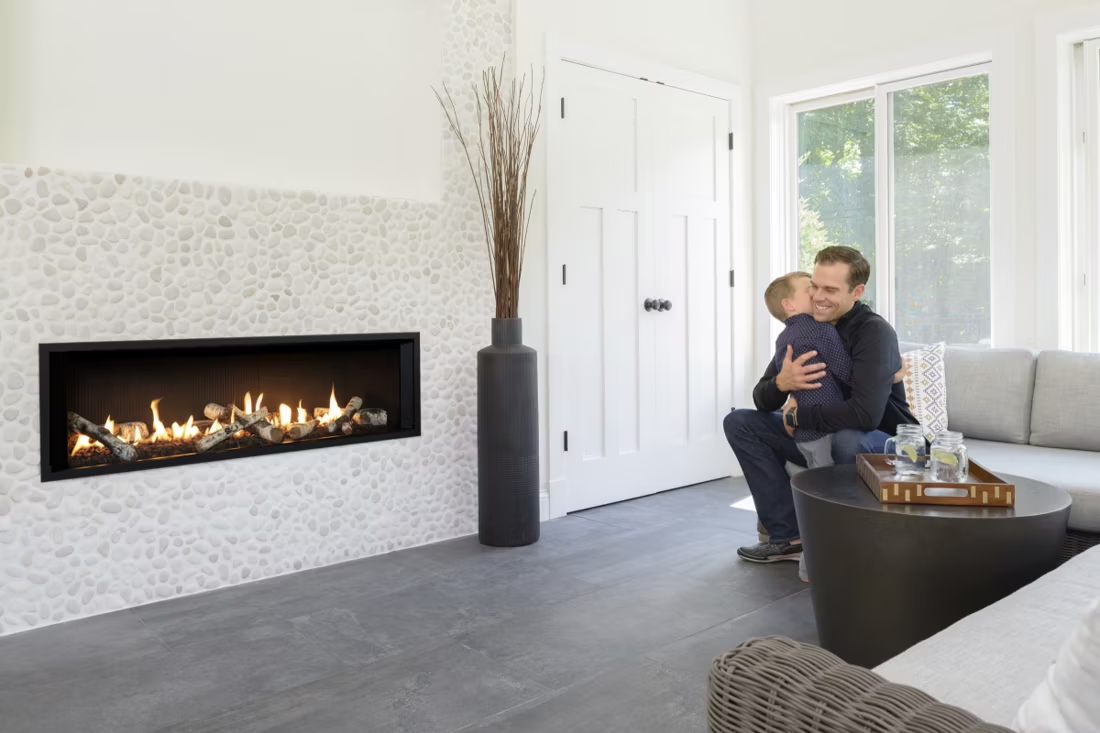
Gas fireplaces fit Gainesville's suburban rhythm.
Gainesville sits in Prince William County, roughly 35 miles southwest of Washington, D.C., where winters are moderate by East Coast standards—climate zone 4A, average lows near 24°F, and a moderate winter heating load overall. That's mild compared to a place like Burlington, Vermont, but it's still cold enough to make a working fireplace worth having for three to four months a year. Most of the housing stock here is newer construction—subdivisions like Dominion Valley, Heritage Hunt, and Piedmont went up through the 1990s and 2000s—and builders overwhelmingly specified gas fireplaces as the standard fixture rather than masonry wood-burning units.
There isn't much public land to cut firewood near Gainesville, and the county's suburban lot sizes don't leave much room for stacking cords, so wood heat never took hold here the way it has in more rural parts of Virginia. Natural gas service reaches much of the area, and propane fills in for homes on the edges of the service territory or on well-and-septic lots further out. Electric service comes from either Virginia Electric & Power Co. (Dominion Energy) or Northern Virginia Electric Cooperative, depending on your street, and both support electric inserts as a no-venting alternative. For most Gainesville homeowners, a gas fireplace or insert delivers real ambiance and real heat at the flip of a switch, without the wood-handling logistics that don't fit suburban life here.
Three steps. No salesperson until you're ready.
Tell us about your project
Your zip code, your situation, and the fuel you're leaning toward—or let the answers point you to one.
See what's actually available
The brands dealers within 100 miles genuinely carry—real options, never a catalog mirage.
Get your dealer & Project Guide
A trusted local dealer, plus the free Project Guide & Parts List that names every component of the job.
Frequently Asked Questions
How much does a gas fireplace installation cost in Gainesville?
Gas fireplace installations in the Gainesville area typically run $3,500 to $10,000, with venting driving most of the spread. A direct-vent gas insert dropped into an existing masonry fireplace—common in the older sections near Old Town Gainesville—sits toward the low end because the chimney already provides a vent path. A built-in gas fireplace added during a home addition, which needs framing and a fresh vent run through an exterior wall, lands higher. Homes without an existing gas line that need a propane tank see an added cost on top. A local hearth dealer can give you a firm number after walking your specific setup.
Can I convert my existing wood fireplace to gas?
Yes, and it's a common project in the older parts of Gainesville and nearby Haymarket, where some homes still have a traditional masonry wood fireplace. A gas insert with a stainless liner run up your existing chimney is the standard approach—you keep the look of your current surround but gain instant on-off heat and lose the ash and creosote maintenance entirely. Most conversions in this area land in the $4,000 to $8,500 range depending on whether the home already has natural gas or needs a propane tank installed.
Do I need natural gas, or is propane more common here?
It depends on where in the 20155, 20169, or 20156 zip codes you're located. Neighborhoods closer to Route 66 and the more established parts of Gainesville typically have natural gas service, while some newer developments further out, or homes on well-and-septic lots, run on propane instead. If your home already has a gas range, gas water heater, or gas furnace, you almost certainly have a line a fireplace installer can tap. If not, your local dealer can tell you whether a propane tank setup makes more sense than trenching a new gas line.
Will my gas fireplace work during a power outage?
Most gas fireplaces with a standing pilot or intermittent pilot ignition (IPI) keep working through a power outage, because the flame itself doesn't depend on electricity—only certain blower fans and remote features do. IPI units run on a couple of AA batteries as backup, worth checking every fall before storm season. Given how often Prince William County loses power to ice storms or summer thunderstorms, a gas fireplace that doesn't need grid power is a real advantage. Ask your installer specifically about ignition type—millivolt and IPI systems function without power, while some fully electronic ignition systems on contemporary linear units may not.
What's the difference between a gas fireplace, gas insert, and gas stove?
A gas fireplace is a built-in unit framed into a wall—the standard choice for new construction, which describes most of Gainesville's housing stock. A gas insert drops into an existing masonry firebox and uses the chimney as its vent path, the right call for one of the area's older wood-burning fireplaces you want to upgrade. A gas stove is a freestanding cabinet-style unit that sits out in the room, less common here but occasionally used in basements or additions with no existing chimney or wall cavity to frame into.
Do I need a permit to install a gas fireplace in Gainesville?
Yes—Prince William County requires a building permit and, separately, a permit for the gas line work, both issued through the county's Development Services building permit office. Most hearth dealers in the area pull both permits as part of the installation and schedule the required inspection, so you generally don't have to deal with the county directly. Because the gas line work has to be done by a licensed gas-fitter, working with an established local dealer who already coordinates that trade tends to be simpler than piecing it together yourself.
What's the difference between vented and vent-free gas fireplaces?
Vented, direct-vent gas fireplaces pull combustion air from outside and exhaust byproducts back outside through a sealed pipe—they're the most common choice in Gainesville and fully code-compliant. Vent-free units burn without any external venting and release some moisture and combustion byproducts into the room, so Virginia limits their use based on room volume and requires an oxygen depletion sensor. Given how tightly sealed newer Gainesville homes are built for energy efficiency, most local dealers steer customers toward direct-vent units for both air quality and code-compliance reasons.
How often should my gas fireplace be serviced?
Plan on an annual inspection, ideally in early fall before you start using the fireplace regularly for the season. A technician checks the burner, pilot assembly, gas connections, and venting, and cleans the glass and log set. This is quicker and cheaper than a wood chimney sweep—most local gas hearth service calls in the area run $150 to $225 for a standard inspection and cleaning.
Gas vs. electric fireplace—which is right for my Gainesville home?
Gas fireplaces put out real, sustained heat—enough to take the chill off a room on a 24°F January morning—and most keep working during a power outage. Electric fireplaces plug into a standard outlet, need no venting or gas line at all, and install in an afternoon for roughly $400 to $1,200, but they're mainly a supplemental or ambiance option rather than a serious heat source, and they go dark the moment Dominion or NOVEC service drops. For a primary living-room heat source in Gainesville, gas usually wins; for a bedroom, basement, or rental where installation simplicity matters more than heat output, electric is often the practical choice.
What's the difference between an insert and a zero-clearance fireplace?
An insert is a fireplace that slides into a pre-existing wood-burning fireplace—if you don't have one, there's nothing to insert it into. A zero-clearance fireplace is built into a framed wall, which makes it the answer for remodels and new construction. Simple test: existing masonry fireplace means insert; blank or framed wall means zero-clearance.
Can I put a TV above my fireplace?
Yes—with an asterisk. Fireplaces are hot and TVs don't like heat. Either put a mantel between them to deflect rising warmth, or choose a fireplace with heat-management technology that creates a cool zone on the wall above—the wall stays around 125 degrees, barely warm, while the room still gets full heat. If you like clean lines and don't want a mantel, heat management is the answer.
Does a fireplace add value to my home?
On average, a fireplace adds back to the home about the same amount you spent installing it. Add the monthly savings from heating the rooms you actually use instead of the whole house—often hundreds of dollars a year—and the value case is strong before you even count what a fire does for how your family uses the room.
How much should I budget for a fireplace?
For an average home—covering the fireplace, the vent pipe, and basic installation—a budget between $3,900 and $5,500 gives you a lot of options across wood, gas, and pellet. By the time you add finish work, gas line, and electrical, the average complete installation lands between $5,000 and $12,000 all-in. In a remodel or new build, a good rule is to put about 2.5% of the total project cost toward the fireplace.
Nearby Dealers
Hearth shops serving Gainesville and the surrounding area. Every listing shows whether it is a WhyFire partner, a dealer we have verified as authorized for the brands we recommend, or a local business carrying hearth products. No manufacturer pays for placement. How we verify dealers →
Nova Fire Design
Deckscapes Of Virginia
Fireside Hearth & Home - Manassas
Costello's Hearth & Spa - Warrenton
Homeliving Fireplaces
Genesis Chimney Services
Lawn & Leisure
Aspen Green Gasworks
Nova Fireplace And Stove
Holtzman Propane
Find your gas fireplace in Gainesville.
Tell us about your Gainesville home and we'll match you with a trusted local dealer, plus a free Project Guide & Parts List with the exact parts—including the vent kit—for your gas fireplace project.
Find Your Fireplace →