
Reliable Heat for Allegheny Highlands Winters, No Chimney Required.
Zero-clearance, plug-in-or-hardwired heat for Clifton Forge's older railroad-era homes. Find the right unit and connect with a trusted local dealer.
Every Project Starts From One of These Five Situations
Instant, zero-clearance heat for the Alleghany Highlands.
Clifton Forge sits at 1,114 feet along the Jackson River in Alleghany County, in a climate zone 4A pocket that logs about 5,144 heating degree days a year and average winter lows around 22°F. That's a real, sustained heating season—colder than most of Virginia's Piedmont, though nowhere near the extremes of a place like Duluth, MN. For this town's stock of early-1900s railroad cottages and brick storefronts, retrofitting a chimney or running new gas line is often more disruptive than it's worth.
That's where electric fireplaces, inserts, and stoves earn their keep. There's no venting, no combustion byproducts, and no masonry work—a unit can go into a plaster wall or an existing firebox in an afternoon. Electric service here comes from a mix of Virginia Electric & Power Co (Dominion), Craig-Botetourt Electric Cooperative, and BARC Electric Cooperative depending on which side of town or county line you're on, with residential rates around $0.14 per kWh. Many Clifton Forge homeowners pair an electric unit for daily zone heating in a bedroom or living room with a wood stove for backup—oak, hickory, and maple are the dominant local species, and cutting permits through the George Washington & Jefferson National Forest run about $20 a cord from May through October.
Three steps. No salesperson until you're ready.
Tell us about your project
Your zip code, your situation, and the fuel you're leaning toward—or let the answers point you to one.
See what's actually available
The brands dealers within 100 miles genuinely carry—real options, never a catalog mirage.
Get your dealer & Project Guide
A trusted local dealer, plus the free Project Guide & Parts List that names every component of the job.
Frequently Asked Questions
How much does an electric fireplace installation cost in Clifton Forge?
Electric fireplaces are the least expensive hearth project by a wide margin. A plug-in freestanding unit or a basic insert that drops into an existing firebox can run as little as $300 to $800 including a simple trim kit—no permit, no electrician needed if it plugs into an existing outlet. A built-in, hardwired wall unit or a linear electric fireplace set into new framing typically runs $1,500 to $3,500 once you factor in a dedicated 20-amp circuit and an electrician's time. Compare that to the $4,500-plus you'd typically spend converting one of Clifton Forge's older masonry fireplaces to gas or wood, and it's easy to see why electric is often the practical choice for a secondary room.
Will an electric fireplace actually heat a room in a Clifton Forge winter?
Most electric fireplaces top out around 1,500 watts, which translates to roughly 5,100 BTUs—enough to comfortably heat a single room of 300 to 400 square feet, especially in the older, smaller-footprint homes common around Clifton Forge's historic district. They're not sized to replace central heat during a stretch of 22°F nights, but as supplemental heat for a bedroom, den, or home office, they hold their own and let you turn the furnace down elsewhere in the house. If you're trying to heat a larger open floor plan, a local dealer can point you toward a higher-output insert or recommend a different fuel entirely.
Do I need a licensed electrician to install an electric fireplace?
For a plug-in unit, no—it works like any other appliance. For a hardwired built-in or an insert that requires a new dedicated circuit, yes, and Alleghany County requires an electrical permit for that work. A licensed electrician will size the circuit correctly (most units draw close to 12.5 amps at full output) and make sure the install meets code, which matters when it comes time to sell the house or file an insurance claim. The dealers we match Clifton Forge homeowners with typically coordinate the electrician as part of the installation rather than leaving you to find one separately.
What happens to my electric fireplace during a power outage?
It stops working—electric fireplaces, along with the heat pumps and furnaces most homes rely on, go dark the moment the grid does. That's a real consideration in Alleghany County, where ice storms and downed lines on Craig-Botetourt and BARC cooperative lines can mean multi-day outages in a bad winter. It's the honest reason a lot of Clifton Forge households keep a wood stove or insert as backup even after adding electric heat for daily convenience—wood keeps working when the power doesn't, and a cord of local oak or hickory from a Forest Service permit costs about $20 either way.
What's the difference between an electric fireplace, insert, and stove?
An electric fireplace is usually a wall-mounted or built-in unit designed to look like a modern linear or traditional firebox, often used in new construction or a remodel. An electric insert is sized to slide into an existing masonry firebox, letting you keep an old Clifton Forge fireplace's mantel and surround while swapping in flame-effect LED heat instead of smoke and ash. An electric stove is a freestanding cabinet-style unit that mimics a wood stove's look and can sit anywhere near an outlet. All three plug into standard household current for smaller models, or need a dedicated circuit for higher-wattage built-ins.
Do I need a permit to install an electric fireplace in Clifton Forge?
A plug-in unit that uses an existing outlet doesn't require a permit. A hardwired built-in fireplace or insert that needs new wiring does require an electrical permit through the Alleghany County Building Department, since Clifton Forge itself doesn't maintain a separate building office. Unlike wood or gas installs, there's no venting inspection or chimney clearance to worry about—the permit process is limited to the electrical work itself, which keeps the paperwork and timeline short.
What's the best electric fireplace for an older Clifton Forge home?
For the plaster-and-lath construction common in Clifton Forge's early-1900s housing stock, a shallow-depth insert or a wall-mounted linear unit tends to fit best without major demolition. Look for a model with a thermostat and a separate flame-only setting, so you can run the visual effect without the heater in shoulder-season months, and a 1,500-watt heater output if you want it to meaningfully take the edge off a cold bedroom. Brands like Dimplex and Napoleon are widely stocked by regional hearth dealers and offer insert kits sized for the smaller fireboxes typical of pre-war homes.
How much does it cost to run an electric fireplace in Clifton Forge?
At the area's residential rate of roughly $0.14 per kWh, a typical 1,500-watt electric fireplace costs about 21 cents an hour to run on high heat. Used for a few hours each evening in a bedroom or den—a common pattern here—that's roughly $15 to $25 a month, far less than heating the same space with electric baseboard or running the whole-home system harder. Running the flame effect alone without the heater draws only a fraction of that, making it cheap to use for ambiance year-round.
Electric vs. wood vs. gas—which fits my Clifton Forge home?
Wood is the traditional choice in the Alleghany Highlands and the only one that keeps working through a co-op power outage—oak and hickory are abundant, and Forest Service cutting permits run about $20 a cord. Gas is less common here since Clifton Forge has no natural gas utility serving most of the town, so a gas fireplace typically means installing a propane tank, which adds cost and a supplier relationship most homeowners don't already have. Electric is the simplest and cheapest to install, ideal for a room that just needs supplemental warmth or ambiance without construction, but it's entirely dependent on grid power. Many households here end up with a wood stove for backup heat and an electric unit for everyday convenience in a second room.
Can I put a TV above my fireplace?
Yes—with an asterisk. Fireplaces are hot and TVs don't like heat. Either put a mantel between them to deflect rising warmth, or choose a fireplace with heat-management technology that creates a cool zone on the wall above—the wall stays around 125 degrees, barely warm, while the room still gets full heat. If you like clean lines and don't want a mantel, heat management is the answer.
Does an electric fireplace need a vent or chimney?
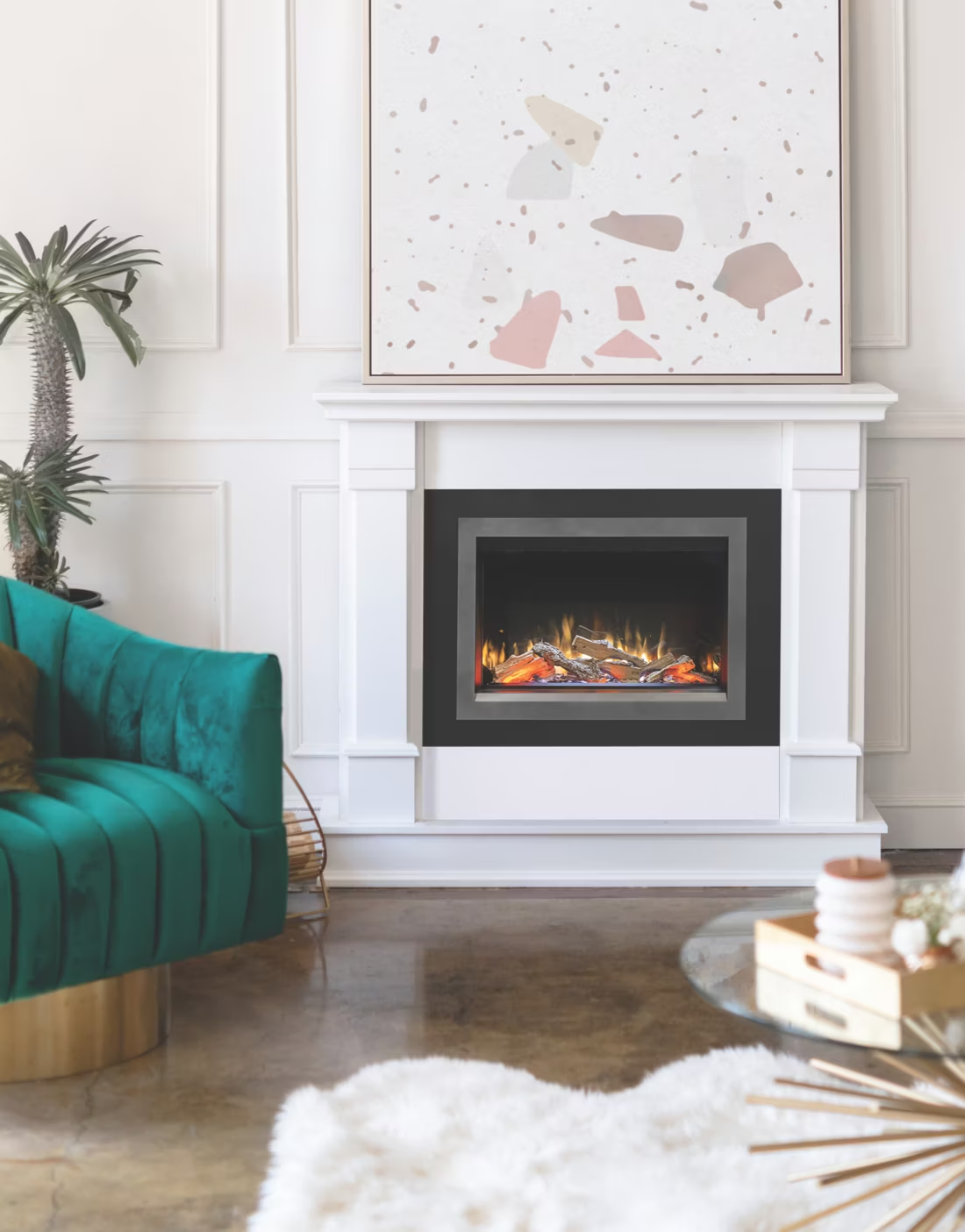
No—that's its superpower. An electric fireplace needs a wall and an outlet, period. No vent pipe, no gas line, no clearances to design around, which is why it works in bedrooms, offices, apartments, and walls where venting a gas or wood unit would be impractical or impossible. Installation is typically the simplest and least expensive of any fireplace type.
Can a fireplace actually lower my heating bill?
Yes—by creating a comfort zone. A furnace heats every square foot of the house just to warm the one room you're in; a gas fireplace on low burns roughly a sixth of the gas a typical furnace does. Set the furnace around 55–60 degrees as a baseline, then heat the rooms your family actually uses. Families who heat this way commonly save $20–$60 a month.
Can I install a fireplace myself?
If you're putting a fire in your house on purpose, it's best to work with an expert. Unless you're genuinely experienced in framing, gas line, vent pipe, and the national code on clearances to combustibles, have a professional do it—and ideally the same company that sells you the fireplace, so warranty, service, and liability all live under one roof.
Nearby Dealers
Hearth shops serving Clifton Forge and the surrounding area. Every listing shows whether it is a WhyFire partner, a dealer we have verified as authorized for the brands we recommend, or a local business carrying hearth products. No manufacturer pays for placement. How we verify dealers →
Top Hat Stove & Fireplace
Black Goose Chimney
Davenport Energy Roanoke
Blossman Gas And Appliance
Skyline Hearth & Fire
Electric Service in Clifton Forge
An electric fireplace's heater draws about 1,500 watts—pennies per hour at local rates.
Virginia Electric & Power Co
Craig-Botetourt Electric Coop
Barc Electric Coop Inc
Find your electric fireplace in Clifton Forge.
Tell us a bit about your home and we'll match you with a trusted local dealer and send over a free Project Guide & Parts List built for your Clifton Forge electric fireplace project.
Find Your Fireplace →