
Instant Heat That Doesn't Add to the Inversion.
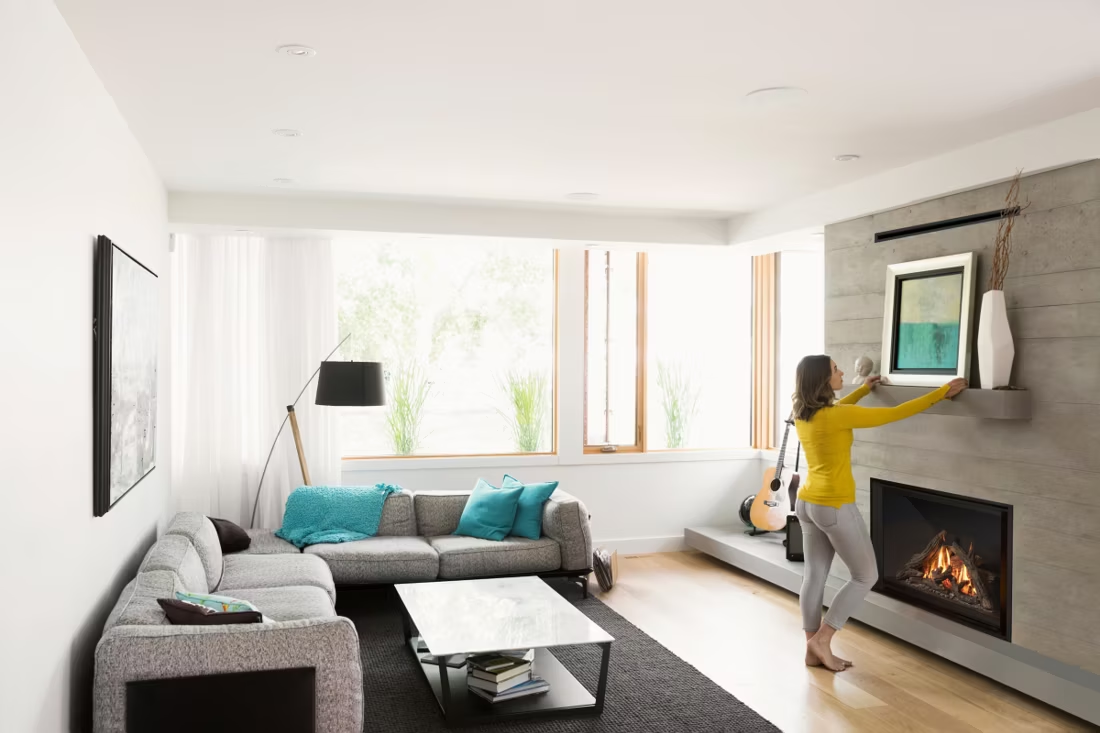
West Point sits in the Davis County bowl of the Wasatch Front, where winter inversions can trap smoke and exhaust for days. A direct-vent gas fireplace delivers real heat on demand without adding another burn to the mix—find the right unit and connect with a trusted local dealer.
Every Project Starts From One of These Five Situations
A valley that already breathes hard in winter.
West Point sits at about 4,286 feet in Davis County, tucked between the Wasatch Range and the Great Salt Lake. Winters here bring an average low near 21°F and a heating season about as demanding as mountain towns like Helena, Montana. But the geography that makes the Wasatch Front beautiful also traps air: winter temperature inversions settle over the valley floor for days at a time, holding vehicle exhaust, industrial emissions, and wood smoke close to the ground. Utah's Division of Air Quality calls mandatory no-burn days during the worst of these inversions, and solid-fuel appliances—wood and pellet stoves alike—are the first thing restricted. That's a big reason wood heat barely registers as a primary option in West Point today, even though pinyon, juniper, and aspen are still cut under Forest Service permit in the nearby Uinta-Wasatch-Cache National Forest for camping and recreational fires.
Gas fireplaces sidestep the curtailment problem entirely—a direct-vent gas unit can run every day of a red air-quality alert without violating county rules. Natural gas service reaches nearly every home in West Point through Dominion Energy Utah, making a gas fireplace, insert, or stove one of the simplest upgrades available for existing construction. Electric fireplaces are the other clean option in town, running on power from Rocky Mountain Power (PacifiCorp) at roughly 12.5 cents per kWh—a fit for condos, rentals, or rooms where venting isn't practical. For most West Point homeowners who want real heat output and the look of a fire without adding to the inversion, gas is the default choice.
Three steps. No salesperson until you're ready.
Tell us about your project
Your zip code, your situation, and the fuel you're leaning toward—or let the answers point you to one.
See what's actually available
The brands dealers within 100 miles genuinely carry—real options, never a catalog mirage.
Get your dealer & Project Guide
A trusted local dealer, plus the free Project Guide & Parts List that names every component of the job.
Frequently Asked Questions
How much does a gas fireplace installation cost in West Point?
Most direct-vent gas fireplace and insert installations in West Point run in the $4,000 to $9,000 range, with the low end covering a gas insert dropped into an existing masonry fireplace that already has a gas line nearby, and the higher end covering new-construction units that need framing, venting, and a fresh gas line run from the meter. Homes needing a longer gas line extension, a new regulator, or work tied into a remodel can push past $12,000. A local hearth dealer will walk your home and give you a firm number—the square footage of the room and your existing gas service matter more than the fireplace model itself.
Can I convert an old wood-burning fireplace to gas?
Yes, and it's a common project in West Point, where many homes built in the 1990s and 2000s have a wood-burning masonry fireplace that rarely gets used—partly because Davis County's mandatory no-burn days during winter inversions make wood heat unreliable exactly when you'd want it most. A gas insert typically drops into that existing firebox, uses the same chimney with a stainless liner, and connects to a new gas line run from your Dominion Energy service. Expect $4,000 to $8,000 depending on the insert and how far the gas line has to travel.
Do I need natural gas service, or can I run a fireplace on propane?
Nearly every home in West Point already has natural gas service through Dominion Energy Utah, so most installations simply tap into the existing line—if you have a gas water heater or furnace, extending a line to a fireplace is usually straightforward. Propane is really only a consideration for detached structures, sheds, or rural pockets of Davis County outside the natural gas footprint. Almost all gas fireplace models can be configured for either fuel, so it comes down to what's already running to your house.
Will a gas fireplace still work if the power goes out?
Most direct-vent gas fireplaces with intermittent pilot ignition (IPI) include a battery backup that keeps the unit lighting on command even when the grid drops—a real consideration in Davis County, where wind events off the Great Salt Lake and heavy winter storms occasionally knock out Rocky Mountain Power service for hours. Valor fireplaces take a different approach: their pilot assembly generates its own electricity through the thermocouple, so there's no battery to remember at all. Either way, a gas fireplace is one of the few heat sources in the house that keeps working when the power doesn't.
What's the difference between a gas fireplace, insert, and stove?
A gas fireplace is a built-in unit framed into a wall—the standard choice for new construction or a full remodel. A gas insert is built to slide into an existing masonry firebox, which is common in older West Point homes that started out as wood-burning fireplaces. A gas stove is a freestanding cabinet-style unit that sits out in the room like a traditional wood stove but burns gas and vents through the wall or roof. Homeowners with an existing fireplace opening almost always go with an insert; new rooms or additions usually call for a built-in fireplace or a freestanding stove.
Do I need a permit to install a gas fireplace in West Point?
Yes. The West Point City Building Department requires a building permit for the fireplace installation and a separate gas permit for any new gas line work, and the gas line itself has to be run by a licensed gas-fitter. Most hearth dealers coordinate both permits and the final inspection as part of the installation, so you're not stuck managing separate trades. Given how strictly Davis County treats winter air quality, inspectors also confirm the unit is a sealed, direct-vent design rather than an open, unsealed combustion appliance.
Should I get a vented or vent-free gas fireplace?
Vented (direct-vent) units draw combustion air from outside and exhaust the byproducts back outside through sealed pipe—nothing goes into the room. Vent-free units burn without any exterior venting, releasing some water vapor and combustion byproducts indoors instead. Utah permits vent-free units under specific room-size and ventilation rules, but for a city that already deals with mandatory no-burn days and inversion-trapped air several times a winter, most West Point homeowners and local dealers lean toward direct-vent units—no debate about indoor air quality, and no added load on a valley that's already working hard to breathe in January.
How often does a gas fireplace need to be serviced?
Plan on an annual inspection, ideally before the heating season ramps up in the fall. A technician checks the burner, pilot assembly, venting, and any electronic ignition components, and cleans the glass and interior. It's a lighter lift than chimney sweeping for a wood stove—most West Point service calls run $150 to $250—but skipping it is still the most common cause of pilot and ignition problems reported to local dealers.
Gas vs. electric fireplace—which fits my West Point home better?
Gas delivers real heat output—enough to take the chill off a room during a cold snap—and it keeps running during Rocky Mountain Power outages if the pilot has battery backup or a self-powering thermocouple. Electric fireplaces plug into a standard outlet, need no venting or gas line, and run on power from PacifiCorp at roughly 12.5 cents per kWh, which makes them a fit for a condo, a rental, a basement room without chimney access, or anywhere permitting a vent isn't practical. Wood, by contrast, barely factors into West Point's fireplace decisions anymore—between the burn restrictions during winter inversions and the convenience of an already-built-out gas system, most homeowners here choose between gas and electric rather than wood.
Is my gas fireplace wasting gas?
If it was installed more than 15 years ago, probably. Older gas fireplaces keep a standing pilot light burning all the time, and that little flame can cost a couple hundred dollars a year. Newer models use pilot-on-demand ignition—the pilot lights only when you use the fireplace and goes out when you turn it off.
What's the difference between an insert and a zero-clearance fireplace?
An insert is a fireplace that slides into a pre-existing wood-burning fireplace—if you don't have one, there's nothing to insert it into. A zero-clearance fireplace is built into a framed wall, which makes it the answer for remodels and new construction. Simple test: existing masonry fireplace means insert; blank or framed wall means zero-clearance.
Can a fireplace actually lower my heating bill?
Yes—by creating a comfort zone. A furnace heats every square foot of the house just to warm the one room you're in; a gas fireplace on low burns roughly a sixth of the gas a typical furnace does. Set the furnace around 55–60 degrees as a baseline, then heat the rooms your family actually uses. Families who heat this way commonly save $20–$60 a month.
Does a fireplace add value to my home?
On average, a fireplace adds back to the home about the same amount you spent installing it. Add the monthly savings from heating the rooms you actually use instead of the whole house—often hundreds of dollars a year—and the value case is strong before you even count what a fire does for how your family uses the room.
Nearby Dealers
Hearth shops serving West Point and the surrounding area. Every listing shows whether it is a WhyFire partner, a dealer we have verified as authorized for the brands we recommend, or a local business carrying hearth products. No manufacturer pays for placement. How we verify dealers →
Timber Ridge Fireplace
Comfort Solutions
Stone World Supply
Rocky Mountain Stove
Hearth & Home Dist. Of UT-Ogden
Ogden Lawn & Garden
Utah Air
Croft Fireplaces (Bountiful)
Find your gas fireplace in West Point.
Tell us about your home and we'll match you with a trusted local dealer and a free Project Guide & Parts List—a plan for your West Point gas fireplace project with the exact parts, including the vent kit, spelled out.
Find Your Fireplace →