
Warm, Clean Heat for Cache Valley Winters.
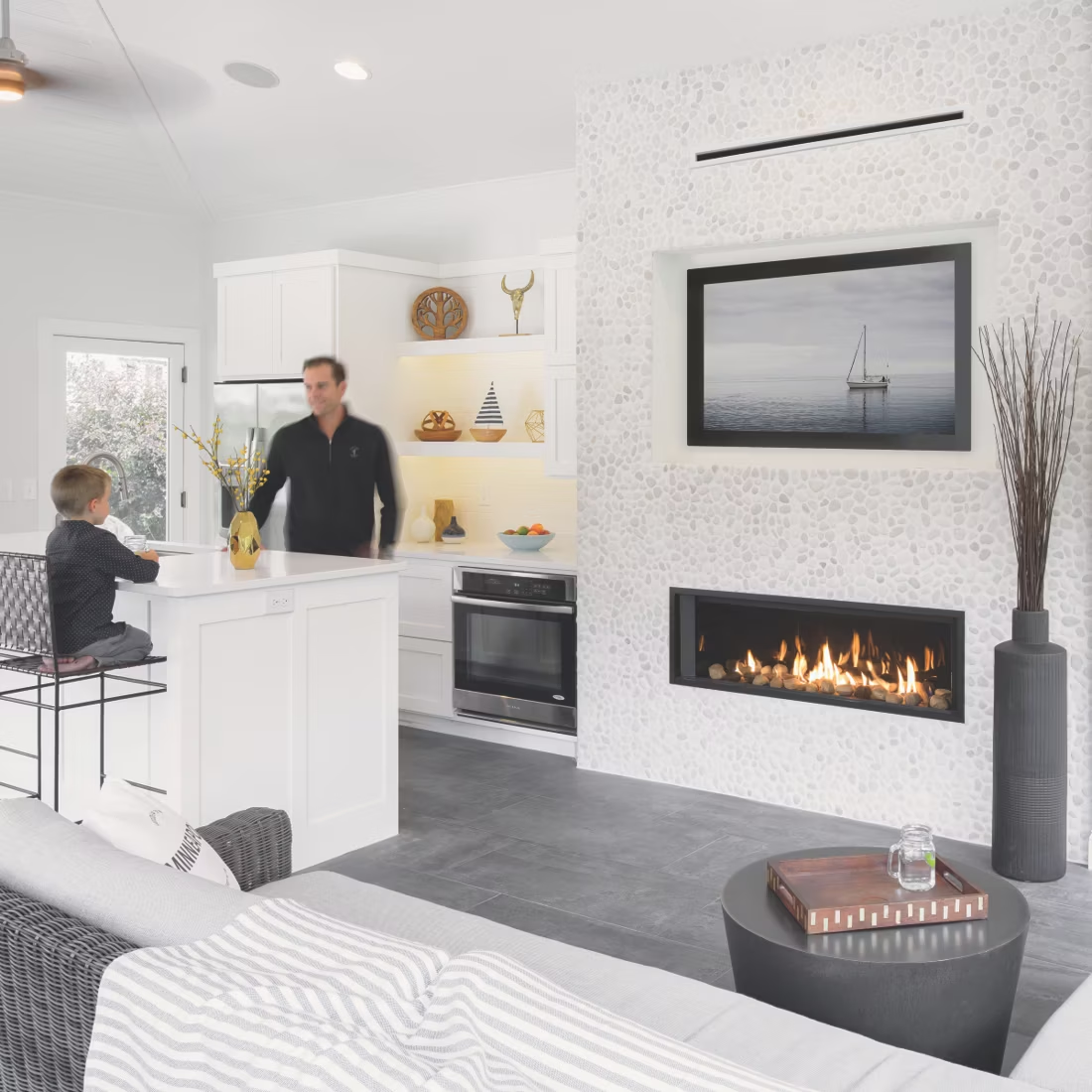
Smithfield sits in a high mountain valley where winter inversions trap smoke close to the ground. Gas delivers real heat without adding to the haze. Find the right unit and connect with a trusted local dealer.
Every Project Starts From One of These Five Situations
When the inversion settles in, gas keeps burning clean.
At 4,637 feet in the Cache Valley, Smithfield sees roughly 6,865 heating degree days a year and average winter lows around 15°F—a climate more in line with Bozeman, Montana than most of the Wasatch Front. The Bear River Range boxes the valley in on both sides, and that same geography that makes it beautiful also traps cold, stagnant air against the valley floor for days at a stretch every winter.
That trapped air is the reason wood heat has largely fallen out of favor here. Cache Valley is a federal PM2.5 nonattainment area, and mandatory burn restrictions kick in on Red and sometimes Yellow air quality days, which can mean weeks each winter when solid-fuel appliances legally can't run. Gas fireplaces and inserts aren't subject to those restrictions, which is why they've become the default choice for Smithfield homeowners who want dependable heat through the coldest, stillest stretches of January without watching the daily air quality forecast.
Three steps. No salesperson until you're ready.
Tell us about your project
Your zip code, your situation, and the fuel you're leaning toward—or let the answers point you to one.
See what's actually available
The brands dealers within 100 miles genuinely carry—real options, never a catalog mirage.
Get your dealer & Project Guide
A trusted local dealer, plus the free Project Guide & Parts List that names every component of the job.
Frequently Asked Questions
How much does a gas fireplace installation cost in Smithfield?
Most gas fireplace and insert installations in Smithfield run between roughly $4,500 and $10,000, depending on the unit, the venting path, and whether new gas line work is required. A direct-vent insert going into an existing masonry fireplace with a gas line already run to that wall lands on the lower end. New construction or a fireplace added to a room that never had one—requiring framing, a new gas line, and full venting—sits toward the higher end. A local dealer will give you a firm number after walking your home, since venting distance and gas line routing through a finished basement can move the price more than the fireplace itself does.
Can I convert my old wood-burning fireplace to gas?
Yes, and it's one of the more common projects in this part of Cache Valley, particularly in the older homes around Smithfield's historic core. A gas insert slides into your existing masonry firebox and vents through a stainless liner run up your existing chimney, so you keep the look of the original fireplace while gaining heat that isn't affected by winter burn restrictions. Given how often solid-fuel burning is curtailed here during inversion season, converting an old wood fireplace to gas is often the single best fix for a fireplace that's sat unused half the winter.
Do I need natural gas service, or can I run on propane?
Either works, and which one applies depends on where in Smithfield you're located. Homes within the city's natural gas service area can tie a fireplace directly into that line, which is the simplest and cheapest setup if you already have a gas furnace or water heater. Homes on the edges of town or out toward the county's more rural stretches sometimes fall outside the gas main and rely on a propane tank instead. Most gas fireplace models can be set up for either fuel—your installer swaps the orifice and regulates the pressure accordingly—so the fireplace itself isn't the limiting factor, your address is.
Will a gas fireplace still work if the power goes out?
Most will, which matters in a valley where winter storms occasionally take down power lines along with the temperature. Units with intermittent pilot ignition (IPI) run on a small battery backup that kicks in the moment power drops, so the fireplace lights and operates normally off batteries until service is restored—just remember to swap those batteries once a year. Valor fireplaces take a different approach: the pilot's thermocouple generates its own electricity, so there's no battery to remember at all. For a Smithfield home where you want heat you can count on during a January outage, ask your local dealer about the ignition system before you commit to a model.
What's the difference between a gas fireplace, insert, and stove?
A gas fireplace is a fully built-in unit framed into a wall, typically chosen for new construction or a remodel. A gas insert is built to slide into an existing masonry firebox, turning an old wood-burning fireplace into a sealed, efficient gas unit that vents through the existing chimney. A gas stove is a freestanding cabinet-style unit that sits on the floor, similar in footprint to a wood stove but running on gas. For the many Smithfield homes with an original wood fireplace that's gone unused during burn-restriction days, an insert is usually the straightforward upgrade. New spaces without an existing chimney are better suited to a built-in fireplace or a freestanding stove.
Do I need a permit to install a gas fireplace in Smithfield?
Yes. New gas fireplace installations require a building permit through the City of Smithfield, and any new or modified gas line needs to be run and permitted by a licensed gas-fitter. Most established hearth dealers handle this paperwork as part of the installation, coordinating the gas line, venting, and inspection so you're not managing separate trades yourself. If you're converting an existing wood fireplace to gas, the permit review is generally quicker since the chimney chase and hearth clearances already exist.
Should I get a vented or vent-free gas fireplace given the local air quality?
In Smithfield, this is a more important question than it is in most towns. Vented (direct-vent) gas fireplaces pull combustion air from outside and exhaust all combustion byproducts back outdoors through a sealed pipe—nothing enters the room. Vent-free units burn directly into the living space and release some water vapor and trace combustion gases indoors. Utah permits vent-free units under specific room-sizing and oxygen-sensor rules, but in a valley that already deals with some of the worst wintertime PM2.5 readings in the country during inversions, most local dealers steer Cache Valley homeowners toward direct-vent units. It keeps indoor air quality out of the equation entirely on top of everything already happening outside.
How often does a gas fireplace need to be serviced?
Plan on an annual inspection, ideally in late summer or early fall before the valley's inversion season sets in and you start relying on the fireplace daily. A technician checks the burner, pilot assembly, venting, and gas connections, and cleans the glass and interior components. This is a much smaller job than a wood chimney sweep—usually $150 to $250—but skipping it is the most common reason a fireplace stops igniting reliably right when you need it most, in the middle of a cold snap.
Why does gas make more sense than wood for heating in Smithfield?
Cache Valley's geography is the deciding factor. The same mountains that make the valley scenic also trap cold air and smoke against the ground for days at a time each winter, and Cache County sits in a federal PM2.5 nonattainment area as a result. Utah DEQ mandates solid-fuel burn restrictions on Red and Yellow air quality days, and during a bad inversion stretch that can mean your wood stove or fireplace is off-limits for a week or more—even though permits for cutting pinyon, juniper, or aspen on the Uinta-Wasatch-Cache National Forest are cheap and easy to get. Gas fireplaces aren't subject to those restrictions, run whenever you want, and don't add particulate matter to air that's often already struggling to meet federal standards. That combination is why gas, not wood, has become the practical default for supplemental and even primary hearth heat in Smithfield.
What's the difference between an insert and a zero-clearance fireplace?
An insert is a fireplace that slides into a pre-existing wood-burning fireplace—if you don't have one, there's nothing to insert it into. A zero-clearance fireplace is built into a framed wall, which makes it the answer for remodels and new construction. Simple test: existing masonry fireplace means insert; blank or framed wall means zero-clearance.
Why is a fireplace insert so efficient?
An insert does two things: it seals the chimney completely, so you stop losing air you already paid to heat, and it radiates warmth into the room through the firebox and glass. Most add a heat-exchange fan that pulls cool room air underneath, wraps it around the hot firebox, and pushes it back out warm. Your home is more efficient before you've even lit the first fire.
Can I install a fireplace myself?
If you're putting a fire in your house on purpose, it's best to work with an expert. Unless you're genuinely experienced in framing, gas line, vent pipe, and the national code on clearances to combustibles, have a professional do it—and ideally the same company that sells you the fireplace, so warranty, service, and liability all live under one roof.
Can a fireplace actually lower my heating bill?
Yes—by creating a comfort zone. A furnace heats every square foot of the house just to warm the one room you're in; a gas fireplace on low burns roughly a sixth of the gas a typical furnace does. Set the furnace around 55–60 degrees as a baseline, then heat the rooms your family actually uses. Families who heat this way commonly save $20–$60 a month.
Nearby Dealers
Hearth shops serving Smithfield and the surrounding area. Every listing shows whether it is a WhyFire partner, a dealer we have verified as authorized for the brands we recommend, or a local business carrying hearth products. No manufacturer pays for placement. How we verify dealers →
Gary Ricks Services
Advanced Fireplace And Stove
Western Mechanical
Standard Plumbing - Logan
Tremonton Heating & Cooling
Mr Cool Inc
Chim Chiminey Fireplace
Find your gas fireplace in Smithfield.
Tell us a bit about your home and we'll match you with the right gas fireplace, insert, or stove, plus a free Project Guide & Parts List with the exact venting and parts your installer will need—and a trusted local dealer to install it.
Find Your Fireplace →