
Warmth That Plugs In—No Chimney Required.
Zone heat and real ambiance for Mountain Green homes, without venting, gas lines, or masonry work. Find the right unit and get matched with a trusted local dealer.
Every Project Starts From One of These Five Situations
Clean heat for a growing mountain valley town.
Mountain Green sits at nearly 4,900 feet along the Weber River, tucked between Ogden and the town of Morgan on the I-84 corridor. Winters here are genuinely cold—average lows near 20°F and roughly 6,100 heating degree days a year, a heating season on par with towns like Helena, Montana. As a small but fast-growing community of newer homes, additions, and finished basements, Mountain Green has a lot of rooms that were never built with a masonry chimney in mind.
That's where electric fireplaces do their best work. There's no venting to run, no gas line to trench, and no combustion byproducts to manage—which matters in a valley where wildfire smoke already affects summer and fall air quality. PacifiCorp and Morgan City supply power locally at a relatively low residential rate, which keeps day-to-day operating costs modest for a fireplace used as supplemental zone heat rather than a whole-house furnace replacement.
Three steps. No salesperson until you're ready.
Tell us about your project
Your zip code, your situation, and the fuel you're leaning toward—or let the answers point you to one.
See what's actually available
The brands dealers within 100 miles genuinely carry—real options, never a catalog mirage.
Get your dealer & Project Guide
A trusted local dealer, plus the free Project Guide & Parts List that names every component of the job.
Frequently Asked Questions
How much does it cost to install an electric fireplace in Mountain Green?
Plug-in electric inserts and freestanding stove-style units typically run $300 to $1,500 installed, and many need nothing more than a standard 120-volt outlet—no electrician required. Built-in wall units, linear models set into a framed wall, or larger inserts that need a dedicated 240-volt circuit run closer to $1,500 to $3,500 once an electrician's time is factored in. Because most Mountain Green homes are newer wood-frame construction without an existing masonry fireplace, installs here are usually straightforward: no chimney, no liner, no gas line.
Do I need a permit to install an electric fireplace in Morgan County?
A plug-in electric fireplace or insert that uses an existing outlet generally doesn't require a permit. If your installer needs to add a new dedicated circuit or run wiring into a wall for a built-in unit, that electrical work does require a permit through Morgan County—Mountain Green is unincorporated, so the county handles permitting rather than a separate city building department. Any licensed electrician doing the circuit work will typically pull this permit as part of the job.
Will an electric fireplace actually heat my home during Mountain Green's cold winters?
Not as a whole-house solution. Most electric fireplaces run on a standard 1,500-watt heater element, good for comfortably warming a single room of 400 to 1,000 square feet—not a 4,900-foot-elevation home on a 20°F night. Think of it as zone heat: it takes the edge off a bonus room, finished basement, or home office so you can turn down the central thermostat, rather than replacing your furnace. For homes here relying on electric as a primary heat source, talk to a local dealer about BTU output and room size before buying.
What's the difference between an electric insert and a built-in wall unit?
An electric insert is designed to slide into an existing fireplace opening—useful if a Mountain Green home has an old wood-burning firebox that's no longer used and the homeowner wants flame effect and heat without dealing with wood or gas. A built-in wall unit is framed into new construction or a remodel, often as a linear, widescreen-style unit set flush into drywall with no visible fireplace opening at all. Given how many homes in town are newer builds without existing fireplaces, built-in wall units and freestanding mantel packages are actually more common here than insert conversions.
Will my electric fireplace still work if the power goes out?
No—and this is worth being direct about. Electric fireplaces need power to run, full stop, unlike a gas unit with battery-backup ignition or a wood stove that burns regardless of the grid. Weber Canyon and the I-84 corridor do see occasional winter storm outages, so if backup heat during a power failure matters to you, an electric fireplace shouldn't be your only heat source in the home. Many Mountain Green homeowners pair electric fireplaces for everyday ambiance and zone heat with a furnace or generator for outage coverage.
Electric vs. gas—which is right for my Mountain Green home?
Gas fireplaces put out real heat—often 20,000 to 40,000 BTU—and many models keep working during a power outage with battery-backup ignition, which matters given occasional winter outages in this area. But gas installs mean venting, a gas line, and in parts of Mountain Green that means propane rather than piped natural gas, so service availability at your specific address is worth checking with a local installer. Electric skips all of that: no venting, no fuel line, installed in an afternoon, but it won't heat a large room on its own and it goes dark with the grid. For a supplemental-heat accent in a finished basement or bonus room, electric usually wins on simplicity. For real heat output and outage resilience, gas is the stronger choice.
How much will an electric fireplace add to my power bill?
At PacifiCorp and Morgan City's residential rate of about $0.1252 per kWh, a typical 1,500-watt electric fireplace costs roughly $0.19 per hour to run on high heat. Used five hours an evening through a Mountain Green winter, that's about $0.94 a day, or a little under $30 a month—noticeably cheaper than running central heat harder in a drafty room. Most units let you run flame effect alone (a few watts) without the heater engaged, which cuts that cost to nearly nothing if you just want ambiance.
Why don't I see more wood or pellet stoves in Mountain Green?
Wood and pellet heating are genuinely uncommon here. Periodic wildfire smoke in the Weber River valley makes solid-fuel burning a harder sell for everyday use, and few dealers in a town this size stock and service wood or pellet appliances. Cutting permits are technically available through the Uinta-Wasatch-Cache National Forest (May through October, $5 to $20 per cord), but that firewood is typically used for camping and recreational fires rather than home heating systems. If you want a real flame and heat without those tradeoffs, gas and electric are the practical local options.
Where can I put an electric fireplace in my home?
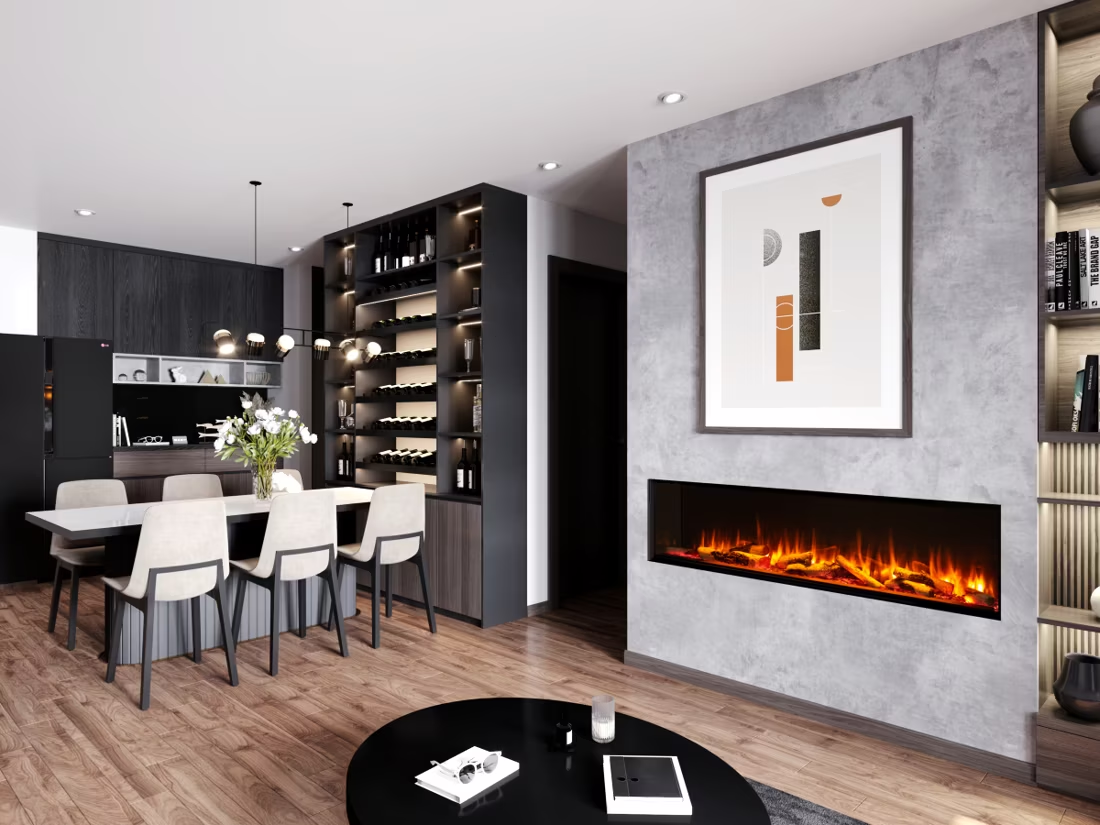
Almost anywhere with an outlet. Wall-mounted linear units work well above a media console or built into a accent wall in a living room, TV-stand inserts combine the fireplace with furniture in one piece, and mantel packages give a traditional look in a room that never had a fireplace to begin with. They're a particularly good fit for Mountain Green's finished basements and additions—rooms added after the original build that don't connect to an existing chimney or gas line—and for renters, since a freestanding or plug-in unit requires no permanent modification to the home.
Can I put a TV above my fireplace?
Yes—with an asterisk. Fireplaces are hot and TVs don't like heat. Either put a mantel between them to deflect rising warmth, or choose a fireplace with heat-management technology that creates a cool zone on the wall above—the wall stays around 125 degrees, barely warm, while the room still gets full heat. If you like clean lines and don't want a mantel, heat management is the answer.
Do electric fireplaces actually produce heat?
Yes—most put out around 4,800–5,000 BTUs from a standard outlet, which comfortably warms a bedroom, office, or den as a comfort-zone heater. What they won't do is carry a whole house the way wood, gas, or pellet can. Think of electric as ambiance-first with honest supplemental heat: flames on with no heat in July, flames plus warmth in January.
How much should I budget for a fireplace?
For an average home—covering the fireplace, the vent pipe, and basic installation—a budget between $3,900 and $5,500 gives you a lot of options across wood, gas, and pellet. By the time you add finish work, gas line, and electrical, the average complete installation lands between $5,000 and $12,000 all-in. In a remodel or new build, a good rule is to put about 2.5% of the total project cost toward the fireplace.
What is an in-home preview and do I need one?
It's a visit where a hearth professional measures your space, confirms the model you picked actually works in your home, and walks the specs—framing, gas line, venting, finish work—before anything is ordered. Some details you just can't know until you see the house. Never make a down payment without one; it's the single most-skipped step that burns buyers.
Nearby Dealers
Hearth shops serving Mountain Green and the surrounding area. Every listing shows whether it is a WhyFire partner, a dealer we have verified as authorized for the brands we recommend, or a local business carrying hearth products. No manufacturer pays for placement. How we verify dealers →
Timber Ridge Fireplace
Rocky Mountain Stove
Stone World Supply
Ogden Lawn & Garden
Comfort Solutions
Hearth & Home Dist. Of UT-Ogden
Utah Air
Croft Fireplaces (Bountiful)
Electric Service in Mountain Green
An electric fireplace's heater draws about 1,500 watts—pennies per hour at local rates.
Morgan City - (Ut)
Find your electric fireplace in Mountain Green.
Tell us about your room and your goals, and we'll match you with a trusted local dealer and send over a free Project Guide & Parts List—the right unit, the exact parts, and a plan sized for your home.
Find Your Fireplace →