
Built for a climate where cold snaps are the exception, not the rule.
At 5 feet of elevation on Galveston Bay with one of the mildest winter heating seasons around and winter lows averaging 49°F, Tiki Island doesn't need a furnace-replacement fireplace. We'll help you find a trusted local dealer who knows what actually installs well on an elevated island home.
Every Project Starts From One of These Five Situations
Comfort for the handful of nights it actually gets cold.
Tiki Island sits in climate zone 2A, a hot-humid Gulf Coast zone where the entire winter's heating need is just a fraction of what a place like Duluth or Fargo racks up in a single month of real winter. Most years, a gas fireplace here is doing ambiance duty and the occasional January cold snap—not carrying the house through a six-month heating season. That said, Texas has learned the hard way, in events like the February 2021 freeze, that even a mild-winter island can see hard cold for a few days, and a gas fireplace that fires instantly without a generator is worth having when temperatures on the bay drop into the 20s.
Tiki Island is small enough, and far enough out on its own causeway-connected spit of land, that natural gas mains aren't a given the way they are closer to Houston proper—plenty of homes here run on a propane tank instead, with CenterPoint Energy's natural gas footprint more reliably reaching the mainland side of Galveston County. Electric service comes through a mix of Texas-New Mexico Power, CenterPoint, and Entergy Texas depending on exactly where on the island you sit, at a residential rate around 13.66 cents per kWh. Given how often hurricanes and tropical storms knock out power along the bay—Ike and Harvey both left parts of Galveston County dark for a week or more—a gas fireplace with a battery-backed ignition system is one of the more practical hedges an island homeowner can make.
Three steps. No salesperson until you're ready.
Tell us about your project
Your zip code, your situation, and the fuel you're leaning toward—or let the answers point you to one.
See what's actually available
The brands dealers within 100 miles genuinely carry—real options, never a catalog mirage.
Get your dealer & Project Guide
A trusted local dealer, plus the free Project Guide & Parts List that names every component of the job.
Frequently Asked Questions
How much does a gas fireplace installation cost on Tiki Island?
Expect somewhere in the $4,000 to $9,500 range for most direct-vent installs, with the spread driven less by the fireplace itself and more by how your home is built. A lot of Tiki Island houses sit elevated on pilings per FEMA flood requirements, and running gas line and venting up through an elevated floor system takes more planning—and more labor—than a slab-on-grade install on the mainland. A straightforward insert into an existing opening lands toward the low end; new venting through an elevated structure with a propane tank set pushes toward the top.
Should I plan on natural gas or propane for a fireplace here?
Propane is the more realistic default for most Tiki Island addresses. Natural gas mains from CenterPoint Energy serve a good chunk of Galveston County, but coverage thins out on smaller, more isolated footprints like this one, and many island homes already run their water heater or range off a propane tank. If you're not already on natural gas, your local dealer will typically spec the fireplace for propane and work out tank placement—worth discussing early, since pilings and tight canal-front lots limit where a tank can legally sit.
Do I need a permit to install a gas fireplace on Tiki Island?
Yes. Despite its population of around 1,100, Tiki Island is its own incorporated village with a Building Department that handles permitting, and any gas line work also requires a licensed gas-fitter. Elevated homes add a wrinkle: the permit review often includes how the gas line and vent penetrate the raised floor system, since that framing is tied to flood-compliance rules. Most hearth dealers who regularly work the island already know the Village's process and fold the permit into the installation timeline.
Will a gas fireplace keep working if the power goes out during a hurricane?
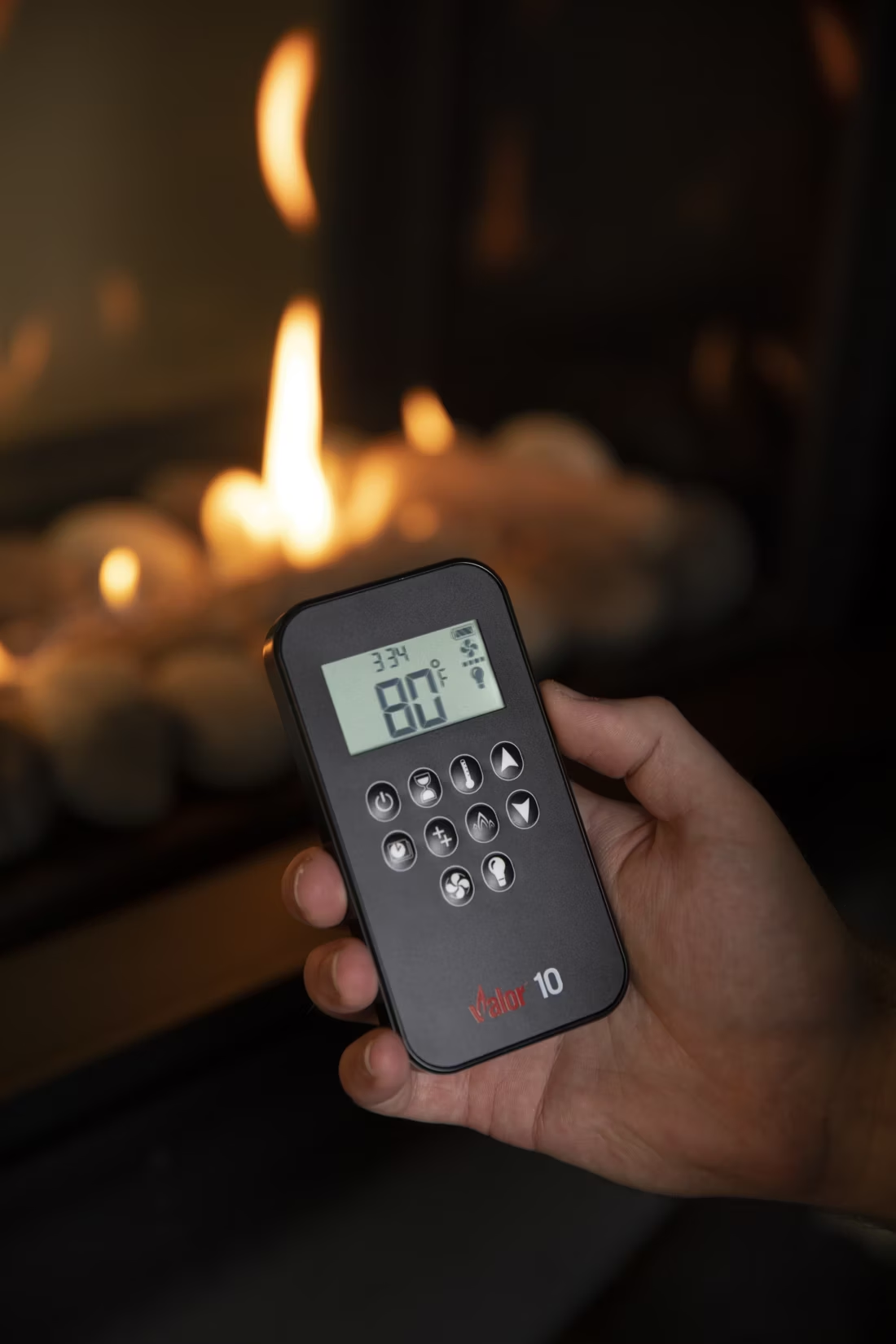
It can, if you choose the right ignition system—and on an island reached by a single causeway, that's not a small consideration. Units with intermittent pilot ignition (IPI) run their control board and valve off AA batteries that kick in automatically when the grid drops. Valor fireplaces go a step further and skip batteries altogether, since their pilot's thermocouple generates its own current. After storms like Ike and Harvey left parts of Galveston County without power for a week or more, a lot of island homeowners treat battery-backup ignition as a baseline requirement, not an upgrade.
Vented vs. vent-free gas fireplaces—does Gulf Coast humidity change the answer?
It pushes the answer further toward direct-vent. Vent-free units burn into the room and release moisture as a combustion byproduct, which is the last thing a home already dealing with Gulf humidity and salt air needs working against window seals and interior finishes. Direct-vent units pull outside air for combustion and exhaust everything back outside through sealed pipe, keeping that moisture load off the house entirely. It's the setup most local dealers install by default on the island, humidity concerns aside.
Does salt air affect gas fireplace venting equipment here?
It does, more than it would 20 miles inland. Standard galvanized vent components can corrode faster in a canal-front, salt-spray environment than manufacturer literature assumes, which is why dealers who regularly install on Tiki Island and the rest of the bay tend to default to stainless steel venting even when a cheaper option is technically code-compliant. It costs a bit more up front but avoids a vent replacement years sooner than expected—a known issue for homes within a block or two of open water.
What size gas fireplace do I actually need in a climate this mild?
Smaller than you'd guess from the fireplace's visual presence. With winter lows averaging 49°F and a winter heating season that barely adds up most years, a Tiki Island living room almost never needs a high-BTU unit sized for all-day heating—oversizing just means you're opening windows to cool the room down on a 55-degree evening. Most local installs land in a modest BTU range chosen for ambiance and occasional-use comfort, with your dealer sizing against the room's actual volume rather than treating it like a primary heat source.
How often does a gas fireplace need servicing in a humid bay climate?
An annual check is still the standard recommendation, but on Tiki Island it's worth timing it in spring, after hurricane season planning is behind you and before the brief late-year cold snaps arrive. A technician checks the burner, pilot or ignition module, gas connections, and venting—and on an island with heavy salt air, that vent inspection carries a little more weight than it would inland, since corrosion can progress faster than a standard service interval assumes. Plan on roughly $150-$250 for a routine visit.
Gas vs. wood—why isn't wood heat really a thing on Tiki Island?
Oak, pecan, and mesquite are all common Gulf Coast woods, but around here they're split for the smoker and the grill far more often than for a fireplace. With such a mild, short heating season and winter lows rarely troubling the 40s, there's little practical need for a wood-burning heat source, and the Gulf humidity makes seasoning and storing firewood outdoors genuinely difficult without mold and pest problems. A small number of island homeowners still install a wood-burning unit purely for look and feel, but gas is the overwhelming choice for anyone who wants real heat on the rare cold night without the upkeep.
What's the difference between an insert and a zero-clearance fireplace?
An insert is a fireplace that slides into a pre-existing wood-burning fireplace—if you don't have one, there's nothing to insert it into. A zero-clearance fireplace is built into a framed wall, which makes it the answer for remodels and new construction. Simple test: existing masonry fireplace means insert; blank or framed wall means zero-clearance.
Is my gas fireplace wasting gas?
If it was installed more than 15 years ago, probably. Older gas fireplaces keep a standing pilot light burning all the time, and that little flame can cost a couple hundred dollars a year. Newer models use pilot-on-demand ignition—the pilot lights only when you use the fireplace and goes out when you turn it off.
Can a fireplace actually lower my heating bill?
Yes—by creating a comfort zone. A furnace heats every square foot of the house just to warm the one room you're in; a gas fireplace on low burns roughly a sixth of the gas a typical furnace does. Set the furnace around 55–60 degrees as a baseline, then heat the rooms your family actually uses. Families who heat this way commonly save $20–$60 a month.
What is an in-home preview and do I need one?
It's a visit where a hearth professional measures your space, confirms the model you picked actually works in your home, and walks the specs—framing, gas line, venting, finish work—before anything is ordered. Some details you just can't know until you see the house. Never make a down payment without one; it's the single most-skipped step that burns buyers.
Nearby Dealers
Hearth shops serving Tiki Island and the surrounding area. Every listing shows whether it is a WhyFire partner, a dealer we have verified as authorized for the brands we recommend, or a local business carrying hearth products. No manufacturer pays for placement. How we verify dealers →
We’ve paused dealer listings for this connection today. Enter your zip or postal code above to find dealers near you, or come back tomorrow.
Popular Gas Brands
Where each brand came from, what's inside it today, and every current model. No brand pays to be here. Not every dealer carries every brand, so enter your zip code to see what's sold near Tiki Island.
Kozy Heat
Kozy Heat was founded in 1976 by Dudley Hussong in Lakefield, Minnesota, and incorporated as Hussong Manufacturing Co., Inc. in 1978.
28 gas models →Fireplace Xtrordinair
Fireplace Xtrordinair, now often called FireplaceX, is the fireplace brand of Travis Industries, Inc., of Mukilteo, Washington.
25 gas models →Town & Country
Town & Country Fireplaces is the luxury gas fireplace brand of Pacific Energy Fireplace Products Ltd., of Duncan, British Columbia.
14 gas models →Lopi
Lopi is a wood, pellet, and gas stove brand founded by Kurt Rumens in Bellevue, Washington, in 1979.
7 gas models →Forge & Flame
Forge & Flame is the stove brand Hearth & Home Technologies introduced in August 2023 to bring Vermont Castings, Harman, and Quadra-Fire under one name.
6 gas models →Vermont Castings
Vermont Castings was founded in 1975 by Duncan Syme, the designer, and his brother-in-law Murray Howell, the business partner, in Randolph, Vermont.
6 gas models →Get your free Project Guide & Parts List for a Tiki Island gas fireplace.
Tell us about your home—elevated on pilings or slab, propane or natural gas access—and we'll help you find a trusted local dealer and send a free Project Guide & Parts List with the exact vent kit and parts your project needs.
Find Your Fireplace →