
Instant Warmth for Georgetown's Mild Winter Nights.
Georgetown winters rarely demand heavy heat, but a gas fireplace still earns its keep during Hill Country cold snaps and grid stress. Find the right unit and connect with a trusted local dealer.
Every Project Starts From One of These Five Situations
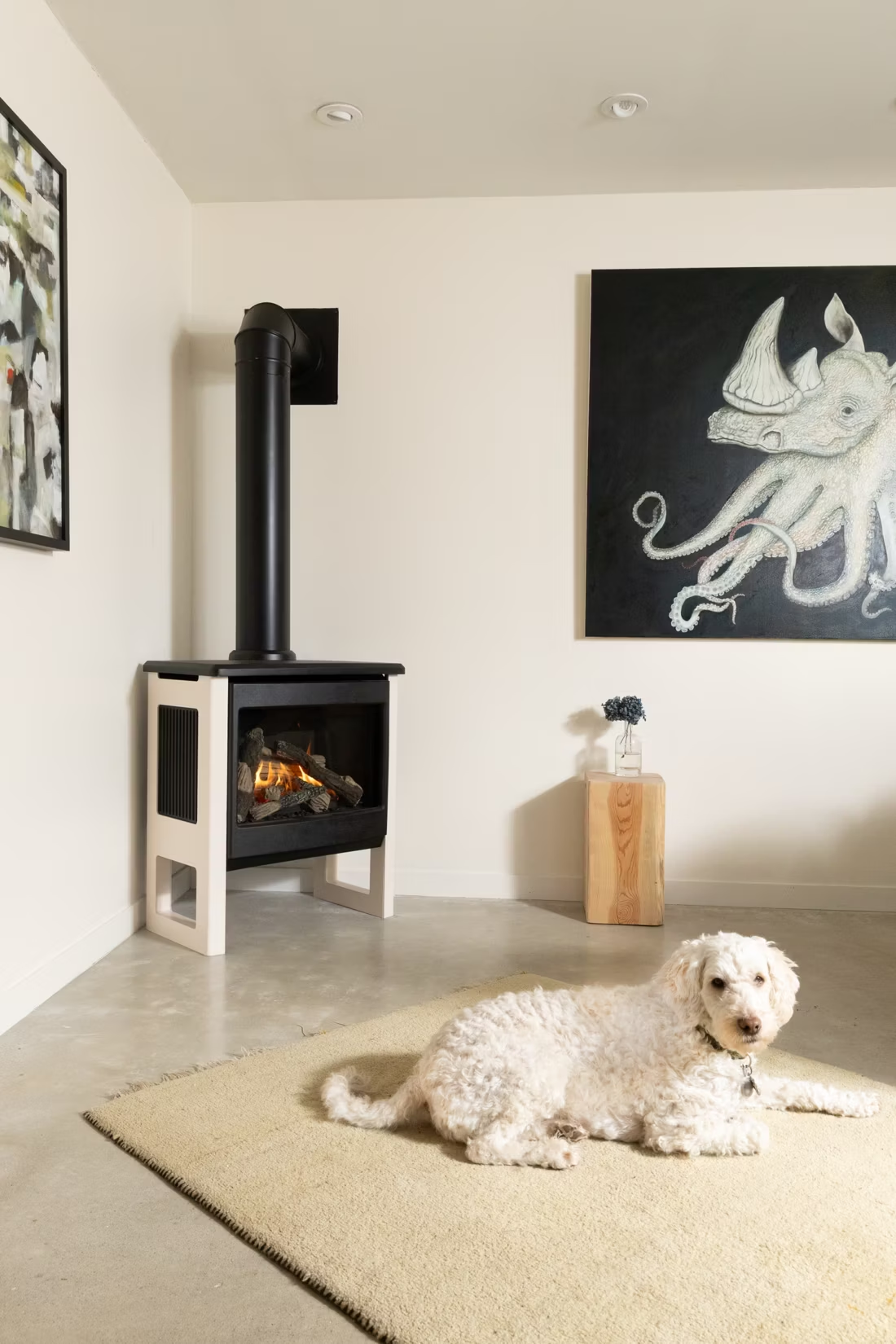
Ambiance-first heat for Hill Country winters.
Georgetown sits at roughly 789 feet in climate zone 2A, where the average winter low hovers around 36°F and the city has a light, mild winter heating season—a fraction of what a place like Duluth, Minnesota racks up in a single January. Wood heat has essentially no functional role here; oak, pecan, and mesquite are far more common on a backyard smoker than in a firebox. Gas, on the other hand, fits Georgetown well: it delivers real ambiance and quick supplemental warmth on the handful of nights each winter when temperatures actually drop, without asking homeowners to manage a wood-burning setup they'd rarely use.
Most homes inside Georgetown proper have access to natural gas service, while parts of the surrounding Williamson County zip codes—including areas around Sun City and the more rural edges of 78633 and 78628—rely on propane instead. Either fuel works well in a modern direct-vent fireplace or insert. There's also a very Texas-specific reason to care about how your fireplace performs without power: after Winter Storm Uri strained ERCOT and left homes served by Oncor, Bluebonnet Electric Cooperative, and Bartlett Electric Cooperative without power for days, more Georgetown homeowners started asking installers specifically about standing-pilot and battery-backup gas units. I match homeowners here with a trusted local dealer who can size the right unit, pull permits through the City of Georgetown, and get the gas line and venting done correctly—no big-box guesswork, and I don't take manufacturer money to steer the recommendation.
Three steps. No salesperson until you're ready.
Tell us about your project
Your zip code, your situation, and the fuel you're leaning toward—or let the answers point you to one.
See what's actually available
The brands dealers within 100 miles genuinely carry—real options, never a catalog mirage.
Get your dealer & Project Guide
A trusted local dealer, plus the free Project Guide & Parts List that names every component of the job.
Frequently Asked Questions
How much does a gas fireplace installation cost in Georgetown?
A direct-vent gas insert into an existing masonry fireplace typically runs $4,000 to $8,500 in Georgetown, depending on the unit and whether a gas line already reaches the firebox. A new built-in gas fireplace for a remodel or addition—with framing, venting, and a fresh gas line run from the meter—usually falls between $6,000 and $12,000. Many newer Georgetown subdivisions near Rancho Sienna or Wolf Ranch are already stubbed for gas, which keeps costs toward the lower end. Homes relying on propane instead of piped natural gas may see a modest add for regulator and line work.
Does a gas fireplace even make sense in a climate as mild as Georgetown's?
It does, just for a different reason than in colder states. With winter lows averaging around 36°F and a mild, short winter heating season, Georgetown homeowners aren't leaning on a fireplace to survive January the way someone in Bozeman, Montana would. Here, gas fireplaces are chosen mainly for ambiance, for the handful of genuinely cold nights each winter, and increasingly as a hedge against ERCOT grid strain. A smaller-BTU direct-vent unit is usually plenty—you don't need the oversized, high-output stove a cold-climate home would require.
Should I install a natural gas or propane fireplace in Georgetown?
If your home is inside city limits with existing natural gas service, sticking with natural gas is simplest and usually cheaper to run. If you're in one of the more rural parts of Williamson County—some pockets of 78633 or 78628 outside the main gas distribution lines—propane is the standard alternative, either from an existing tank or a new tank set by a local propane supplier. Most gas fireplace models can be configured for either fuel; your installer sets the correct orifice and regulator for whichever you have.
Will my gas fireplace still work if the power goes out?
Many will, which matters more in Georgetown than the mild climate alone would suggest. Winter Storm Uri showed how fast ERCOT grid strain can leave Oncor, Bluebonnet Electric Cooperative, and Bartlett Electric Cooperative customers without power during a cold snap. Gas fireplaces with IPI (intermittent pilot ignition) run on AA battery backup that kicks in automatically when power drops. Valor units go a step further—the pilot's thermocouple generates its own electricity, so there are no batteries to remember at all. If outage-proof heat is a priority, ask your local dealer specifically about the ignition system before you buy.
What's the difference between a gas fireplace, gas insert, and gas stove?
A gas fireplace is a fully built-in unit framed into a wall—the common choice for new construction or additions without an existing chimney. A gas insert drops into an existing masonry firebox and uses the chimney as its vent path, which is the more common project in Georgetown's older neighborhoods near the historic square that still have wood-burning fireplaces. A gas stove is a freestanding unit that sits on the floor like a wood stove but burns gas, often chosen for sunrooms or additions. For most Georgetown homes with an existing hearth, an insert is the straightforward upgrade.
Do I need a permit to install a gas fireplace in Georgetown?
Yes—the City of Georgetown Development Services requires a building permit for the installation, and any new gas line work has to be done by a licensed gas-fitter and inspected separately. Most established local hearth dealers handle the permitting and coordinate the gas line, framing, and venting inspections as part of the job, so you're not left managing multiple trades and city sign-offs yourself.
Vented or vent-free—which makes more sense for a Georgetown home?
Vented (direct-vent) gas fireplaces draw combustion air from outside and exhaust it back outside through sealed venting, and they're the default recommendation almost everywhere, including Georgetown. Vent-free units are legal in Texas and get used occasionally in additions or garage conversions that don't have an existing flue, but because Georgetown's climate zone 2A already deals with high humidity for much of the year, adding a vent-free unit's combustion moisture into the living space is a tradeoff worth thinking through with your installer. For a primary living area, a vented direct-vent fireplace is almost always the better call here.
How often does a gas fireplace need to be serviced in Georgetown?
Plan on an annual inspection, ideally in early fall before the first cold front rolls through Central Texas. A technician checks the burner, pilot assembly, venting, and gas connections, and cleans the glass and interior. It's a lighter lift than wood-stove chimney sweeping, but skipping it is still the main reason units develop sooting or ignition problems. Local gas appliance service techs in the Georgetown-Round Rock area typically charge $150 to $225 for a standard annual visit.
What's the best type of gas fireplace for a Georgetown home?
Given how mild the winters run here, most homeowners are better served by a mid-size direct-vent fireplace chosen for its look and glass-front design—linear, contemporary units are popular in newer Georgetown builds—rather than the high-output, long-burn-time stoves you'd see recommended in a place like Fargo, North Dakota. If backup heat during a grid outage matters to you, prioritize a model with standing pilot or a Valor self-powering ignition system over raw BTU output. A local dealer can walk you through options that match both your room size and your outage tolerance.
Is my gas fireplace wasting gas?
If it was installed more than 15 years ago, probably. Older gas fireplaces keep a standing pilot light burning all the time, and that little flame can cost a couple hundred dollars a year. Newer models use pilot-on-demand ignition—the pilot lights only when you use the fireplace and goes out when you turn it off.
What's the difference between an insert and a zero-clearance fireplace?
An insert is a fireplace that slides into a pre-existing wood-burning fireplace—if you don't have one, there's nothing to insert it into. A zero-clearance fireplace is built into a framed wall, which makes it the answer for remodels and new construction. Simple test: existing masonry fireplace means insert; blank or framed wall means zero-clearance.
What is an in-home preview and do I need one?
It's a visit where a hearth professional measures your space, confirms the model you picked actually works in your home, and walks the specs—framing, gas line, venting, finish work—before anything is ordered. Some details you just can't know until you see the house. Never make a down payment without one; it's the single most-skipped step that burns buyers.
Does a fireplace add value to my home?
On average, a fireplace adds back to the home about the same amount you spent installing it. Add the monthly savings from heating the rooms you actually use instead of the whole house—often hundreds of dollars a year—and the value case is strong before you even count what a fire does for how your family uses the room.
Nearby Dealers
Hearth shops serving Georgetown and the surrounding area.
Find your gas fireplace in Georgetown.
Tell us a bit about your home and we'll put together a free Project Guide & Parts List for your Georgetown gas fireplace project—the right unit, the vent kit, and a trusted local dealer to install it.
Find Your Fireplace →