
Find the right gas fireplace for your Frisco home.
Frisco winters rarely demand much heat, but a gas fireplace still earns its keep—for ambiance most nights and real backup warmth on the rare hard freeze. Find the right unit and connect with a trusted local dealer.
Every Project Starts From One of These Five Situations
Built-in ambiance for a mild-winter boomtown.
Frisco sits in climate zone 3A with an average winter low of just 36°F and roughly 2,294 heating degree days a year—a fraction of what a place like Duluth, Minnesota racks up in a single hard month. That mild profile is exactly why gas dominates the fireplace conversation here: with a population that's grown past 202,000 in the last two decades, most Frisco homes are recent construction, and builders across the 75034-75036 corridor default to gas log sets or direct-vent gas fireplaces as a standard amenity, not a primary heat source.
Frisco's electric service is split across Oncor Electric Delivery, Texas-New Mexico Power, and Denton County Electric Cooperative depending on which side of the city you're on—and after Winter Storm Uri in February 2021, plenty of homeowners here learned firsthand what it means when the ERCOT grid buckles during a freeze. A gas fireplace with battery-backed ignition doesn't solve a statewide grid failure, but it does mean your living room stays warm and lit when the power doesn't. Add in the fact that a well-chosen gas insert or fireplace looks better, burns cleaner, and requires none of the wood handling a Frisco lot rarely has room for anyway, and it's easy to see why gas is the default here.
Three steps. No salesperson until you're ready.
Tell us about your project
Your zip code, your situation, and the fuel you're leaning toward—or let the answers point you to one.
See what's actually available
The brands dealers within 100 miles genuinely carry—real options, never a catalog mirage.
Get your dealer & Project Guide
A trusted local dealer, plus the free Project Guide & Parts List that names every component of the job.
Frequently Asked Questions
How much does a gas fireplace installation cost in Frisco?
A full gas fireplace or insert installation in Frisco typically runs $3,500 to $9,000, depending on whether you're upgrading a builder-grade log lighter, converting an existing masonry fireplace to a sealed direct-vent insert, or installing a new built-in unit during a remodel. Many Frisco homes already have a gas line stubbed to the fireplace from construction, which keeps costs toward the lower end. Homes needing a new gas line run, additional framing, or venting through brick or stone exteriors will land higher. Simply swapping a basic vented log set for a higher-output set with a new burner pan can run as little as $1,500 to $3,000.
My builder installed a gas log lighter—can I upgrade to a real gas fireplace?
Yes, and it's a common project in Frisco's newer subdivisions. Many production-built homes come with a basic open masonry fireplace and a gas log lighter meant for occasional ambiance, not real heat output. Converting to a sealed direct-vent gas insert or a higher-output vented log set can dramatically improve both the look and the heat output while using the gas line and chimney you already have. Costs run $3,500 to $7,000 depending on the insert and whether your existing flue needs a liner.
Do I need natural gas, or can I run a fireplace on propane in Frisco?
Most established Frisco neighborhoods are served by natural gas, so if your home already has gas appliances—a range, water heater, or furnace—adding or upgrading a fireplace is straightforward. Some newer or more rural pockets on the edges of Collin and Denton counties are propane-served instead, which just means a tank and a different regulator setup. Nearly every gas fireplace model on the market can be configured for either fuel; your installer sets the correct orifice and pressure regulator during install.
Will my gas fireplace work if the power goes out?
It can, and after Winter Storm Uri in 2021 this is one of the first questions Frisco homeowners ask. Gas fireplaces with IPI (intermittent pilot ignition) run on a small battery backup—typically AA batteries inside the unit—that keeps the igniter working when Oncor, TNMP, or Denton County Electric Cooperative service drops. Valor units go a step further: their pilot assembly generates its own electricity through the thermocouple, so there's no battery to remember at all. Given how unevenly the Texas grid has performed during hard freezes, that detail is worth asking about when you're comparing models.
What's the difference between a gas fireplace, gas insert, and gas stove?
A gas fireplace is a fully built-in unit framed into a wall—the standard choice for new construction or a remodel where there's no existing fireplace. A gas insert drops into an existing masonry firebox, sealing it up and using the chimney as a vent path while dramatically boosting efficiency over an open log-lighter setup. A gas stove is a freestanding cabinet-style unit, less common in Frisco's newer housing stock but sometimes used in casual or secondary living spaces. For the majority of Frisco homes with an existing builder fireplace, an insert is the most direct upgrade.
Do I need a permit to install a gas fireplace in Frisco?
Yes—the City of Frisco requires a building permit and gas line inspection for new gas fireplace installs or any work that alters existing gas piping, and most local hearth dealers handle that paperwork as part of the install. If you're in one of Frisco's many HOA-governed subdivisions, it's also worth checking with your HOA's architectural review process before changing anything visible from the street, such as a new vent termination on an exterior wall.
Are vent-free gas fireplaces allowed in Frisco?
Yes—Texas permits vent-free (unvented) gas fireplaces, and they show up fairly often in Frisco because they don't require exterior venting, which simplifies installation in interior rooms or condos. Vent-free units burn fuel directly into the living space and rely on room-sizing rules and oxygen depletion sensors for safety. Direct-vent gas fireplaces, which draw combustion air from outside and exhaust it back out through a sealed pipe, remain the more commonly recommended option for full-time use since they don't add moisture or combustion byproducts to the room. A local dealer can walk you through both for your specific space.
How often should a gas fireplace be serviced in Frisco?
An annual inspection is recommended even in a mild climate like Frisco's, where a fireplace might only run occasionally through a short winter. A technician checks the burner, pilot assembly, gas connections, and venting, and cleans the glass and interior—something that matters even more for units that sit unused for months at a stretch, since dust and insects can settle into the burner ports. Most local service providers charge $150 to $250 for a standard annual visit.
Gas vs. wood—does wood even make sense in Frisco?
Not really, and it's worth being upfront about that. With winter lows averaging 36°F and just 2,294 heating degree days a year, Frisco doesn't have the sustained cold that makes wood heat practical the way it is farther north. Wood-burning fireplaces are uncommon in newer Frisco construction—most builders skip them entirely in favor of gas log lighters—though a small number of homeowners with older homes or larger lots still burn oak, pecan, or mesquite for occasional ambiance. For nearly everyone else, gas delivers the same look with none of the wood storage, ash cleanup, or chimney maintenance a wood setup demands.
Can I put a TV above my fireplace?
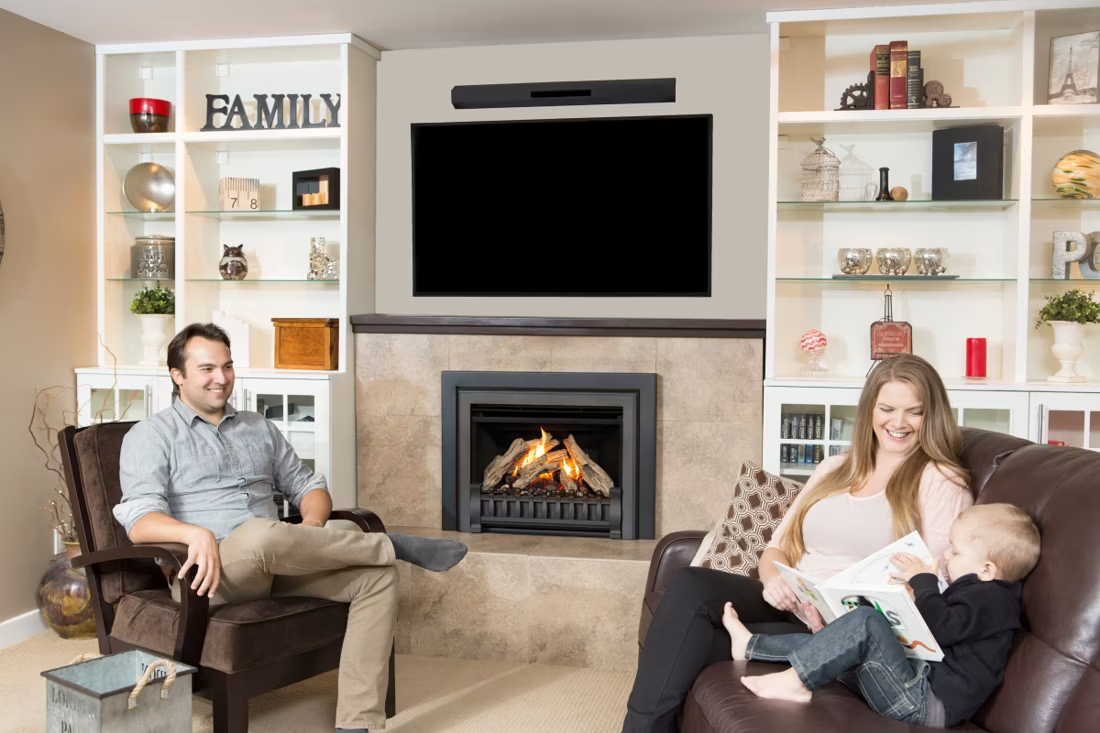
Yes—with an asterisk. Fireplaces are hot and TVs don't like heat. Either put a mantel between them to deflect rising warmth, or choose a fireplace with heat-management technology that creates a cool zone on the wall above—the wall stays around 125 degrees, barely warm, while the room still gets full heat. If you like clean lines and don't want a mantel, heat management is the answer.
Is my gas fireplace wasting gas?
If it was installed more than 15 years ago, probably. Older gas fireplaces keep a standing pilot light burning all the time, and that little flame can cost a couple hundred dollars a year. Newer models use pilot-on-demand ignition—the pilot lights only when you use the fireplace and goes out when you turn it off.
What is an in-home preview and do I need one?
It's a visit where a hearth professional measures your space, confirms the model you picked actually works in your home, and walks the specs—framing, gas line, venting, finish work—before anything is ordered. Some details you just can't know until you see the house. Never make a down payment without one; it's the single most-skipped step that burns buyers.
Can a fireplace actually lower my heating bill?
Yes—by creating a comfort zone. A furnace heats every square foot of the house just to warm the one room you're in; a gas fireplace on low burns roughly a sixth of the gas a typical furnace does. Set the furnace around 55–60 degrees as a baseline, then heat the rooms your family actually uses. Families who heat this way commonly save $20–$60 a month.
Nearby Dealers
Hearth shops serving Frisco and the surrounding area. Every listing shows whether it is a WhyFire partner, a dealer we have verified as authorized for the brands we recommend, or a local business carrying hearth products. No manufacturer pays for placement. How we verify dealers →
Flames Fireplaces & Gas Grills
Yard Art Patio & Fireplace - Allen
Elegant Fireside & Patio, LLC
Sweeps N Ladders
Distrinctive Outdoor Environments, LLC
Golden Blount
Pittman Supply Company
Overhead Door Co. Of Dallas
Cosentino – Dallas
EarthCore Industries
Jacksons Home & Garden
Bbq Outfitters
Get your Frisco gas fireplace Project Guide & Parts List.
Tell us about your home and current fireplace setup, and we'll match you with a trusted local Frisco dealer plus a free Project Guide & Parts List—the exact parts, vent kit, and install plan for your project.
Find Your Fireplace →