
Clean, instant heat for Texas's largest county.
From Alpine's high-desert nights to the lower-elevation stretches near Terlingua and Study Butte, propane fuels most gas fireplaces in Brewster County. Find the right unit and connect with a trusted local dealer.
Every Project Starts From One of These Five Situations
Mild winters, but the cold still finds you.
Brewster County is the largest county in Texas by land area—more than 6,000 square miles for just 6,604 residents scattered across Alpine, Terlingua, Study Butte, and Marathon. At 2,467 heating degree days and a 31°F average winter low, this is nowhere near the punishing cold of a place like Bismarck ND or Duluth MN. But elevation swings the equation locally: Alpine sits around 4,500 feet and sees hard freezes and the occasional snow, while Study Butte and Terlingua near Big Bend National Park sit much lower and stay noticeably milder. For most homes here, a gas fireplace isn't about surviving a brutal winter—it's about taking the edge off high-desert nights when temperatures drop into the teens or 20s and the wind picks up across the Chisos foothills.
There's no natural gas utility service reaching most of Brewster County—propane, delivered by regional suppliers, is effectively the standard gas fuel here, whether you're in town in Alpine or out on a ranch property toward Marathon. Because the county is so remote and thinly populated, installers often travel long distances, and propane tank placement, delivery truck access, and gas line runs across large properties all factor into a realistic quote. A local dealer familiar with Big Bend-area homes will size the unit, plan the venting, and coordinate the propane setup—rather than leaving you to guess at what a big-box store catalog suggests.
Three steps. No salesperson until you're ready.
Tell us about your project
Your zip code, your situation, and the fuel you're leaning toward—or let the answers point you to one.
See what's actually available
The brands dealers within 100 miles genuinely carry—real options, never a catalog mirage.
Get your dealer & Project Guide
A trusted local dealer, plus the free Project Guide & Parts List that names every component of the job.
Frequently Asked Questions
How much does a gas fireplace installation cost in Brewster County?
A typical gas fireplace or insert installation in Brewster County runs roughly $3,800 to $9,500, depending on the unit, whether a new propane tank or line run is needed, and how far the installer has to travel. Homes in or near Alpine tend to land on the lower end since dealers are based there; properties out toward Terlingua, Study Butte, or Marathon often see a travel surcharge added to the estimate given the distances involved on this end of the state. Adding a new propane tank, running gas line across a larger rural lot, or venting through a masonry chimney with a stainless liner pushes costs toward the higher end.
Can I convert my existing wood fireplace to gas?
Yes—it's a common project for older homes in and around Alpine that already have a masonry fireplace. A gas insert drops into the existing firebox and vents through the chimney with a stainless liner, typically running $4,000 to $8,500 depending on the insert and whether new propane line work is required. Given that most of Brewster County runs on propane rather than piped natural gas, your installer will also confirm tank placement and delivery access before finalizing the quote—something that matters more here than in a city with utility gas already at the curb.
Do I need natural gas, or is propane the standard here?
Propane is the standard gas fuel across nearly all of Brewster County. There's no piped natural gas utility reaching Terlingua, Study Butte, Marathon, or most rural properties, and even in Alpine, natural gas service is limited to none in most residential areas. Nearly every gas fireplace installed locally runs on propane, either from an existing tank or a new one set by a regional propane supplier. Most gas fireplace and insert models can be configured for propane with the correct orifice and regulator, so fuel type isn't a barrier—it just needs to be specified before your installer orders the unit.
Will my gas fireplace work during a power outage?
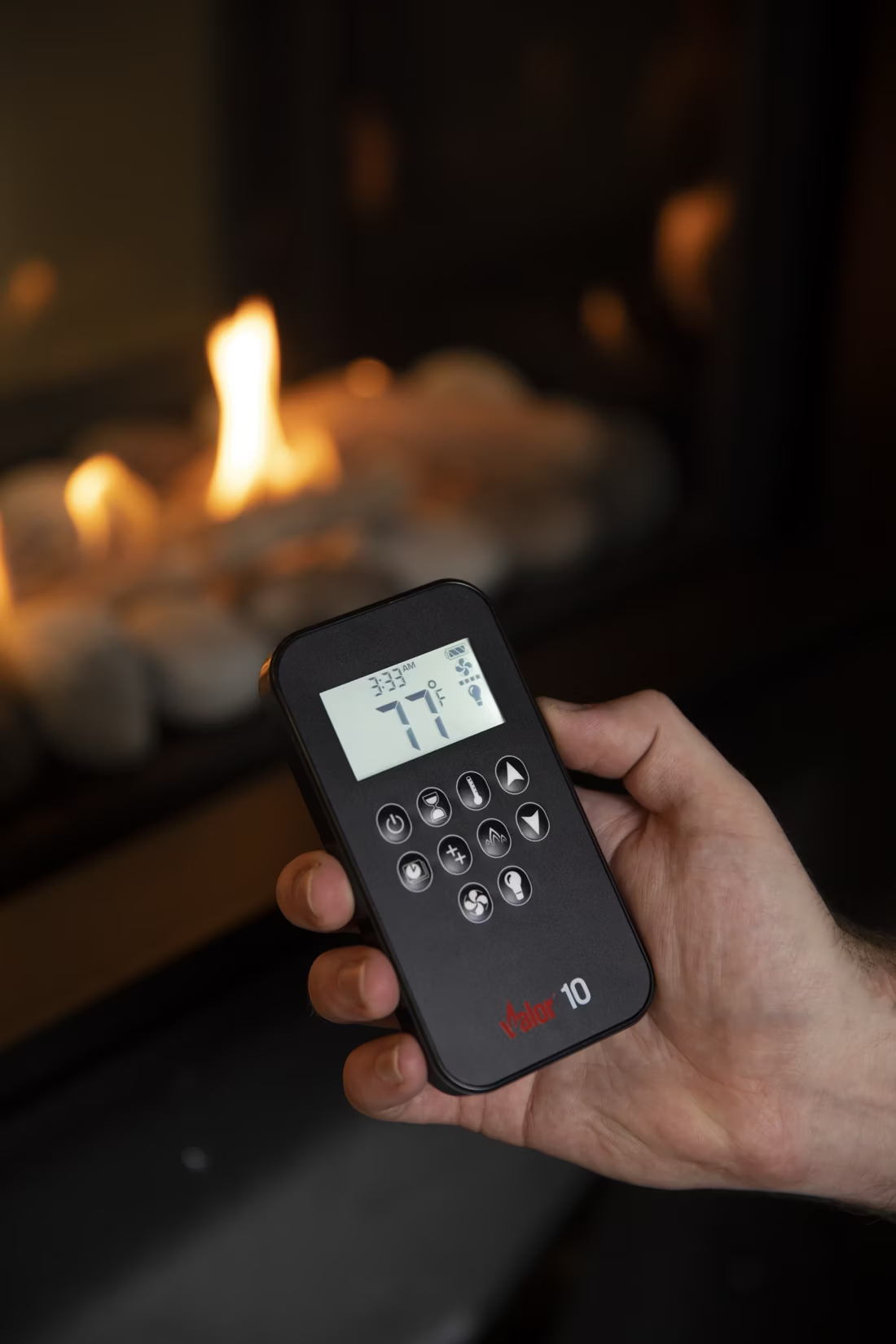
Most modern gas fireplaces will, which matters in a county where the nearest utility crew may be an hour or more away. Units with IPI (intermittent pilot ignition) run on battery backup—typically a few AA batteries inside the unit—that kicks in the moment power drops, so the fireplace lights on demand just like normal. Valor fireplaces go a step further: their pilot assembly generates its own electricity through the thermocouple, so there's no battery to remember or replace. For ranch properties and homes well outside Alpine where outages can stretch longer, that self-powering design is worth asking your local dealer about.
What's the difference between a gas fireplace, gas insert, and gas stove?
A gas fireplace is a fully built-in unit framed into a wall—the right call for new construction or a remodel that doesn't already have a firebox. A gas insert is built to slide into an existing masonry fireplace, which suits many of the older adobe and ranch-style homes around Alpine and Marathon that already have a chimney. A gas stove is a freestanding, floor-sitting unit that can go almost anywhere with the right clearances, which works well for smaller homes, casitas, or additions where framing a full fireplace isn't practical. Your local dealer will look at what you already have—or don't—and steer you toward the right category.
Do I need a permit to install a gas fireplace in Brewster County?
It depends on where the home sits. Within Alpine city limits, the City of Alpine Building Department requires a permit for new gas fireplace installations and gas line work. Outside the city—which is most of Brewster County's land area—there's no county-wide residential building code enforcing permits, since Brewster County, like many large rural Texas counties, doesn't require them for this kind of work. That said, propane gas line installation should still follow LP-gas safety rules and be done by a qualified installer regardless of whether a permit is pulled; skipping that step over informality isn't worth the risk with a pressurized fuel line.
What's the difference between vented and vent-free gas fireplaces?
Vented gas fireplaces (direct-vent or B-vent) pull combustion air from outside and exhaust the byproducts back outside through sealed venting—they're the cleanest, safest option and code-compliant everywhere, including Texas. Vent-free units burn fuel directly into the room without exterior venting; they're legal in Texas but come with strict room-sizing rules and an oxygen depletion sensor requirement. In a county with plenty of older adobe and rock homes without existing chimneys, vent-free units sometimes get considered for their installation simplicity, but direct-vent remains the more universally recommended choice for indoor air quality, especially in smaller, tightly sealed ranch homes.
How often should my gas fireplace be serviced?
An annual inspection is recommended for any gas appliance, including direct-vent fireplaces and inserts. A technician checks the burner, pilot assembly, venting, and gas connections, and cleans the glass and interior—usually a $150 to $250 visit. Because qualified gas hearth technicians are thin on the ground across a county this large and this sparsely populated, it's worth scheduling service in the late summer before the fall travel season picks up around Big Bend National Park, rather than waiting until you need it in December.
Gas vs. wood—which is right for my home?
Wood is deeply practical out here—oak, pecan, and mesquite are all locally available, self-cut firewood costs next to nothing on many ranch properties, and a wood stove keeps working with no propane delivery or power required. Gas offers the convenience ranchers and Alpine homeowners alike appreciate on a cold, windy evening: instant on-off operation with no wood to split or haul, and no ash to clean up. Given that Brewster County's winters are mild by national standards—this isn't Anchorage AK or Caribou ME—many homeowners choose gas for daily convenience in the main living space and keep a wood stove or fireplace as backup, especially on properties where mesquite and oak are already falling on the land.
Why is my open fireplace making my house colder?
Open fireplaces suck—literally. As the fire burns, it consumes air your furnace already paid to heat and pulls it out through the chimney, so the house is actually colder after the fire goes out than before you lit it. An insert fixes this: it seals the chimney, puts fixed glass across the front, and turns that hole in your house into a real heat source.
Why is a fireplace insert so efficient?
An insert does two things: it seals the chimney completely, so you stop losing air you already paid to heat, and it radiates warmth into the room through the firebox and glass. Most add a heat-exchange fan that pulls cool room air underneath, wraps it around the hot firebox, and pushes it back out warm. Your home is more efficient before you've even lit the first fire.
What is an in-home preview and do I need one?
It's a visit where a hearth professional measures your space, confirms the model you picked actually works in your home, and walks the specs—framing, gas line, venting, finish work—before anything is ordered. Some details you just can't know until you see the house. Never make a down payment without one; it's the single most-skipped step that burns buyers.
How much should I budget for a fireplace?
For an average home—covering the fireplace, the vent pipe, and basic installation—a budget between $3,900 and $5,500 gives you a lot of options across wood, gas, and pellet. By the time you add finish work, gas line, and electrical, the average complete installation lands between $5,000 and $12,000 all-in. In a remodel or new build, a good rule is to put about 2.5% of the total project cost toward the fireplace.
Find your gas fireplace in Brewster County.
Tell us a bit about your home—in Alpine, Terlingua, Marathon, or out on the ranch—and we'll match you with a trusted local dealer and send over your free Project Guide & Parts List, sized correctly for propane delivery and Big Bend's high-desert nights.
Find Your Fireplace →