
Warm Up Without the Wood Pile.
Propane and gas heat for the Holston River Valley's cold snaps—find the right fireplace or insert and connect with a trusted local dealer.
Every Project Starts From One of These Five Situations
Reliable heat without a wood lot.
Church Hill sits in the Holston River valley of upper East Tennessee, at about 1,249 feet in elevation, where climate zone 4A winters bring an average low of 27°F and a winter heating load comparable to a moderate Appalachian valley—noticeably milder than places like Duluth, MN or Burlington, VT, but still enough for a real four-to-five month heating season. Hawkins County doesn't have the wood-heating culture found in parts of the Appalachians further south; most Church Hill homeowners looking for supplemental heat skip the wood stove entirely and go straight to gas or electric.
Church Hill and most of rural Hawkins County aren't reached by a piped natural gas utility, so propane is the standard fuel for gas fireplaces and inserts here—supplied by local propane companies rather than a municipal gas main. Electric service comes from Kingsport Power Co. inside city limits and Holston Electric Cooperative across the surrounding county, with residential rates running about 12.8 to 13 cents per kWh. A propane fireplace delivers instant, thermostat-controlled heat that keeps working during the ice storms that occasionally knock out power along the Holston Electric lines—as long as you choose a model with battery-backup or millivolt ignition.
Three steps. No salesperson until you're ready.
Tell us about your project
Your zip code, your situation, and the fuel you're leaning toward—or let the answers point you to one.
See what's actually available
The brands dealers within 100 miles genuinely carry—real options, never a catalog mirage.
Get your dealer & Project Guide
A trusted local dealer, plus the free Project Guide & Parts List that names every component of the job.
Frequently Asked Questions
How much does a gas fireplace installation cost in Church Hill?
Most propane fireplace and insert installations in and around Church Hill run in the $3,500 to $9,000 range, depending on the unit, whether you're converting an existing masonry fireplace or building out a new hearth, and whether a propane tank needs to be set. A direct-vent propane insert into an existing wood-burning fireplace, using a stainless liner, sits toward the lower end. New construction or a built-in gas fireplace with fresh framing and a new tank installation runs higher. Because there's no municipal natural gas line reaching most of Hawkins County, budget for either an existing propane tank or a new tank lease as part of the project—your local dealer can walk you through that cost separately.
Can I convert my existing wood-burning fireplace to gas?
Yes, and it's a common request from Church Hill homeowners in older homes with a masonry fireplace that's rarely used because hauling and stacking cordwood—oak, hickory, maple, and pine are the typical local species—isn't practical for daily heat. A propane insert can usually be installed into that existing masonry opening with a stainless steel liner run up the flue, giving you instant heat without touching your chimney's structure. Since Church Hill isn't on a natural gas main, the conversion ties into propane rather than city gas, which your installer will size along with the tank.
Is natural gas available in Church Hill, or do I need propane?
Church Hill and the surrounding parts of Hawkins County don't have a piped natural gas utility reaching most homes, so propane is the standard fuel for gas fireplaces here. That's not a downside for the fireplace itself—propane units perform identically to natural gas models once the orifice and regulator are set correctly, and most manufacturers build both configurations into the same product line. You'll need either an existing propane tank or a new tank from a local supplier, which your installer typically coordinates as part of the project.
Will my gas fireplace still work if the power goes out?
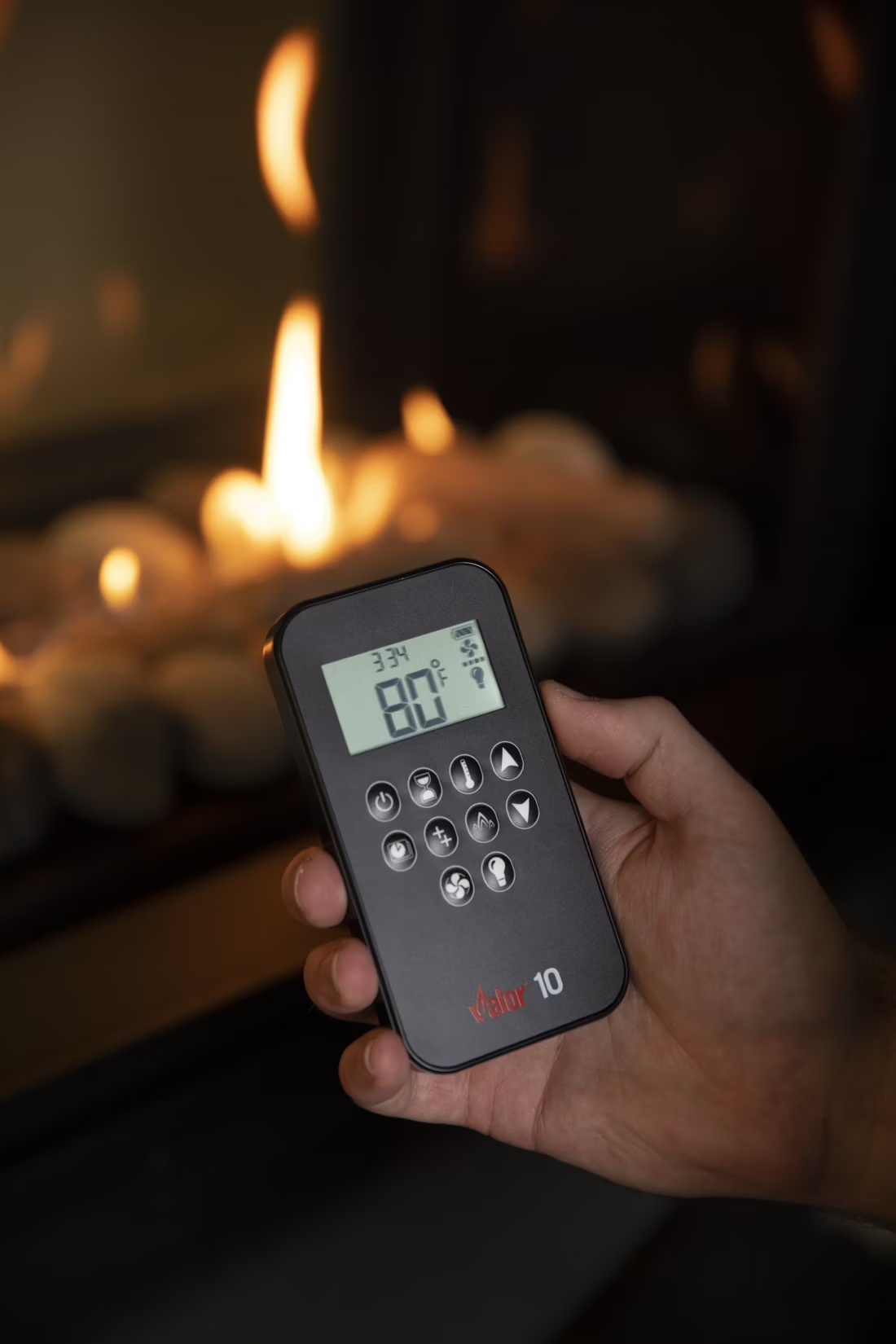
Most will, with the right ignition system. Units with intermittent pilot ignition run off a battery backup that kicks in automatically when power drops, so the fireplace lights and runs normally on batteries. Valor fireplaces go a step further—the pilot's thermocouple generates its own electricity, so there's no battery at all. That matters in Church Hill, where ice storms and high winds occasionally take down lines served by Holston Electric Cooperative for a day or more at a stretch. Ask your local dealer about the ignition system before you buy if backup heat during outages is a priority.
What's the difference between a gas fireplace, gas insert, and gas stove?
A gas fireplace is a fully built-in unit framed into a wall—the right choice for new construction or a remodel without an existing fireplace. A gas insert slides into an existing masonry firebox and uses the chimney as its venting path, which is the common upgrade for Church Hill's older homes with an unused wood-burning fireplace. A gas stove is a freestanding cabinet-style unit that sits on the floor like a wood stove but runs on propane—a good option if you want stove-style heat without an existing chimney at all. A local dealer can tell you which fits your home's layout in a few minutes.
Do I need a permit to install a gas fireplace in Church Hill?
Yes—Hawkins County requires a building permit for new gas fireplace and insert installations, and any propane line work should be done by a licensed gas fitter. Most hearth dealers serving Church Hill handle the permitting and inspection scheduling as part of the installation, so it's rarely something homeowners have to manage themselves. If you're adding a new propane tank, your propane supplier also handles the setback requirements for tank placement.
Should I choose a vented or vent-free gas fireplace?
Vented (direct-vent) units draw combustion air from outside and exhaust it back outside through sealed venting—they're the safest option and work in any room size. Vent-free propane units burn without external venting and release some water vapor and combustion byproducts into the room, so Tennessee limits their use based on room volume and requires an oxygen depletion sensor. Vent-free is legal here and popular for supplemental heat in rooms without an existing flue, but for a primary fireplace in a Church Hill living room, most local dealers steer homeowners toward direct-vent units for cleaner air and a more realistic flame.
How often does a gas fireplace need to be serviced?
Plan on an annual inspection, ideally before the first cold snap each fall. A technician checks the burner, pilot assembly, venting, and gas connections, and cleans the glass and interior—routine maintenance that typically runs $150 to $250 in the Church Hill and Kingsport area. Since most local units run on propane rather than piped gas, it's also worth having the technician check your regulator and tank connection at the same visit.
Gas vs. electric fireplace—which makes more sense for my home?
A propane gas fireplace delivers real heat output—enough to warm a room on its own during a cold snap—plus the option to keep running during a power outage if you choose the right ignition system. An electric fireplace plugs into a standard outlet, needs no venting or gas line at all, and costs far less to install, but it draws on the grid through Kingsport Power Co. or Holston Electric Cooperative, so it's out when the power is. For a Church Hill home that wants supplemental heat with outage protection, gas is usually the better fit; for ambiance in a bedroom or basement where installing a vent isn't practical, electric is hard to beat on cost and simplicity.
What's the difference between an insert and a zero-clearance fireplace?
An insert is a fireplace that slides into a pre-existing wood-burning fireplace—if you don't have one, there's nothing to insert it into. A zero-clearance fireplace is built into a framed wall, which makes it the answer for remodels and new construction. Simple test: existing masonry fireplace means insert; blank or framed wall means zero-clearance.
Why is a fireplace insert so efficient?
An insert does two things: it seals the chimney completely, so you stop losing air you already paid to heat, and it radiates warmth into the room through the firebox and glass. Most add a heat-exchange fan that pulls cool room air underneath, wraps it around the hot firebox, and pushes it back out warm. Your home is more efficient before you've even lit the first fire.
Can a fireplace actually lower my heating bill?
Yes—by creating a comfort zone. A furnace heats every square foot of the house just to warm the one room you're in; a gas fireplace on low burns roughly a sixth of the gas a typical furnace does. Set the furnace around 55–60 degrees as a baseline, then heat the rooms your family actually uses. Families who heat this way commonly save $20–$60 a month.
How much should I budget for a fireplace?
For an average home—covering the fireplace, the vent pipe, and basic installation—a budget between $3,900 and $5,500 gives you a lot of options across wood, gas, and pellet. By the time you add finish work, gas line, and electrical, the average complete installation lands between $5,000 and $12,000 all-in. In a remodel or new build, a good rule is to put about 2.5% of the total project cost toward the fireplace.
Nearby Dealers
Hearth shops serving Church Hill and the surrounding area. Every listing shows whether it is a WhyFire partner, a dealer we have verified as authorized for the brands we recommend, or a local business carrying hearth products. No manufacturer pays for placement. How we verify dealers →
Hammond's Heating And Air
Hammonds HVAC & Gas Services
Builders First Source- Gray
Marsh Lp Gas
Admiral Propane LLC
Southwest Heating & Air
Lee Propane
Gas House Inc
Find your gas fireplace in Church Hill.
Tell us about your home and heating goals, and we'll match you with a trusted local dealer plus a free Project Guide & Parts List—the exact parts, vent kit, and recommended installer for your Church Hill gas fireplace project.
Find Your Fireplace →