
Add Heat Exactly Where You Need It.
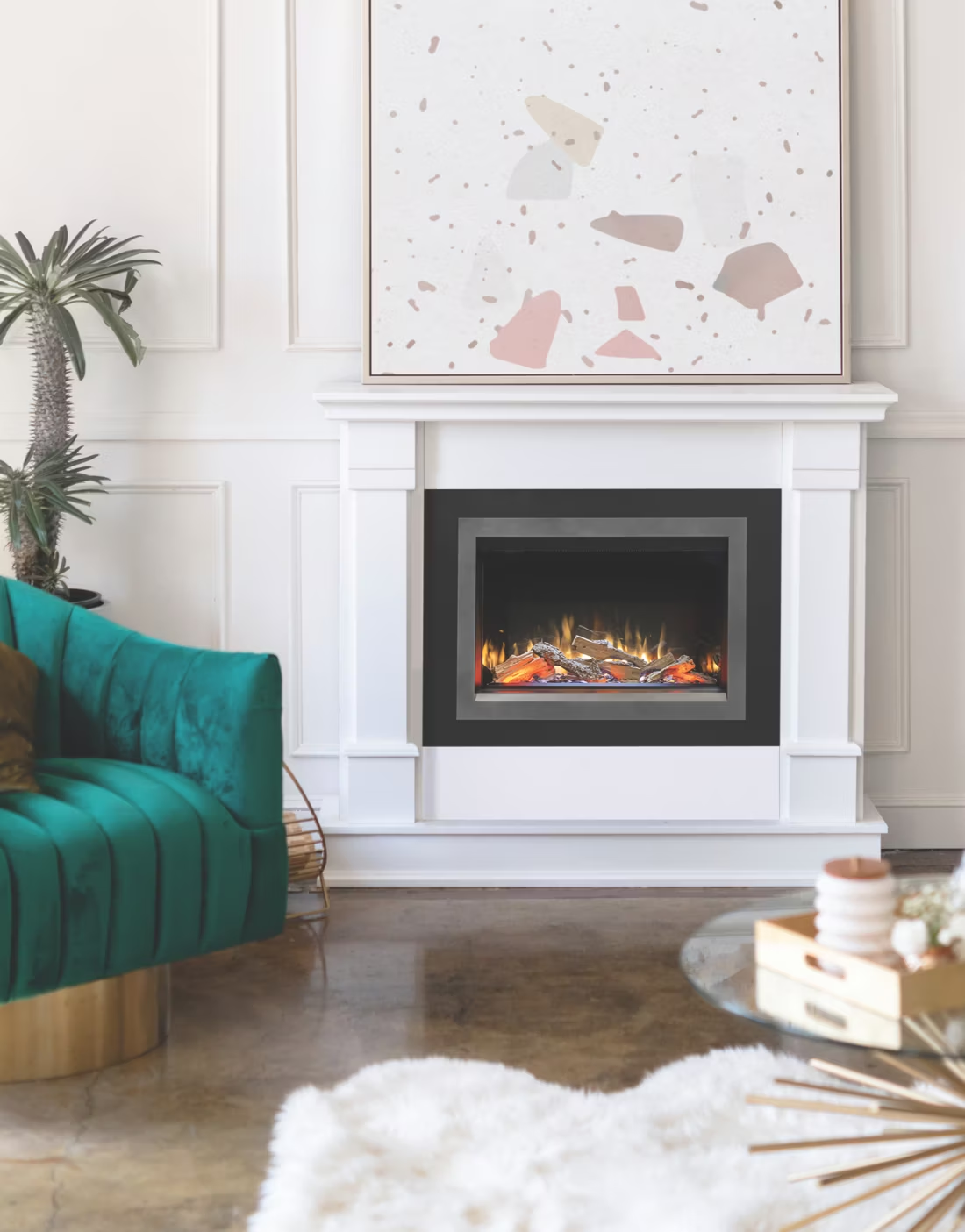
No gas line, no chimney, no venting—just a fireplace that plugs in and warms the room in Dewey County's coldest months.
Every Project Starts From One of These Five Situations
Simple heat that works with what you've already got.
North Eagle Butte sits in Dewey County on the Cheyenne River Sioux Reservation in north-central South Dakota, at 2,389 feet in USDA climate zone 6A—winters here run long and hard, with conditions that track close to what Bismarck or Fargo see across the state. With a population under 1,700 and homes spread across a rural landscape served by Moreau-Grand Electric Cooperative, most heating decisions here come down to what's reliable and what's affordable to run, not what's trendy.
Electric fireplaces fill a specific role in this climate: zone heat for a bedroom, a mobile home addition, or a living room that the main furnace doesn't quite reach—without touching gas lines, chimneys, or combustion venting. At Moreau-Grand's residential rate of roughly 12.4 cents per kWh, running a 1,500-watt unit for supplemental evening heat costs real money but stays predictable, which matters in a community where propane deliveries and wood supply can be harder to count on than the power line to the house.
Three steps. No salesperson until you're ready.
Tell us about your project
Your zip code, your situation, and the fuel you're leaning toward—or let the answers point you to one.
See what's actually available
The brands dealers within 100 miles genuinely carry—real options, never a catalog mirage.
Get your dealer & Project Guide
A trusted local dealer, plus the free Project Guide & Parts List that names every component of the job.
Frequently Asked Questions
How much does an electric fireplace cost to install in North Eagle Butte?
Plug-in electric fireplace inserts that use a standard household outlet typically run $200 to $1,200 installed, since there's no venting or gas work involved—just placement and, for a built-in look, some trim carpentry. Larger built-in units that need a dedicated 20-amp circuit run higher, often $1,000 to $2,500, because an electrician needs to run new wiring to the wall location. Given how spread out homes are around North Eagle Butte, a local dealer who already knows the housing stock here (a lot of manufactured and modular homes) will save you from guessing on circuit capacity.
What size electric fireplace do I need?
Most electric fireplace heaters are rated to warm 400 to 1,000 square feet, which covers a single room or open living area comfortably—they're built for zone heating, not whole-home heating. For a small bedroom or add-on room typical of homes in Dewey County, a 750–1,500 watt unit is usually enough. If you're trying to take the edge off a larger open-concept space, look at units with a stated heating capacity closer to 1,000 sq ft, and plan to run your primary heat source alongside it once temperatures drop into the single digits.
Will an electric fireplace actually keep my house warm in a North Eagle Butte winter?
Not on its own, and it's worth being direct about that. Electric resistance heat is 100% efficient at the plug, but it's expensive to run as a whole-home heat source once outdoor temperatures fall well below zero, which happens routinely here. Electric fireplaces work best as supplemental or zone heat—warming the room you're actually using—while a furnace, propane system, or other primary heat source carries the load for the rest of the house during the coldest stretches of a Dewey County winter.
Do I need a permit to install an electric fireplace in North Eagle Butte?
A simple plug-in insert generally doesn't require a permit since it uses an existing outlet—no different than plugging in a space heater. If you're installing a built-in unit that requires new electrical wiring or a dedicated circuit, that work should be pulled through Dewey County's building and electrical permitting process and done by a licensed electrician. It's a much lighter permitting lift than a wood stove or gas fireplace install, which is part of why electric is often the fastest option to get up and running before the weather turns.
What's the difference between an electric insert, a mantel package, and a built-in wall unit?
An electric insert is sized to slide into an existing fireplace opening, useful if a home here has an old masonry or wood-burning firebox that's no longer used. A mantel package is a freestanding cabinet with the electric firebox built in—no fireplace opening required, just floor space and an outlet. A built-in wall unit is recessed into the wall for a flush, linear look, which usually means the electrical work described above. For a lot of homes around North Eagle Butte without an existing fireplace, the mantel package is the simplest path since it needs no construction at all.
What should I look for in an electric fireplace for this climate?
Prioritize a unit with a real thermostat (not just high/low settings) so it cycles efficiently rather than running full power constantly, and check the stated heating capacity against the room you're placing it in—undersized units will run flat out and still leave a cold room. Because heating bills matter in a rural cooperative service area, look for a unit with a stated wattage in the 1,500-watt range for real heat output, not just ambiance. LED flame effects are mostly cosmetic; the heater element is what does the work in a January cold snap.
What will it cost me to run an electric fireplace each month?
At Moreau-Grand Electric Cooperative's residential rate of about 12.4 cents per kWh, a 1,500-watt heater running 8 hours a day uses roughly 12 kWh daily, which works out to about $1.50 a day, or roughly $45 a month of steady evening use. Running it only during the coldest hours, or on a thermostat that cycles the heating element on and off, brings that down meaningfully. It's a manageable add to a power bill, but it's not free heat—treat it as a supplement to your main heat source rather than a replacement.
Why isn't wood or pellet heat more common in North Eagle Butte?
Ponderosa pine, oak, and cottonwood all grow in this part of South Dakota, but wood and pellet heating infrastructure—dealers, certified installers, pellet supply—is thin to nonexistent this far into Dewey County, and there's no meaningful local market for either fuel type as a primary heating appliance. Homes here are far more likely to rely on propane, electric baseboard or furnace systems, or electric zone heat like a fireplace insert. If you're set on wood heat, expect to source the stove and installer from Rapid City or Pierre and factor that travel into your project.
Will my electric fireplace still work if the power goes out?
No—an electric fireplace is entirely dependent on grid power, so it shuts down the moment the line goes down. That matters here: rural cooperative lines across Dewey County can take longer to restore after a bad blizzard than a line closer to a substation in a larger town. If backup heat during outages is a real concern for your household, pair an electric fireplace with a propane heater, a wood-burning option, or a generator rather than relying on electric as your only fallback plan.
Can I put a TV above my fireplace?
Yes—with an asterisk. Fireplaces are hot and TVs don't like heat. Either put a mantel between them to deflect rising warmth, or choose a fireplace with heat-management technology that creates a cool zone on the wall above—the wall stays around 125 degrees, barely warm, while the room still gets full heat. If you like clean lines and don't want a mantel, heat management is the answer.
Does an electric fireplace need a vent or chimney?
No—that's its superpower. An electric fireplace needs a wall and an outlet, period. No vent pipe, no gas line, no clearances to design around, which is why it works in bedrooms, offices, apartments, and walls where venting a gas or wood unit would be impractical or impossible. Installation is typically the simplest and least expensive of any fireplace type.
How much should I budget for a fireplace?
For an average home—covering the fireplace, the vent pipe, and basic installation—a budget between $3,900 and $5,500 gives you a lot of options across wood, gas, and pellet. By the time you add finish work, gas line, and electrical, the average complete installation lands between $5,000 and $12,000 all-in. In a remodel or new build, a good rule is to put about 2.5% of the total project cost toward the fireplace.
Can a fireplace actually lower my heating bill?
Yes—by creating a comfort zone. A furnace heats every square foot of the house just to warm the one room you're in; a gas fireplace on low burns roughly a sixth of the gas a typical furnace does. Set the furnace around 55–60 degrees as a baseline, then heat the rooms your family actually uses. Families who heat this way commonly save $20–$60 a month.
Popular Electric Brands
Where each brand came from, what's inside it today, and every current model. No brand pays to be here. Not every dealer carries every brand, so enter your zip code to see what's sold near North Eagle Butte.
Fireplace Xtrordinair
Fireplace Xtrordinair, now often called FireplaceX, is the fireplace brand of Travis Industries, Inc., of Mukilteo, Washington.
5 electric models →DaVinci
DaVinci Custom Fireplaces is a brand of Travis Industries, Inc., of Mukilteo, Washington, the company behind Lopi and Fireplace Xtrordinair.
5 electric models →Kozy Heat
Kozy Heat was founded in 1976 by Dudley Hussong in Lakefield, Minnesota, and incorporated as Hussong Manufacturing Co., Inc. in 1978.
3 electric models →Forge & Flame
Forge & Flame is the stove brand Hearth & Home Technologies introduced in August 2023 to bring Vermont Castings, Harman, and Quadra-Fire under one name.
1 electric model →Electric Service in North Eagle Butte
An electric fireplace's heater draws about 1,500 watts—pennies per hour at local rates.
Moreau-Grand Electric Coop Inc
Find your electric fireplace in North Eagle Butte.
Tell us about your home and we'll put together a free Project Guide & Parts List—sized for your space, priced against Moreau-Grand Electric Coop rates, and designed to help you find a local dealer who can install it right.
Find Your Fireplace →