
Instant Warmth for Port Royal's Coastal Evenings.
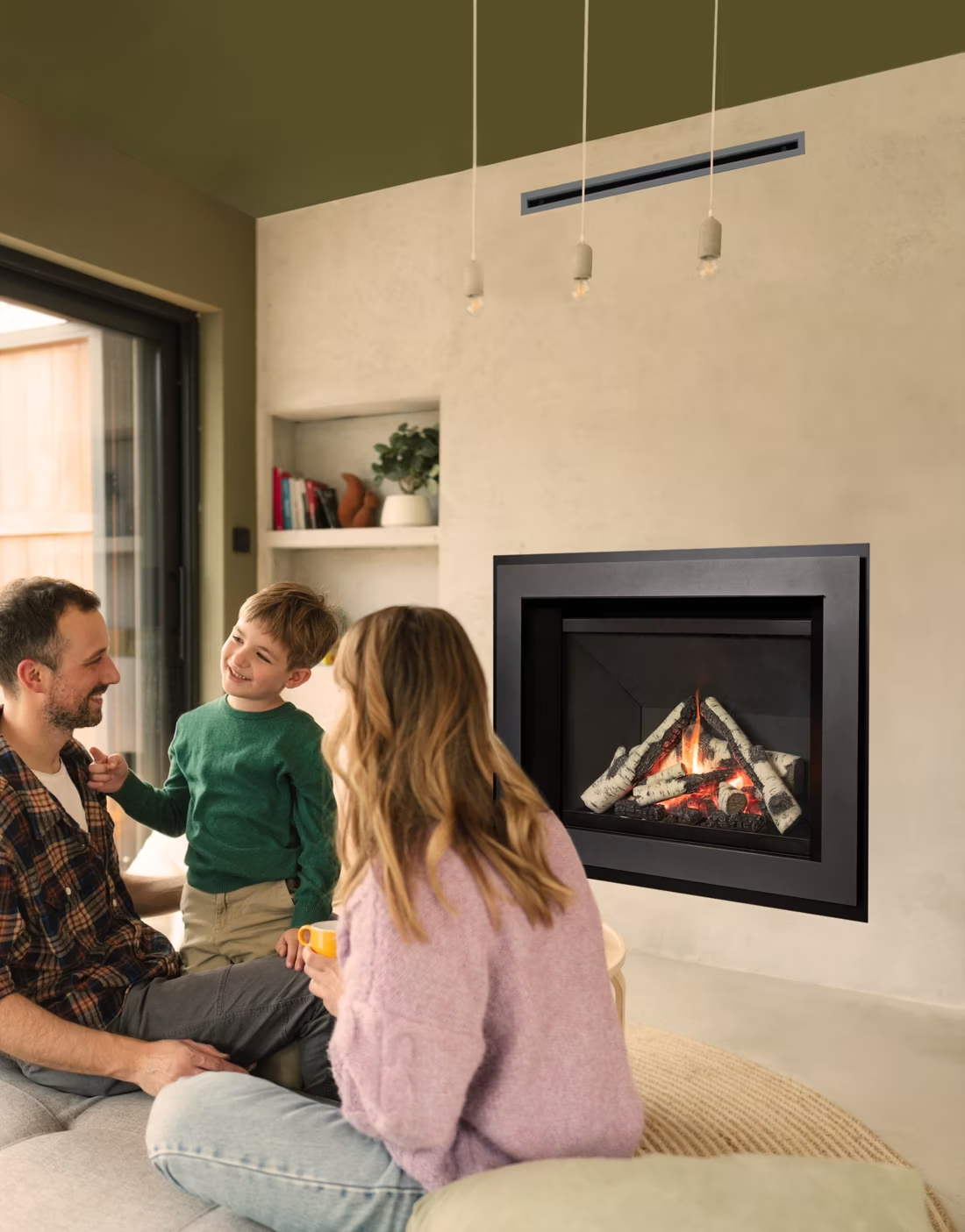
Gas fireplaces bring real flame and on-demand heat to Port Royal homes—perfect for chilly Lowcountry nights and handy when hurricane season knocks out the power. Find the right unit and connect with a trusted local dealer.
Every Project Starts From One of These Five Situations
Comfort heat built for a mild coastal climate.
Port Royal sits at just 3 feet above sea level on Battery Creek in the South Carolina Lowcountry, where winter lows average a mild 41°F and the whole season adds up to roughly 1,584 heating degree days—a fraction of what a place like Burlington, VT racks up in a single cold month. Wood stoves and pellet stoves rarely make sense in a climate this mild, and most Port Royal homeowners who ask about wood heat are better served by a gas unit instead: real flame, instant on-off operation, and none of the cord storage or ash cleanup a Lowcountry home doesn't need.
Piped natural gas service is limited across much of Beaufort County, so most gas fireplace installations in Port Royal actually run on propane, delivered and stored in a tank rather than fed from a municipal line. That's not a downside—propane fireplaces perform identically to natural gas units and give homeowners in Port Royal's older neighborhoods near Paris Avenue and Ribaut Road the same push-button ambiance and supplemental warmth, with one real advantage: many models keep running when the grid goes down during a tropical storm, independent of Dominion Energy South Carolina's electric service.
Three steps. No salesperson until you're ready.
Tell us about your project
Your zip code, your situation, and the fuel you're leaning toward—or let the answers point you to one.
See what's actually available
The brands dealers within 100 miles genuinely carry—real options, never a catalog mirage.
Get your dealer & Project Guide
A trusted local dealer, plus the free Project Guide & Parts List that names every component of the job.
Frequently Asked Questions
How much does a gas fireplace installation cost in Port Royal?
Most Port Royal gas fireplace installations run in the $3,500 to $8,500 range, with the low end covering a direct-vent gas insert into an existing masonry fireplace and the higher end covering a new built-in unit with framing and venting. Because natural gas lines aren't universal here, factor in the cost of a propane tank if your home doesn't already have one—that can add several hundred dollars depending on tank size and whether it's set above ground or buried. A local retailer will give you a firm number after seeing your home and existing fireplace, if you have one.
Can I convert my existing wood fireplace to gas?
Yes, and it's a common project in Port Royal's older homes, including many in the historic district near the waterfront where original masonry fireplaces were built for wood but see little actual use. A gas insert typically installs into that existing firebox using a stainless liner run up the chimney, and the whole job usually lands between $4,000 and $7,500 depending on whether you're running natural gas or propane and whether new gas line or tank work is needed. You keep the look of the original masonry opening while gaining instant, controllable heat.
Should I plan for natural gas or propane in Port Royal?
Check with your installer before you shop, because it changes the equation. Natural gas coverage is spotty in and around Port Royal, so a large share of local installations end up on propane, either from an existing tank or a new one set by a regional propane supplier. Almost every gas fireplace model on the market can be configured for either fuel—it's a matter of the correct orifice and regulator at install time—so fuel availability shouldn't limit which fireplace you choose, only how it's fed.
Will my gas fireplace still work if the power goes out?
Most will, which matters in a town that sits in the storm track for Atlantic hurricanes. Units with intermittent pilot ignition (IPI) run on a battery backup that kicks in the moment grid power drops, so the fireplace lights on demand just as it does any other day—just remember to keep fresh batteries in the unit before storm season. Valor fireplaces take it a step further: their pilot assembly generates its own electricity through the thermocouple, so there are no batteries to maintain at all. For a coastal home that could lose power for days after a named storm, that's worth asking about directly.
What's the difference between a gas fireplace, gas insert, and gas stove?
A gas fireplace is a fully built-in unit framed into a wall, typically chosen for new construction or a remodel. A gas insert slides into an existing masonry firebox and uses the chimney as its vent path, which is the common route for Port Royal's older homes with unused wood fireplaces. A gas stove is a freestanding cast-iron or steel unit that sits on the floor and vents through a wall or existing chimney, and works well in a sunroom or addition that never had a fireplace to begin with. Which one fits depends mostly on what's already built into your home.
Do I need a permit to install a gas fireplace in Port Royal?
Generally yes—a building permit and gas-line or propane connection permit are required for new installations, handled through the Town of Port Royal Building & Codes Department, or Beaufort County Building Codes Enforcement for properties outside town limits. If you're adding a propane tank, there are also setback rules governing how close it can sit to the house, property line, and any ignition sources. A licensed hearth retailer handling your install will typically pull these permits and coordinate the gas or propane hookup so you're not managing multiple trades yourself.
Should I choose a vented or vent-free gas fireplace in Port Royal?
Vented, direct-vent units are the better call for most Lowcountry homes. Vent-free fireplaces are legal in South Carolina and burn efficiently, but they release combustion byproducts—including water vapor—directly into the room. In a climate as humid as coastal South Carolina's, adding more moisture indoors is the last thing most homes need; it can aggravate mildew and humidity issues that Beaufort County homes already contend with for much of the year. A sealed direct-vent fireplace exhausts everything outside and keeps indoor air quality unaffected, which is why it's the standard recommendation here.
How often should a gas fireplace be serviced in Port Royal?
Plan on an annual inspection, ideally in early fall before you start using it regularly through the winter. A technician checks the burner, pilot assembly, gas connections, and venting, and cleans the glass and interior. Coastal salt air can accelerate corrosion on exterior venting caps and hardware faster than it would inland, so it's worth having your technician specifically check outdoor components each year. Most local service providers charge in the $150–$250 range for a standard annual visit.
Gas vs. electric fireplace—which makes more sense for a Port Royal home?
Given how mild Port Royal winters are—average lows only dip to 41°F and the heating season is short—the choice often comes down to how much real heat you want versus pure ambiance. Gas fireplaces deliver genuine BTU output, work as supplemental or even primary heat on the rare cold snap, and can run during a power outage with the right ignition system. Electric fireplaces plug into a standard outlet, need no venting or gas line at all, and cost far less to install, but they're realistically an ambiance-and-light-supplemental-heat option rather than a serious heat source. At Dominion Energy South Carolina's residential rate of about 14.6 cents per kWh, electric units are cheap to run for occasional evening use. Many Port Royal homeowners land on gas for the living room and electric for a bedroom or sunroom accent.
What's the difference between an insert and a zero-clearance fireplace?
An insert is a fireplace that slides into a pre-existing wood-burning fireplace—if you don't have one, there's nothing to insert it into. A zero-clearance fireplace is built into a framed wall, which makes it the answer for remodels and new construction. Simple test: existing masonry fireplace means insert; blank or framed wall means zero-clearance.
Why is a fireplace insert so efficient?
An insert does two things: it seals the chimney completely, so you stop losing air you already paid to heat, and it radiates warmth into the room through the firebox and glass. Most add a heat-exchange fan that pulls cool room air underneath, wraps it around the hot firebox, and pushes it back out warm. Your home is more efficient before you've even lit the first fire.
Does a fireplace add value to my home?
On average, a fireplace adds back to the home about the same amount you spent installing it. Add the monthly savings from heating the rooms you actually use instead of the whole house—often hundreds of dollars a year—and the value case is strong before you even count what a fire does for how your family uses the room.
Can a fireplace actually lower my heating bill?
Yes—by creating a comfort zone. A furnace heats every square foot of the house just to warm the one room you're in; a gas fireplace on low burns roughly a sixth of the gas a typical furnace does. Set the furnace around 55–60 degrees as a baseline, then heat the rooms your family actually uses. Families who heat this way commonly save $20–$60 a month.
Nearby Dealers
Hearth shops serving Port Royal and the surrounding area. Every listing shows whether it is a WhyFire partner, a dealer we have verified as authorized for the brands we recommend, or a local business carrying hearth products. No manufacturer pays for placement. How we verify dealers →
Casual Living Fireside And Grillin'
La Source
Mf Masonry
Find your gas fireplace in Port Royal.
Tell us a bit about your home and we'll match you with a trusted local dealer and send over your free Project Guide & Parts List—the fireplace or insert, vent kit, and everything else your Port Royal installation needs, spelled out before you buy a thing.
Find Your Fireplace →