
Built for winters that average minus 24°C in Nipawin.
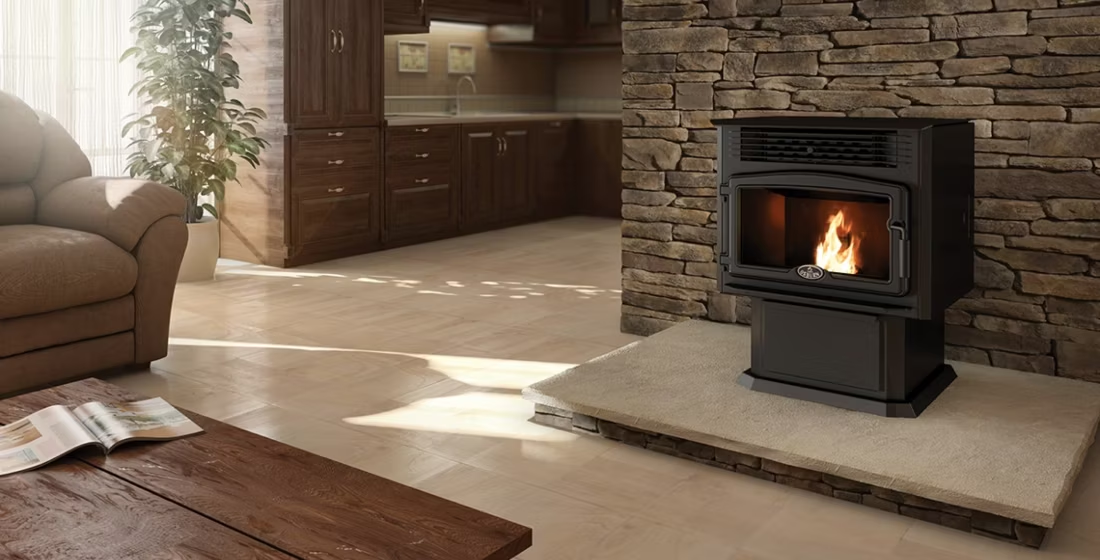
Nipawin sits on the edge of the boreal forest at 361 metres, where the heating season stretches six months and nights routinely fall well past minus 24. A pellet stove gives you that same steady, automated heat without the splitting and stacking wood demands. I'll match you with a trusted local dealer who knows what's actually installable in your home.
Every Project Starts From One of These Five Situations
Automated heat for a boreal-edge winter.
Nipawin's winters run long and hard, closer to what Prince George or Fort McMurray residents deal with than the milder pockets of southern Saskatchewan. Trembling aspen, paper birch, jack pine, and white spruce fill the forest fringe around town, and a lot of households still cut their own wood—the Saskatchewan Ministry of Environment Forest Service Branch permits dead-and-down firewood year-round, and it's free for own-use. Pellet appliances appeal to homeowners who want that same wood-fired warmth without a woodpile to manage through a season this long: load the hopper, set the thermostat, and it runs itself for a day or more.
Regional pellet brands like La Crete Sawmills and Pinnacle Premium are the ones local dealers typically stock, running roughly $400-$575 CAD a tonne—worth buying early in the fall before the coldest stretch pushes demand up. SaskEnergy also serves natural gas here, so some households run gas for daily convenience and keep a pellet unit as a second heat source. The one tradeoff to plan around: pellet stoves need electricity for the auger and blower, so during a SaskPower outage in a hard winter storm, they go quiet unless you've got battery backup or a generator lined up.
Three steps. No salesperson until you're ready.
Tell us about your project
Your postal code, your situation, and the fuel you're leaning toward—or let the answers point you to one.
See what's actually available
The brands dealers within 100 miles genuinely carry—real options, never a catalog mirage.
Get your dealer & Project Guide
A trusted local dealer, plus the free Project Guide & Parts List that names every component of the job.
Frequently Asked Questions
How much does a pellet stove installation cost in Nipawin?
Most pellet stove and insert installations here run $6,000 to $10,000 CAD. Where you land in that range depends mostly on venting—a pellet insert going into an existing masonry firebox is simpler and cheaper than a freestanding stove needing new wall-through venting and a hearth pad built from scratch. Your local municipal building department requires a permit either way, and installation has to follow the CSA B365 code, which most dealers who work in Nipawin handle as part of the quote.
What size pellet stove do I need for a Nipawin home?
Given lows averaging minus 24.2°C and a heating season that runs from roughly October through April, undersizing shows up fast here. A stove rated for 1,200 to 1,800 square feet handles most Nipawin homes as a primary or heavy supplemental source, while larger or older, less-insulated farmhouses around the region often need something at the top of that range or a second heat source for the coldest stretches. A local dealer will size it against your actual floor plan and insulation rather than square footage alone.
Do I need a permit to install a pellet stove in Nipawin?
Yes. New installations go through your municipal building department and must meet CSA B365 installation code. It's also worth knowing that many home insurers ask for a WETT inspection or equivalent documentation on wood-fuel appliances before they'll add the unit to your policy, and pellet appliances often fall under that same insurance review even though they don't need chimney sweeping the way a cordwood stove does. A dealer who regularly installs in Northern Saskatchewan will know what your specific insurer wants to see.
What's the difference between a pellet stove and a pellet insert?
A freestanding pellet stove sits on its own hearth pad and vents through a wall, which works well in homes without an existing fireplace—common in Nipawin's newer builds. A pellet insert slides into an existing masonry firebox and reuses the chimney chase, which is the more typical retrofit in older houses around town that were originally built with a wood-burning fireplace. Inserts usually land toward the lower end of the $6,000-$10,000 range since less new structure is involved.
Where do I buy pellets in and around Nipawin?
La Crete Sawmills and Pinnacle Premium are the two regional brands most local dealers stock, typically priced $400-$575 CAD a tonne. Given how isolated Nipawin is from major distribution routes, it pays to buy your season's supply in September or early October rather than mid-winter, when a cold snap or a highway closure can leave local suppliers temporarily out of stock. Most households here budget for three to four tonnes to get through the full heating season.
What's the best pellet stove for Nipawin's climate?
For a season this long and this cold, a larger-hopper unit from a manufacturer like Enviro, Harman, or Napoleon—commonly carried by dealers serving Northern Saskatchewan—buys you more time between reloads and keeps output steady through multi-day cold snaps. Look for a model with a battery-backup option for the control board and auger motor, since a SaskPower outage during a January storm is exactly when you'd otherwise lose heat.
How much maintenance does a pellet stove need in a place like Nipawin?
Running daily for six months a year, a pellet stove needs the burn pot and ash pan cleaned roughly weekly and a full venting and hopper cleaning at least once a season, plus an annual inspection from a qualified technician to check the auger motor, gaskets, and exhaust fan. It's a lighter lift than sweeping a wood chimney, but skipping it on a unit that's your main heat source through a Nipawin winter is how you end up with an auger jam on the coldest night.
Will my pellet stove still work if the power goes out?
Not without backup. Pellet stoves depend on electricity to run the auger that feeds fuel and the blower that pushes heat into the room, so a SaskPower outage during a winter storm shuts them down unless you've got a battery backup unit or a small generator. This is the main reason some Nipawin households keep a wood stove as a second heat source alongside a pellet unit—wood keeps burning with no power required, which matters given how remote this part of Saskatchewan is when a line goes down.
Pellet vs. wood vs. gas—what makes sense for a Nipawin home?
Wood remains a strong option here since the Saskatchewan Ministry of Environment Forest Service Branch issues free dead-and-down cutting permits year-round, and trembling aspen, paper birch, jack pine, and white spruce are all close at hand. Gas, through SaskEnergy, gives you instant on-demand heat with no fuel storage at all. Pellet sits in between—cleaner and more automated than cordwood, with steadier output than either, but reliant on electricity and on planning your pellet supply ahead of winter. Plenty of households here run gas or wood as the primary source and add a pellet stove for the zones that need consistent, low-maintenance backup heat.
Why do fireplace quotes vary so much?
Because a fireplace is an iceberg—there's more behind the wall than in front of it. A low quote often covers only the unit; the full scope includes vent pipe, gas line or electrical, framing, and the tile or stone that has to come off and go back on. Make every bidder price the whole job. If a dealer can't speak to the full scope with confidence, that's your signal to keep looking.
Is it worth replacing an old fireplace that still sort of works?
Ask three questions: Is it ugly? Is it drafty? Does it actually work? Most old fireplaces fail at least two. Beyond looks, an old unit leaks air around the damper year-round and—if it's gas with a standing pilot—quietly burns a couple hundred dollars a year. A modern replacement seals the wall, heats the room, and changes how the whole space gets used.
What does it take to replace an existing fireplace?
Fireplaces are like icebergs—bigger behind the wall than in front of it. Replacement means removing the surrounding tile or stone (the finish material laps onto the fireplace face), pulling the old unit, setting the new one in the same enclosure, and re-finishing the wall. A hearth professional can determine what's behind your wall without demolition during an in-home preview.
Why is my open fireplace making my house colder?
Open fireplaces suck—literally. As the fire burns, it consumes air your furnace already paid to heat and pulls it out through the chimney, so the house is actually colder after the fire goes out than before you lit it. An insert fixes this: it seals the chimney, puts fixed glass across the front, and turns that hole in your house into a real heat source.
Nearby Dealers
Hearth shops serving Nipawin and the surrounding area. Every listing shows whether it is a WhyFire partner, a dealer we have verified as authorized for the brands we recommend, or a local business carrying hearth products. No manufacturer pays for placement. How we verify dealers →
J.t. PLumbing & Heating
Pellet Brands Stocked Around Nipawin
Typical price runs $400-$575 per ton—buy early-season for the best rates. Manufacturers will point you to the nearest stocking dealer.
La Crete Sawmills
Pinnacle Premium
Get your Nipawin pellet heating project mapped out.
Tell me about your home and I'll match you with a trusted local dealer and send a free Project Guide & Parts List—sized for a season that averages minus 24.2°C, with the vent kit and parts specified for your project.
Find Your Fireplace →