
In Windsor, gas fireplace heat starts with a service check.
Windsor sits in Estrie, where Énergir's natural gas lines cover only pockets of the region—many streets here run on propane, wood, or Hydro-Québec electricity instead. I'll help you find out which one applies to your address before you shop for a fireplace.
Every Project Starts From One of These Five Situations
Wood and electricity heat most of Windsor; gas fits where the line runs.
Windsor is a small Estrie community of about 5,400 people, sitting at 173 metres elevation along the Saint-François River with winter lows that average -16.4°C. It's a genuinely cold climate—closer in feel to Québec City or Sherbrooke than to Montréal's milder river valley—and most homes here heat with wood or electric baseboard rather than gas. Sugar maple, yellow birch, American beech, and red oak are all common in the surrounding Estrie woodlots, and Hydro-Québec's residential rate of roughly $0.078 per kWh keeps electric heat inexpensive enough that gas has never become the default the way it has in parts of greater Montréal.
Énergir's distribution network reaches only partial coverage in this part of Quebec—typically a few served streets or subdivisions rather than the whole municipality—so a gas fireplace project in Windsor almost always starts with confirming whether a main actually runs past your property. If it doesn't, propane is the standard workaround: a tank, a regulator, and the same direct-vent fireplace or insert, just running off a different fuel. Either path means budgeting for licensed gas-fitter work in addition to the fireplace itself, and pulling a permit through the municipal building department before anything gets connected.
Three steps. No salesperson until you're ready.
Tell us about your project
Your postal code, your situation, and the fuel you're leaning toward—or let the answers point you to one.
See what's actually available
The brands dealers within 100 miles genuinely carry—real options, never a catalog mirage.
Get your dealer & Project Guide
A trusted local dealer, plus the free Project Guide & Parts List that names every component of the job.
Frequently Asked Questions
Is natural gas actually available in Windsor?
Only in pockets. Énergir serves parts of Quebec through a network concentrated around greater Montréal, the south shore, and a handful of urban corridors, and Windsor sits outside most of that footprint. Coverage here is described as partial, which in practice means some streets have a main nearby and most don't. Before you plan a gas fireplace, ask your dealer to check whether your address can tie into an existing line—if it can't, propane is the realistic fallback, not a downgrade.
What does a gas fireplace installation cost in Windsor?
Typical installs run $6,000 to $15,000 CAD, and in a town like Windsor the fuel source does more to move that number than the fireplace itself. A direct-vent insert tying into an existing natural gas line, if your street happens to have one, lands toward the lower end. A propane setup—tank, regulator, and line run—usually pushes the project toward the middle or upper end of that range, since you're paying for fuel infrastructure as well as the unit and venting.
If I'm not on the gas line, what are my options?
Propane is the direct substitute—the same fireplace or insert, running off a tank instead of a utility main—and it's the more common path for homes in Estrie outside Énergir's served streets. Plenty of Windsor households skip gas altogether and go with a wood stove or insert (sugar maple and yellow birch split well and are easy to source locally), a pellet stove using regional brands like Granules LG, Energex, or Trebio, or electric heat through Hydro-Québec, which at roughly $0.078 per kWh is cheap enough that an electric fireplace or insert is a genuine competitor to gas here.
Do I need a permit for a gas fireplace in Windsor?
Yes. You'll need a permit through the municipal building department, and the gas connection itself has to be done by a licensed gas fitter—this isn't a job a general contractor signs off on. Most local dealers who install gas fireplaces in Estrie coordinate both the permit and the gas-fitter scheduling as part of the project, which matters in a town this size where you may not already have a gas fitter on speed dial.
Gas vs. wood—which makes more sense for a Windsor home?
Given how limited Énergir's reach is here, wood is still the more natural fit for most Windsor properties, and it's rated standard for a reason: sugar maple, yellow birch, American beech, and red oak are all common Estrie species, and the Ministère des Ressources naturelles et des Forêts issues cutting permits (about $1.85 per cubic metre plus taxes, up to 22.5 m3) for anyone willing to cut their own. Gas wins on convenience—no splitting, no loading—but only if your street can actually get a line or you're willing to run propane. A lot of homeowners here ask about gas first, then install wood or pellet instead once they learn their address isn't served.
What about electric fireplaces instead of gas?
Electric is worth serious consideration in Windsor. Hydro-Québec's residential rate of about $0.078 per kWh is among the lowest in the country, and an electric fireplace or insert installs for $500 to $1,600 CAD—a fraction of the $6,000-$15,000 a gas project typically costs once you factor in propane infrastructure or a gas-line extension. Electric won't replace a primary heat source through a -16.4°C winter, but as a supplemental unit in a living room or bedroom it's a low-cost option that doesn't depend on Énergir's coverage map at all.
What's the difference between a gas fireplace, insert, and stove for a home like mine?
A gas fireplace is a built-in unit framed into a wall, typical for a renovation or addition. A gas insert drops into an existing masonry firebox and reuses the chimney chase, which suits older Windsor homes that started out with a wood-burning fireplace. A gas stove is freestanding on a hearth pad, similar footprint to a wood stove but fed by a gas line or propane tank. Whichever type you choose, the bigger question in this town is fuel source—natural gas main or propane tank—before you even get to picking a model.
Vented vs. vent-free—does it matter here?
Direct-vent units pull combustion air from outside and exhaust it back outside through sealed venting, and that's what most dealers install in Quebec regardless of climate zone—it's the safer, code-standard choice for a home sealed up tight against a Zone 6A winter. Vent-free units are legal in some jurisdictions but carry strict room-sizing rules and aren't the default recommendation for a tightly-built house working to hold heat through months of sub-freezing nights.
How big a gas fireplace do I need for Windsor's winters?
With winter lows averaging -16.4°C and a heating season that runs long by national standards—comparable to Québec City or Sherbrooke rather than the milder St. Lawrence valley closer to Montréal—sizing matters even for a supplemental gas unit. Most Windsor living rooms in the 200 to 400 square-foot range do well with a mid-size direct-vent fireplace rather than a small decorative unit, but if gas is meant to handle real heat load rather than ambiance, a local dealer will size it against your home's insulation and the room's ceiling height rather than square footage alone.
Can a gas fireplace run on a thermostat?
Most modern gas fireplaces can—turn it on and off from the couch with a remote, or set a room temperature and let the fireplace hold the comfort zone for you. If low maintenance matters to your family, this is the feature set that makes gas the convenience pick over wood and pellet.
Why do fireplace quotes vary so much?
Because a fireplace is an iceberg—there's more behind the wall than in front of it. A low quote often covers only the unit; the full scope includes vent pipe, gas line or electrical, framing, and the tile or stone that has to come off and go back on. Make every bidder price the whole job. If a dealer can't speak to the full scope with confidence, that's your signal to keep looking.
Can I put a TV above my fireplace?
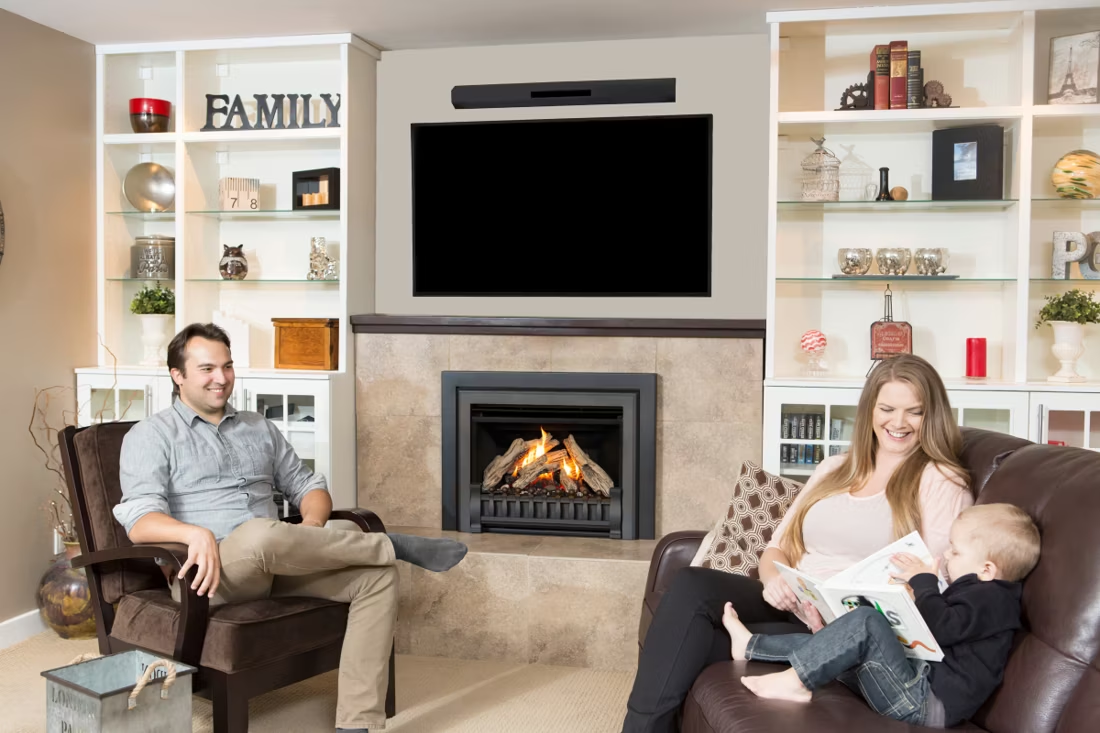
Yes—with an asterisk. Fireplaces are hot and TVs don't like heat. Either put a mantel between them to deflect rising warmth, or choose a fireplace with heat-management technology that creates a cool zone on the wall above—the wall stays around 125 degrees, barely warm, while the room still gets full heat. If you like clean lines and don't want a mantel, heat management is the answer.
Why is a fireplace insert so efficient?
An insert does two things: it seals the chimney completely, so you stop losing air you already paid to heat, and it radiates warmth into the room through the firebox and glass. Most add a heat-exchange fan that pulls cool room air underneath, wraps it around the hot firebox, and pushes it back out warm. Your home is more efficient before you've even lit the first fire.
Nearby Dealers
Hearth shops serving Windsor and the surrounding area. Every listing shows whether it is a WhyFire partner, a dealer we have verified as authorized for the brands we recommend, or a local business carrying hearth products. No manufacturer pays for placement. How we verify dealers →
Actions Multi-Flammes Granby
Gaz Propane Rainville Inc.
Suroît Boutique (Cowansville)
Distribution M.f. Granit Inc.
Natural Gas Service in Windsor
Confirm service at your address before planning a gas fireplace—a quick call settles it.
énergir
Get your free Project Guide & Parts List for a Windsor gas project.
Tell me about your home and whether your street is served by Énergir or you're looking at propane, and I'll match you with a local dealer who can confirm what's actually installable at your address, plus send a free Project Guide & Parts List with the vent kit and parts your project needs.
Find Your Fireplace →