
Find your fireplace across Estrie.
From Sherbrooke's urban core to the maple-country towns around Magog, Coaticook, and Lac-Mégantic, this hub covers every fuel used across the Eastern Townships. Pick a fuel and get matched with a local dealer who knows what's actually installable on your street.
Every Project Starts From One of These Five Situations
Sugar maple country, moderate winters, and a wood-heating tradition that runs deep.
Estrie spreads across the rolling hills of Quebec's Eastern Townships, home to roughly 307,497 people scattered between Sherbrooke's urban core and small maple-country municipalities like Magog, Coaticook, and Lac-Mégantic. The region sits in climate zone 6A, with average winter lows near -16.4°C—a heating season with real bite, though notably milder than Winnipeg or Saskatoon, and closer in character to Ottawa's long, cold shoulder seasons. The same sugar maple stands that make Estrie one of Quebec's best-known maple syrup regions also supply the wood that heats a lot of homes here, alongside yellow birch, American beech, and red oak—all dense hardwoods that hold a fire through a sub-zero overnight. Woodlot harvest permits go through the Ministère des Ressources naturelles et des Forêts (MRNF), and that same local wood supply keeps firewood costs manageable for households that split and season their own.
Fuel choice in Estrie skews heavily toward wood, pellet, and electric. Pellet stoves have strong regional roots too—Granules LG, Energex, and Trebio all mill pellets within the province, which keeps supply local and pricing steadier than in regions that truck pellets in from further away. Electric fireplaces are genuinely practical here as supplemental heat, not just decoration, thanks to Hydro-Québec's low hydroelectric rates. Natural gas is the outlier: Énergir's distribution network only reaches limited corridors, mostly around Sherbrooke's main routes, so most Estrie households don't have mains gas at all, and a gas fireplace here usually means a propane conversion rather than a hookup to the grid. Any wood installation needs to meet the CSA B365 code, and insurers commonly require a WETT inspection before they'll cover a new wood appliance. Several Estrie municipalities are also moving toward the kind of registration and low-emission certification rules the island of Montréal already enforces, so a good local dealer checks your specific municipal bylaw before recommending a unit. This hub rolls up retailers, service technicians, and fuel suppliers across the whole region—pick your fuel below for local dealers, cost ranges, and unit recommendations specific to your town.
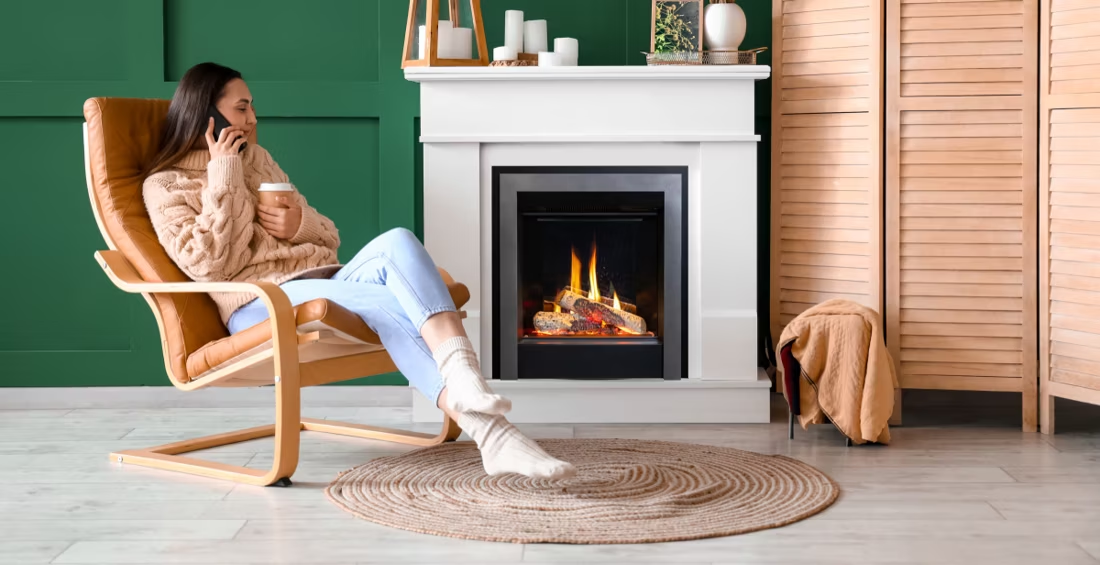
Four fuels. One honest answer for Estrie.
Three steps. No salesperson until you're ready.
Tell us about your project
Your postal code, your situation, and the fuel you're leaning toward—or let the answers point you to one.
See what's actually available
The brands dealers within 100 miles genuinely carry—real options, never a catalog mirage.
Get your dealer & Project Guide
A trusted local dealer, plus the free Project Guide & Parts List that names every component of the job.
Frequently Asked Questions
Which fireplace fuel makes the most sense for a home in Estrie?
It depends on what's already running in your house and which municipality you're in. Wood is the traditional backbone here—sugar maple, yellow birch, American beech, and red oak are all locally abundant, and a modern CSA-certified wood stove or insert burning seasoned hardwood will hold a fire through a -16°C overnight without much trouble. Pellet stoves are a strong alternative if you want less daily tending: Granules LG, Energex, and Trebio all produce pellets within the province, so supply doesn't depend on trucking fuel in from further afield. Electric fireplaces are common as supplemental heat in Estrie homes, partly because Hydro-Québec's rates make running one inexpensive compared to most of the country. Gas is the exception—Énergir's mains network barely touches Estrie outside a few corridors near Sherbrooke, so a 'gas fireplace' here usually means propane, not a natural gas hookup, and it's worth confirming availability before you fall in love with a specific unit.
Do I need a permit to install a wood stove or insert in Estrie?
Yes. Installations go through your municipal building department and must meet the CSA B365 installation code, which covers clearances, venting, and hearth protection. On top of the permit, most home insurers in Quebec require a WETT inspection before they'll add a new wood appliance to a policy, so budget time for that step even after the installer finishes the work. A number of Estrie municipalities are also tightening their bylaws to require registration and low-emission certification for wood appliances, similar to what the island of Montréal already enforces at 2.5 g/h of fine particles—it's not universal across the region yet, but a local dealer who works here regularly will know your municipality's current rule and won't quote you a stove that can't legally be installed.
Is natural gas actually available for a gas fireplace in Estrie?
In most of Estrie, no—not from the mains. Énergir's distribution network is limited to a handful of corridors, largely around Sherbrooke's main arteries, and the rural municipalities and smaller towns across the Eastern Townships generally aren't served at all. That doesn't rule gas out; it just changes the plan. Most gas fireplace installs in Estrie run on propane instead, with a tank on-site rather than a street connection. If you're set on a gas look, the first real step is confirming whether your address sits on an Énergir-served street, and a local dealer can check that before you spend time comparing units.
What firewood species should I be burning in Estrie, and does it matter?
It matters a lot for how often you're feeding the stove. Sugar maple and yellow birch are the two workhorses here—dense, high-BTU hardwoods that season well over a summer and burn long and hot once dried below 20% moisture. American beech burns similarly hot but splits harder green, so it benefits from extra seasoning time. Red oak is excellent once seasoned but needs closer to a full two years to dry properly because of its density, so it's a poor choice if you're buying wood in fall for that same winter. Whatever species you're running, a moisture meter is worth the money—wet wood is the single biggest cause of poor draft, smoke rollback, and creosote buildup in this region's wood stoves.
How much does a fireplace or stove installation typically cost in Estrie?
Costs vary by fuel and how much venting work is involved, but as a general range for the region: a wood stove or insert installed with new venting typically runs $3,500-$8,000 CAD, with full masonry chimney work pushing higher. Pellet stove or insert installs usually land around $3,500-$6,500 CAD. Electric fireplace inserts are the most affordable option, often $1,000-$4,000 CAD installed, and sometimes less if you're dropping a unit into an existing opening with no new circuit needed. Propane fireplace installs—since mains gas isn't an option for most Estrie addresses—usually run $4,000-$9,000 CAD depending on tank setup and line length. A local dealer can tighten these numbers up once they know your home's layout and which municipality's permit rules apply.
How does scheduling work for chimney sweeps and WETT inspections in Estrie?
Book earlier than you think you need to. WETT inspectors and chimney sweeps who cover the whole region—Sherbrooke, Magog, Coaticook, Lac-Mégantic, and the smaller municipalities between them—get busy fast once the first hard frost hits, and a lot of homeowners wait until they're already burning to call. Late summer or early fall is the right window, especially if you're also trying to close on an insurance policy that requires a fresh WETT inspection, since some insurers won't finalize coverage on a wood appliance without one on file. If you're further out from Sherbrooke, ask about trip fees up front; most technicians build routes covering the surrounding towns but the schedule tightens once real winter sets in.
How many BTUs do I need in a fireplace?
Wrong question—and the industry's favorite way to confuse you. More BTUs isn't better if the fireplace cooks you out of the room you spent thousands to enjoy. Think in terms you can verify: how many square feet the unit heats, whether it's primary or backup heat, and whether you want it running overnight. Those three answers size a fireplace correctly every time.
Will we actually use a fireplace once we have one?
In my own home, the room with the fireplace has never been the same—it became the social hub. Game nights, holidays, date nights after the kids are down: the fire is where the house gathers. There's a reason people in this industry joke that we're really in the romance and entertainment business. You won't wonder whether you'll use it; you'll wonder how the room worked before.
What's the difference between an insert and a zero-clearance fireplace?
An insert is a fireplace that slides into a pre-existing wood-burning fireplace—if you don't have one, there's nothing to insert it into. A zero-clearance fireplace is built into a framed wall, which makes it the answer for remodels and new construction. Simple test: existing masonry fireplace means insert; blank or framed wall means zero-clearance.
Can I put a TV above my fireplace?
Yes—with an asterisk. Fireplaces are hot and TVs don't like heat. Either put a mantel between them to deflect rising warmth, or choose a fireplace with heat-management technology that creates a cool zone on the wall above—the wall stays around 125 degrees, barely warm, while the room still gets full heat. If you like clean lines and don't want a mantel, heat management is the answer.
Stove and Fireplace Dealers in Estrie
Listings include WhyFire partner dealers, dealers we have verified as authorized for the brands we recommend, and established local businesses that carry hearth products. Every listing shows which one it is. The ones marked Preferred run on WhyFire's software, so they can show you real pricing and book your appointment right here. No manufacturer pays for placement. How we verify dealers →
Actions Multi-Flammes Granby
Gaz Propane Rainville Inc.
Suroît Boutique (Cowansville)
Distribution M.f. Granit Inc.
Get matched with a local Estrie dealer.
Tell us about your home and we'll put together a free Project Guide & Parts List—the right unit for your fuel and climate, the vent kit it needs, and the local Estrie dealer we recommend for your project.
Find Your Fireplace →