
Electric heat that actually pencils out at Hydro-Québec rates.
At about $0.078 per kWh, running an electric insert through winter lows near -17.7°C costs a fraction of what the same appliance costs in Ontario or the Maritimes. I'll match you with a local dealer who knows what fits your home's wiring and your wall.
Every Project Starts From One of These Five Situations
Cheap hydro power changes the math on electric fireplaces.
Sainte-Catherine-de-la-Jacques-Cartier sits in the Jacques-Cartier valley northwest of Québec City, and its winters track close to the provincial capital's: an average low of -17.7°C, a climate zone rated 7A, and a heating season that runs from October well into April. Wood is the traditional answer here—sugar maple, yellow birch, American beech, and red oak are all cut locally under Ministère des Ressources naturelles et des Forêts permits—and pellet stoves running on Granules LG or Energex have a real following too. Natural gas, by contrast, is a rare sight this far from Énergir's Montréal-area corridors; most homes in this stretch of Capitale-Nationale were never built with a gas line in mind.
That's where electric earns its place. Hydro-Québec's residential rate of roughly $0.078 per kWh is among the lowest in North America, so a 1,500-watt electric insert running for ambiance and supplemental warmth in the living room doesn't carry the same bill shock it would in a province paying two or three times as much. There's no chimney, no venting, and no WETT inspection to schedule for insurance—a municipal building department permit only comes into play if you're adding a new circuit for a built-in unit. For older farmhouses along the river with an existing masonry firebox no one wants to sweep anymore, dropping in an electric insert is often the simplest fix in the whole hearth conversation.
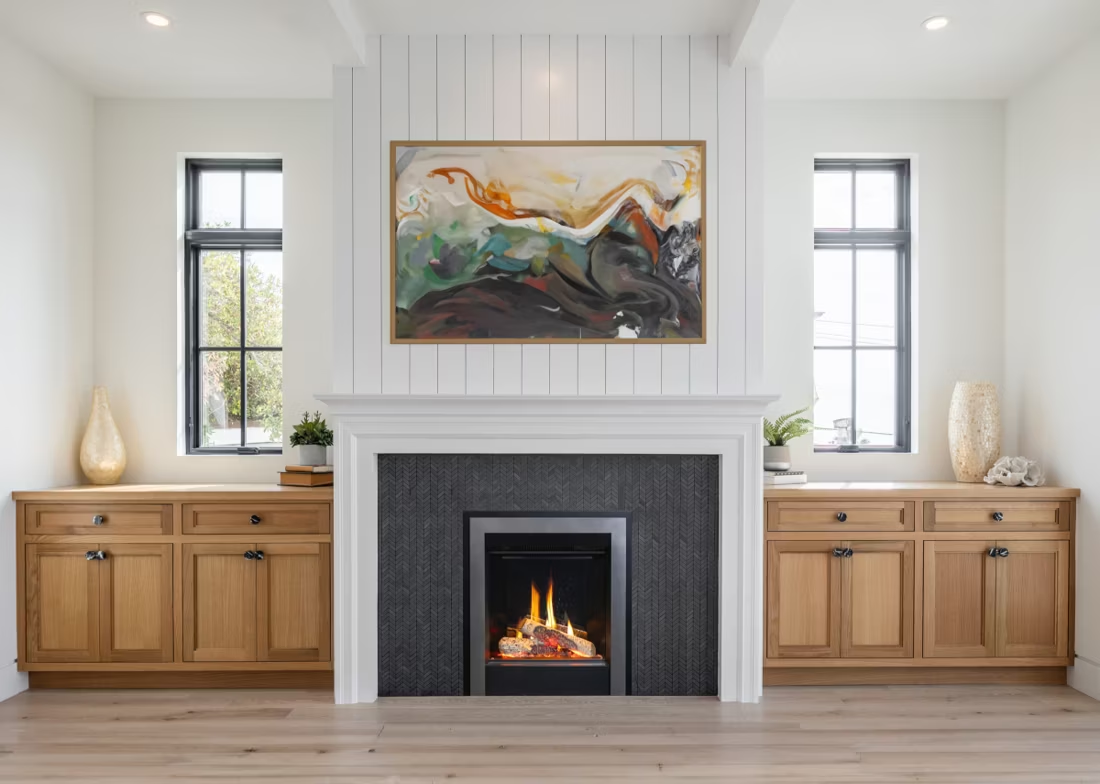
Three steps. No salesperson until you're ready.
Tell us about your project
Your postal code, your situation, and the fuel you're leaning toward—or let the answers point you to one.
See what's actually available
The brands dealers within 100 miles genuinely carry—real options, never a catalog mirage.
Get your dealer & Project Guide
A trusted local dealer, plus the free Project Guide & Parts List that names every component of the job.
Frequently Asked Questions
How much does an electric fireplace installation cost in Sainte-Catherine-de-la-Jacques-Cartier?
Budget $500 to $1,600 CAD for most installs. A plug-in insert or wall-mount unit that ties into an existing 120-volt outlet sits at the low end and often needs no permit at all. A built-in unit wired into a dedicated 240-volt circuit—common when a homeowner wants a larger unit in a new great room—runs closer to the top of that range once an electrician's time is factored in. Either way, it's a fraction of the $6,000 to $12,000 a wood install or $6,000 to $10,000 a pellet install typically runs in this area.
Does an electric fireplace actually make financial sense given Hydro-Québec's rates?
More than in most of the country. At about $0.078 per kWh, Hydro-Québec's residential rate is roughly a third of what homeowners pay in Ontario or the Maritimes for the same kilowatt-hour. Running a 1,500-watt insert for a few hours most evenings through the winter costs a modest amount rather than the bill shock it can be elsewhere. It won't replace a wood stove or baseboard heat as your main source through a -17.7°C stretch, but as supplemental heat in the room you actually live in, the math is genuinely favourable here in a way it isn't in most provinces.
Is natural gas an option here instead of electric?
Not really, and it's worth being upfront about that. Énergir's distribution network reaches parts of greater Montréal and a handful of served corridors, but it doesn't extend into Sainte-Catherine-de-la-Jacques-Cartier or most of the surrounding stretch of Capitale-Nationale. Gas fireplaces are a rare choice out here—you'd be looking at a propane conversion rather than a mains hookup, which adds tank and delivery costs most homeowners skip in favour of electric or wood. Electric fills the same want for instant, no-mess flame without needing a fuel line at all.
Do I need a permit to install an electric fireplace?
Usually not for a plug-in model—it's treated like any other appliance on an existing outlet. If you're installing a built-in unit that requires a new dedicated circuit, the municipal building department will want that electrical work permitted and done by a licensed electrician, which most local dealers coordinate as part of the job. Because there's no combustion involved, none of the CSA B365 solid-fuel rules or WETT inspection requirements that apply to wood installs come into play here.
What's the difference between an electric insert, a wall-mount unit, and an electric stove?
An insert is built to slide into an existing masonry firebox—a common retrofit in the older farmhouses along the Jacques-Cartier River that have a wood fireplace nobody wants to keep sweeping. A wall-mount unit hangs flush or recessed into drywall, popular in newer builds and renovated great rooms where there's no existing chimney at all. A freestanding electric stove looks like a small wood stove and just needs floor space and an outlet, which suits a den, basement, or rental unit where you don't want to touch the walls.
How much actual heat will an electric fireplace put out during a cold snap here?
Most electric units top out around 5,000 BTU on a 1,500-watt heater, enough to noticeably warm a single living room but not a whole house through a night near -17.7°C. In this area, electric fireplaces are almost always installed as supplemental heat or pure ambiance alongside a primary source—wood stove, pellet stove, or baseboard heating—rather than as the sole heat for the home. A local dealer will size the unit to the room, not the house, and tell you plainly if your space is better served by a wood or pellet appliance instead.
Can I put an electric insert into an old wood-burning masonry fireplace?
Yes, and it's one of the more popular projects in this area's older housing stock. Many farmhouses and older village homes along the Jacques-Cartier River still have a working masonry firebox that hasn't been used in years. An electric insert drops in without touching the chimney structure, and because there's no combustion, you skip the WETT inspection insurance companies often ask for on active wood appliances. It's a much quicker project compared to a full wood or pellet retrofit.
Are there Hydro-Québec programs or rebates worth checking before I buy?
Hydro-Québec periodically runs efficiency programs and offers tied to its Rénoclimat initiatives, and they shift year to year, so it's worth asking before you commit to a model. An electric fireplace itself is rarely the direct target of a rebate—the bigger provincial incentives are usually aimed at insulation, heat pumps, and thermostats—but a local dealer who works in this area stays current on what's active and can tell you if your specific project qualifies for anything.
Electric vs. wood vs. pellet—what actually fits a home in Sainte-Catherine-de-la-Jacques-Cartier?
Wood remains the traditional primary heat source here, with sugar maple, yellow birch, American beech, and red oak cut locally under MRNF permits (about $1.85 per cubic metre, up to 22.5 m3) and installs running $6,000 to $12,000 CAD. Pellet stoves using Granules LG, Energex, or Trebio at $400 to $575 a ton offer a cleaner-burning, less labour-intensive middle ground at $6,000 to $10,000. Electric, at $500 to $1,600, is the cheapest to install and—thanks to Hydro-Québec's $0.078 per kWh rate—genuinely cheap to run, but it's best treated as a supplemental or ambiance choice rather than a full replacement for primary heat through a Capitale-Nationale winter.
How much does an electric fireplace cost to run?
With the heater on, a typical unit draws about 1,500 watts—at average electric rates that's roughly 20 cents an hour. Run the flame effect alone and it costs pennies; the flames are LED-driven and use about as much power as a light bulb. There's no pilot light, no fuel delivery, and essentially no maintenance.
What fireplace styles should I know before shopping?
Four cover most of the market: screen-front traditional (mesh front, open feel, fits craftsman homes), traditional door set (the classic look you grew up with), modern linear (wide, low, the statement piece for entertaining), and clean face contemporary (no trim—your tile or stone runs right to the fire's edge). Walk in knowing those four terms and you're ahead of most buyers.
Can I put a TV above my fireplace?
Yes—with an asterisk. Fireplaces are hot and TVs don't like heat. Either put a mantel between them to deflect rising warmth, or choose a fireplace with heat-management technology that creates a cool zone on the wall above—the wall stays around 125 degrees, barely warm, while the room still gets full heat. If you like clean lines and don't want a mantel, heat management is the answer.
Do electric fireplaces actually produce heat?
Yes—most put out around 4,800–5,000 BTUs from a standard outlet, which comfortably warms a bedroom, office, or den as a comfort-zone heater. What they won't do is carry a whole house the way wood, gas, or pellet can. Think of electric as ambiance-first with honest supplemental heat: flames on with no heat in July, flames plus warmth in January.
Nearby Dealers
Hearth shops serving Sainte Catherine de la Jacques Cartier and the surrounding area. Every listing shows whether it is a WhyFire partner, a dealer we have verified as authorized for the brands we recommend, or a local business carrying hearth products. No manufacturer pays for placement. How we verify dealers →
Gespro Poêles Et Foyers
Services Propane Inc.
Chemine, Poeles Et Foyer Quebec
Foyer Québec
Maçonnex (Québec)
Nova Energie Inc
Hubert's Fireplace Consultation + Design
Les Cheminées Gamelin
Propane Multi-Service Inc
A. Tremblay Et Frères
Electric Service in Sainte Catherine de la Jacques Cartier
An electric fireplace's heater draws about 1,500 watts—pennies per hour at local rates.
Hydro-Québec
Get your Sainte-Catherine-de-la-Jacques-Cartier electric fireplace project mapped out.
Tell me about your home and your electrical panel, and I'll match you with a local dealer and send a free Project Guide & Parts List—sized to the room, priced for Hydro-Québec rates, with the exact parts your project needs.
Find Your Fireplace →