
Steady heat for a five-month Centre-du-Québec winter.
With winter lows averaging -17.1°C and a heating season that runs from October into April, this village depends on fuel sources that don't quit. I'll match you with a trusted local dealer and send a free plan for your pellet project.
Every Project Starts From One of These Five Situations
Automated warmth without the daily wood-splitting.
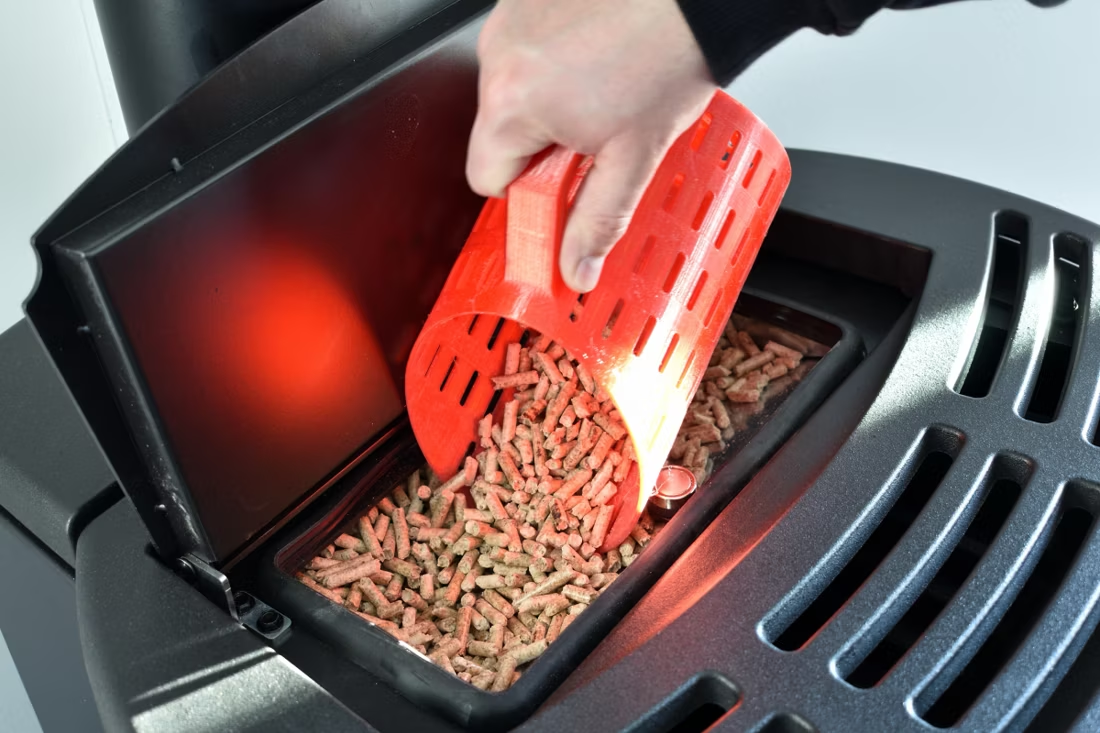
Saint-Léonard-d'Aston sits in the lowlands of the Centre-du-Québec region at just 73 metres of elevation, but climate zone 6A doesn't care about the flat terrain—winter lows average -17.1°C, and the heating season stretches well past five months. Woodlots and sugar bushes across the region are thick with sugar maple, yellow birch, American beech, and red oak, and plenty of households here still burn cordwood cut under an MRNF permit for about $1.85 per cubic metre. Pellet appliances give the same steady radiant heat without the splitting, stacking, and daily reloading that cordwood demands, which matters in a small rural municipality where not every household has the time or storage space for a full wood supply.
Natural gas through Énergir reaches only part of Quebec, and that partial footprint rarely extends to a village this size—gas fireplaces stay a rare option here rather than a mainstream one. Electric baseboard heat is the default in most homes thanks to Hydro-Québec's residential rate of roughly $0.078 per kWh, among the cheapest power in the country, and that low rate is exactly why pellet stoves pencil out well as a supplement: the auger and blower motor cost very little to run, while the pellets themselves—regional brands like Granules LG, Energex, and Trebio, typically $400 to $575 a ton—do the actual heavy lifting. It's a pairing suited to a region where residents already expect long, quiet winters and want a backup that doesn't depend on splitting wood at -17°C in the dark.
Three steps. No salesperson until you're ready.
Tell us about your project
Your postal code, your situation, and the fuel you're leaning toward—or let the answers point you to one.
See what's actually available
The brands dealers within 100 miles genuinely carry—real options, never a catalog mirage.
Get your dealer & Project Guide
A trusted local dealer, plus the free Project Guide & Parts List that names every component of the job.
Frequently Asked Questions
How much does a pellet stove installation cost in Saint-Léonard-d'Aston?
Most pellet installs in this area run $6,000 to $10,000 CAD. An insert dropping into an existing masonry firebox, common in older village homes, sits toward the lower end since the chimney chase is already there. A freestanding stove that needs a new hearth pad, wall penetration, and fresh venting through an exterior wall runs higher. Your municipal building department will require a permit either way, and most local dealers fold that paperwork into the quote rather than leaving it to you to sort out separately.
What pellet brands can I actually get near Saint-Léonard-d'Aston?
Granules LG, Energex, and Trebio are the regional brands local dealers typically carry, running $400 to $575 a ton. All three are produced within Quebec, which matters in a rural municipality like this one where trucking pellets a long distance adds cost and complicates a mid-winter resupply. Plan on buying by the ton or pallet ahead of the season and storing bags somewhere dry—a damp basement or an uninsulated shed will degrade pellets faster than you'd expect over a five-month burning season.
Do I need a permit or inspection to install a pellet stove here?
Yes. New installations go through the municipal building department, and the work has to meet the CSA B365 installation code. Even though pellet appliances burn cleaner than cordwood, most home insurers in Quebec still ask for a WETT inspection on any solid-fuel appliance before they'll extend or renew coverage, so budget for that step even if the building department doesn't require it directly. A local dealer who installs pellet stoves regularly in this region will already know which insurers are strict about it.
Pellet stove or wood stove—which makes more sense for my home here?
Wood is genuinely cheap in this region if you're willing to do the work—an MRNF cutting permit runs about $1.85 per cubic metre up to a 22.5 cubic metre maximum, and sugar maple, yellow birch, and American beech from local woodlots all burn hot and dense once properly seasoned. But that means felling, splitting, stacking, and drying wood a full year ahead. A pellet stove trades that labour for a stored supply of bagged fuel and a thermostat-controlled burn, which a lot of households here choose once cordwood becomes more chore than hobby, especially if no one in the house is set up to process their own wood.
What size pellet stove do I need for a Saint-Léonard-d'Aston home?
With winter lows averaging -17.1°C and stretches that go colder during a hard cold snap, most main living areas in this region need a stove rated for at least 1,500 to 2,000 square feet to keep up without running at maximum output around the clock. A smaller unit rated under 1,000 square feet is fine for a single room or a supplemental setup alongside electric baseboards, but running it as your only heat source through a full Centre-du-Québec winter will leave it working harder than it should. A local dealer will size against your actual insulation and ceiling height rather than square footage alone.
Will my pellet stove still work if the power goes out?
Not without a backup plan. Pellet stoves rely on an electric auger to feed fuel and a blower to move heat into the room, so a power outage stops the stove even with a full hopper. Rural stretches of the Centre-du-Québec region see occasional winter outages from ice and heavy snow, and Quebec has a long memory of just how bad an ice storm can get. A small battery backup or inverter sized for the auger and control board is a reasonable add-on if outage resilience matters to you, and it's worth asking your dealer about at the same time you're picking the stove.
Is a pellet stove actually cheaper to run than my electric baseboards?
Not always, and it's worth being honest about the math. Hydro-Québec's residential rate of about $0.078 per kWh is genuinely low, which keeps baseboard heat inexpensive as a baseline. Pellets at $400 to $575 a ton aren't free, and prices have climbed in recent years. Where a pellet stove earns its keep is zone heating a main living area more efficiently than baseboards spread through a whole house, plus giving you a heat source that isn't tied to the same electrical circuit as everything else—useful backup even if it isn't always the cheapest kWh-for-kWh comparison.
Can I get a gas fireplace instead, since I've seen them elsewhere in Quebec?
It's worth checking, but don't count on it. Énergir's natural gas network covers only part of the province, concentrated around greater Montréal, the south shore, and a few urban corridors—it does not reach a village the size of Saint-Léonard-d'Aston. A gas fireplace here would almost certainly mean a propane setup with a tank, which is a different cost picture and installation than a natural gas hookup. Most homeowners in this area end up comparing pellet against wood rather than against gas, simply because gas isn't a realistic option on most local streets.
How much maintenance does a pellet stove need through the season?
Plan on emptying the ash pan every few days during steady winter use and a deeper cleaning of the burn pot, exhaust vent, and hopper roughly once a month. A full annual service, ideally in late summer before the first cold snap arrives, should include checking the auger motor and gaskets and cleaning the venting completely—lighter work than a wood chimney sweep, but skipping it on a stove running daily through a five-month Centre-du-Québec winter is how you end up with a shutdown on the coldest night. Most local dealers who sell pellet stoves in this region also offer that annual service.
Why do fireplace quotes vary so much?
Because a fireplace is an iceberg—there's more behind the wall than in front of it. A low quote often covers only the unit; the full scope includes vent pipe, gas line or electrical, framing, and the tile or stone that has to come off and go back on. Make every bidder price the whole job. If a dealer can't speak to the full scope with confidence, that's your signal to keep looking.
Is it worth replacing an old fireplace that still sort of works?
Ask three questions: Is it ugly? Is it drafty? Does it actually work? Most old fireplaces fail at least two. Beyond looks, an old unit leaks air around the damper year-round and—if it's gas with a standing pilot—quietly burns a couple hundred dollars a year. A modern replacement seals the wall, heats the room, and changes how the whole space gets used.
Are pellet stoves loud?
They make some noise—there are two fans running plus an auger motor that turns as it feeds pellets. But there's a real range: premium models are engineered quiet, and the best offer a whisper-quiet mode you can comfortably watch TV next to. If noise matters in your room, ask to hear a stove running before you buy—it's a five-minute test that saves years of annoyance.
Can a pellet stove heat a whole house?
It genuinely can. I burned a pellet stove as my only heat source for years after a furnace died, and it kept the entire house warm. Pellets feed automatically from a hopper, so you get wood-heat economics with thermostat-style control. Two honest caveats: it needs weekly cleaning during the season, and most models need electricity to run—ask about battery backup if outages are a concern.
Nearby Dealers
Hearth shops serving Saint-Léonard-d'Aston and the surrounding area. Every listing shows whether it is a WhyFire partner, a dealer we have verified as authorized for the brands we recommend, or a local business carrying hearth products. No manufacturer pays for placement. How we verify dealers →
Cheminee Techni-Pro
L’as Du Propane Inc
Maconnex-Drummondville
Poêle Et Foyer De L'érable
Noréa Foyers Victoriaville
Plomberie 1750
Pellet Brands Stocked Around Saint-Léonard-d'Aston
Typical price runs $400-$575 per ton—buy early-season for the best rates. Manufacturers will point you to the nearest stocking dealer.
Granules Lg
Trebio
Get your free Project Guide & Parts List for a Saint-Léonard-d'Aston pellet stove.
Tell me about your home and I'll match you with a trusted local dealer and send a free Project Guide & Parts List—sized for a -17°C winter, with the vent kit and parts specified so there's no guesswork.
Find Your Fireplace →