
Keep Your Family Warm and Safe—No Matter What
Saint-Canut sits in the Laurentides foothills where winter lows average -16.5°C and the cold settles in for months. I'll match you with a trusted local dealer who knows CSA B365, WETT inspections, and what actually vents safely in this climate.
Every Project Starts From One of These Five Situations
Local hardwood, not novelty heat.
At 76 metres elevation in the Laurentides foothills, Saint-Canut doesn't get the dramatic altitude of the Laurentian ski country to the north, but the winters are plenty serious on their own—an average low of -16.5°C, with a heating season that runs from October well into April. That's roughly the same stretch homeowners in Sherbrooke or Trois-Rivières deal with, and it's long enough that a wood stove here earns its keep as genuine heat, not a weekend accent piece.
Sugar maple, yellow birch, American beech, and red oak are the hardwoods most Laurentides households split and stack, and all four burn dense and long—useful when a February cold snap has you loading the firebox before bed and expecting coals in the morning. Cutting your own on public land means dealing with the Ministère des Ressources naturelles et des Forêts (MRNF), which issues permits valid April 1 to March 31 at roughly $1.85 per cubic metre plus taxes, capped at 22.5 cubic metres per household—enough for most homes burning wood as a serious heat source. Saint-Canut isn't on the island of Montreal, so the city's strict 2.5 g/h fine-particulate bylaw doesn't apply here directly, but the municipal building department still requires CSA B365-compliant installation, and most insurers will ask for a WETT inspection before they'll write a policy on the appliance.
Firewood Cutting Permits Near Saint-Canut
Ministère Des Ressources Naturelles Et Des Forêts (Mrnf)
Three steps. No salesperson until you're ready.
Tell us about your project
Your postal code, your situation, and the fuel you're leaning toward—or let the answers point you to one.
See what's actually available
The brands dealers within 100 miles genuinely carry—real options, never a catalog mirage.
Get your dealer & Project Guide
A trusted local dealer, plus the free Project Guide & Parts List that names every component of the job.
Frequently Asked Questions
How much does a wood stove installation cost in Saint-Canut?
Most installations run $6,000 to $12,000 CAD. An insert going into an existing masonry fireplace—common in the older sections of Saint-Canut near the village core—tends to land at the lower end, since the chimney structure is already in place. A freestanding stove in a newer build without an existing flue needs a full Class A chimney run through the roof, which pushes costs toward the higher end of that range. Either way, your local dealer will also need to build in time for a WETT inspection once the install is done, since most home insurers in the Laurentides won't cover a wood appliance without one.
Do I need a permit to install a wood stove in Saint-Canut?
Yes. Saint-Canut's municipal building department requires a permit for any new wood-burning appliance, and the installation itself has to meet the CSA B365 code, which covers clearances, venting, and hearth protection. Once it's in, plan on a WETT inspection—it's not always legally mandatory depending on your situation, but it's commonly required by home insurers before they'll add a wood stove or insert to your policy, so most local installers schedule one as a matter of course.
What size wood stove do I need for a Saint-Canut home?
With winter lows averaging -16.5°C and a heating season that runs from October into April, this isn't a climate for an undersized stove. Older homes around the Saint-Canut village core, many with less insulation than newer construction farther out, often do better with a mid-to-large stove in the 1,500 to 2,200 square foot range so it can hold a bed of coals through a cold night without constant reloading. Newer, tighter-built homes can sometimes get away with a smaller unit. A local dealer will size it against your actual floor plan and insulation rather than square footage alone.
What's the difference between a wood stove and a wood insert for my house?
A freestanding wood stove sits on its own hearth pad and vents through new Class A pipe, which works well in newer Saint-Canut homes that were never built with a masonry fireplace. A wood insert slides into an existing masonry firebox and reuses the chimney that's already there, which is the more common upgrade in older homes around the village where open fireplaces were standard decades ago. Inserts also tend to land toward the lower end of the $6,000-$12,000 install range since less new venting is usually needed.
Where do I get a firewood cutting permit near Saint-Canut?
Permits for cutting on public land go through the Ministère des Ressources naturelles et des Forêts (MRNF), with the season running April 1 to March 31 depending on the specific harvest zone. Cost works out to about $1.85 per cubic metre plus taxes, with a cap of 22.5 cubic metres per permit. Sugar maple and yellow birch are the two species most local burners target first for their combination of heat output and availability, with American beech and red oak filling out the woodpile.
What's the best wood stove for a Saint-Canut winter?
Dense hardwoods like sugar maple and red oak reward a stove that can hold a long, even burn, which is why catalytic models from manufacturers like Blaze King see steady interest here—they can hold a fire well past 12 hours, useful when overnight lows sit near -16.5°C. Non-catalytic stoves from Pacific Energy or Osburn, both well distributed through Quebec dealers, are a lower-maintenance option for households running wood as a supplement rather than a primary heat source. Whatever you choose, make sure it's CSA-certified—that's what your municipal permit and your insurer's WETT inspection will both expect to see.
How often should my chimney be swept in Saint-Canut?
An annual sweep before the season starts, ideally in September or early October, is the standard most WETT-certified technicians recommend, and it matters more here given how many households burn through a six-month season. Beech and birch tend to produce more creosote than well-seasoned maple or oak if they're not dried a full year or two first, so if your woodpile is heavy on beech, a mid-season check partway through winter is worth scheduling as well.
Do Montreal's wood-burning rules apply to a stove in Saint-Canut?
Not directly. The bylaw limiting wood appliances to 2.5 grams per hour of fine particles and requiring registration is specific to the island of Montreal, and Saint-Canut sits well outside that boundary in the Laurentides. That said, any CSA-certified stove or insert a reputable dealer sells you today already meets or beats that emissions threshold, so it's a non-issue in practice—the more relevant local requirement is that Saint-Canut's own municipal building department still wants a permit and a CSA B365-compliant install regardless of which side of the bylaw line you're on.
Wood vs. pellet vs. electric—what makes sense in Saint-Canut?
Wood keeps working without electricity, which matters during the ice storms that occasionally take down power across the Laurentides, and with MRNF cutting permits running about $1.85 per cubic metre, fuel cost stays low if you're willing to cut and split it yourself. Pellet stoves from brands like Granules LG, Energex, or Trebio are cleaner and easier to run day-to-day, though at $400-$575 CAD a ton and needing electricity for the auger, they won't help during an outage. Electric heat is worth a mention too—Hydro-Québec's residential rate of roughly 7.8 cents per kWh is among the cheapest in the country, which is why some households treat wood as backup heat and lean on electric baseboards or a heat pump for daily use.
Why do fireplace quotes vary so much?
Because a fireplace is an iceberg—there's more behind the wall than in front of it. A low quote often covers only the unit; the full scope includes vent pipe, gas line or electrical, framing, and the tile or stone that has to come off and go back on. Make every bidder price the whole job. If a dealer can't speak to the full scope with confidence, that's your signal to keep looking.
Louvered or clean face—which fireplace front is better?
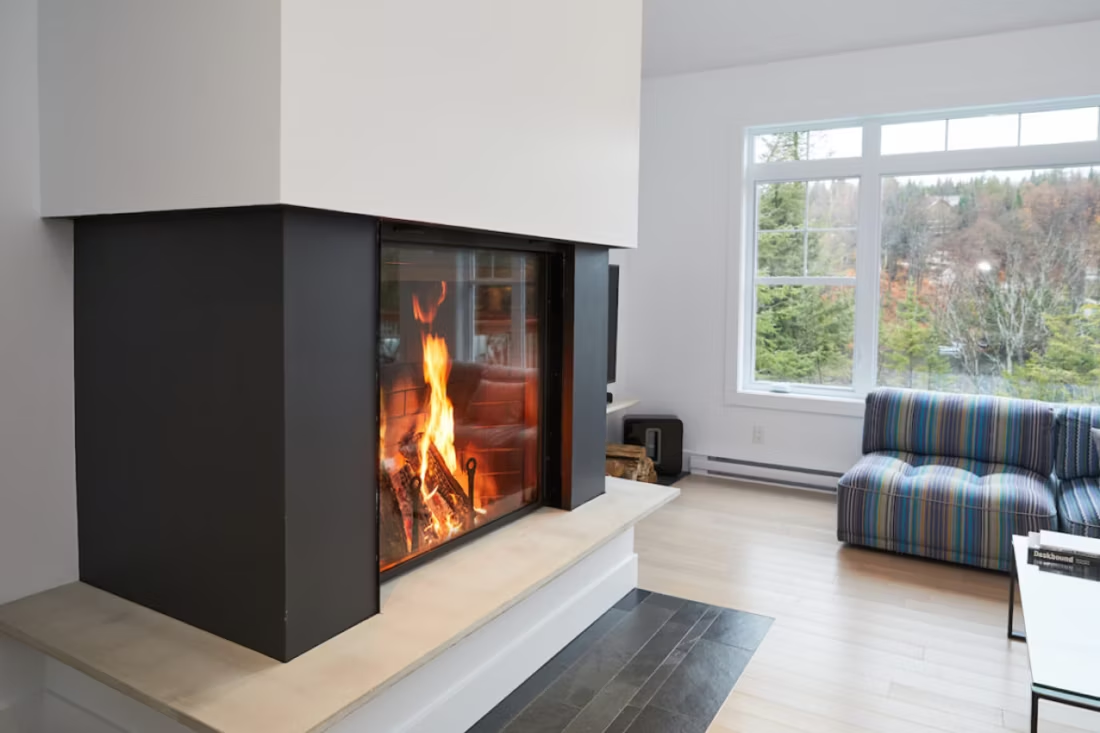
Louvered fronts have grill work above and below the glass for airflow, move heat a little better with a fan, and suit traditional mantels. Clean face designs drop the louvers entirely so finish work runs to the fire's edge—they fit both modern and traditional rooms. When we did our own home we chose clean face: a big viewing area beat a little extra airflow. It depends on your room, not on a rulebook.
Do I need a permit to install a fireplace?
In most jurisdictions, yes—fireplace and stove installations involve venting, clearances, and often gas or electrical work that gets permitted and inspected. That's a feature, not a hassle: the inspection protects your family and your homeowner's insurance. A professional installer pulls the permit, installs to code, and stands behind the inspection. If someone suggests skipping it, keep looking.
What fireplace styles should I know before shopping?
Four cover most of the market: screen-front traditional (mesh front, open feel, fits craftsman homes), traditional door set (the classic look you grew up with), modern linear (wide, low, the statement piece for entertaining), and clean face contemporary (no trim—your tile or stone runs right to the fire's edge). Walk in knowing those four terms and you're ahead of most buyers.
Nearby Dealers
Hearth shops serving Saint-Canut and the surrounding area. Every listing shows whether it is a WhyFire partner, a dealer we have verified as authorized for the brands we recommend, or a local business carrying hearth products. No manufacturer pays for placement. How we verify dealers →
Décor Chaleur Laurentides Inc
Boutique Poêles & Foyers Rive-Nord
Poeles Et Foyers Saint-Sauveur
Les Foyer Mirabel A.m.f.
Finition Belle-Flammes
Max Oxygene Pur
Foyers Braizo
Alternatives
Le Ramoneur Du Foyer
Noeea Foyers Rive-Nord
Pro Du Foyer
Foyer-Gaz
Noréa Foyers Montréal
Nergiflex
Foyer Universel Montreal Inc. (A.m.f.)
Get your free Project Guide & Parts List for a Saint-Canut wood project.
Tell me about your home and I'll match you with a trusted local dealer who knows CSA B365 and WETT requirements in the Laurentides, then send a free Project Guide & Parts List with the exact vent kit and parts your install needs.
Find Your Fireplace →