
Gas heat, if Énergir's line actually reaches your street.
Saint-Apollinaire sits in a genuinely cold pocket of Chaudière-Appalaches, with winter lows averaging -17.9°C, and most homes here heat with wood or electricity rather than gas. If your address falls on an Énergir corridor, or you're open to propane, I'll match you with a trusted local dealer and a clear plan.
Every Project Starts From One of These Five Situations
In Saint-Apollinaire, gas is the exception, not the rule.
At 105 metres elevation in climate zone 7A, Saint-Apollinaire sees a long, hard winter—average lows near -17.9°C and a heating season that stretches well past five months. Most households here answer that with wood or electric heat rather than gas. Sugar maple, yellow birch, American beech, and red oak grow throughout the region, and a Ministère des Ressources naturelles et des Forêts (MRNF) cutting permit runs about $1.85 per cubic metre plus taxes, up to a 22.5 m3 cap—cheap enough that wood stays the default backup heat source for a lot of rural properties. Hydro-Québec's residential rate, around $0.078/kWh, also makes straight electric heat an easy, low-fuss choice for many homes.
Énergir does run a natural gas distribution network through parts of Quebec, but coverage here is partial—it tends to follow specific corridors and developed streets rather than blanket the whole municipality the way it might in a denser suburb of Québec City or Lévis. That means a gas fireplace project in Saint-Apollinaire usually starts with one question: is your address actually on the line? If it isn't, propane is the standard workaround, and most direct-vent gas fireplaces and inserts your local dealer carries can be configured for either fuel. Either path lands in the same typical install range, roughly $6,000 to $15,000 CAD depending on the unit and venting involved.
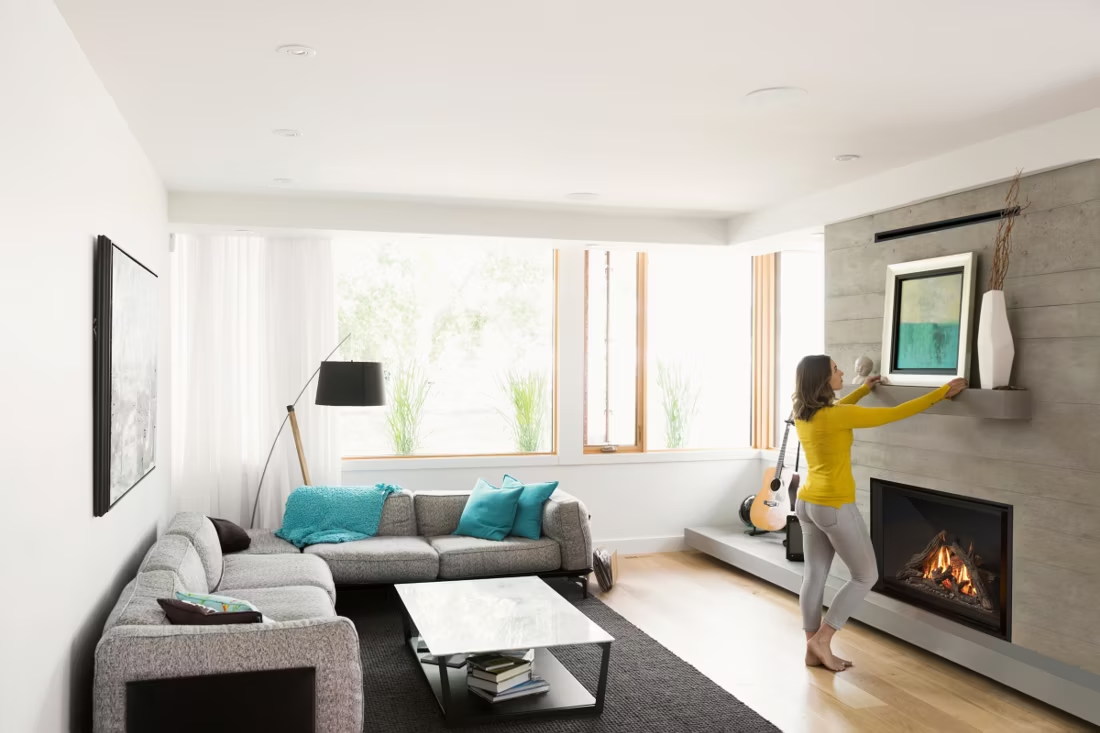
Three steps. No salesperson until you're ready.
Tell us about your project
Your postal code, your situation, and the fuel you're leaning toward—or let the answers point you to one.
See what's actually available
The brands dealers within 100 miles genuinely carry—real options, never a catalog mirage.
Get your dealer & Project Guide
A trusted local dealer, plus the free Project Guide & Parts List that names every component of the job.
Frequently Asked Questions
Is natural gas actually available in Saint-Apollinaire?
Only partially. Énergir serves specific corridors in the area rather than every street, so the honest first step is checking whether your address sits on an active gas main before you commit to a natural gas fireplace. If it doesn't, that's not a dead end—it just means the project shifts to propane, which most gas fireplace models can run on with the right regulator and tank setup. I'll help you confirm which situation you're in before recommending a dealer or a unit.
If I'm not on the Énergir line, can I still get a gas fireplace?
Yes—propane is the common answer across most of rural Chaudière-Appalaches, and it's the more typical path in Saint-Apollinaire than natural gas. A propane-fed direct-vent fireplace or insert looks and operates almost identically to a natural gas one; the difference is a tank on the property instead of a buried line. Install costs land in the same $6,000-$15,000 CAD range, with the tank setup or rental sometimes adding a modest amount depending on your supplier.
How much does a gas fireplace installation cost in Saint-Apollinaire?
Plan on roughly $6,000 to $15,000 CAD. A direct-vent insert going into an existing masonry firebox, with a gas or propane line already nearby, sits toward the lower end. A new built-in unit for a renovation or addition—especially one needing a fresh propane tank set or an extended gas run given the partial Énergir coverage out here—pushes toward the top of that range. Your local dealer can quote the specifics once they see your address and your existing setup.
Do I need a permit to install a gas fireplace here?
Yes. Installations go through your municipal building department, and the work has to meet the CSA B365 installation code, which covers venting, clearances, and gas connections for hearth appliances in Canada. Most dealers who install gas fireplaces in this area handle the permit application and coordinate the final inspection as part of the job, so you're not tracking down the paperwork yourself.
Would wood heat make more sense than gas for my property?
Given how partial the Énergir network is around Saint-Apollinaire, a lot of homeowners end up asking this. Wood has real advantages here: sugar maple, yellow birch, American beech, and red oak are all common local species, and an MRNF cutting permit costs about $1.85 per cubic metre plus taxes, up to 22.5 m3 a year. Wood appliances also need to be CSA-certified and registered with your municipality, and insurers commonly require a WETT inspection on installation—worth factoring in alongside the $6,000-$12,000 CAD typical wood install range. If reliable heat during a power outage matters more to you than push-button convenience, wood is the stronger fit; if convenience wins, gas or propane is still workable if you're near a line or comfortable with a tank.
How does a gas fireplace compare to just using electric heat here?
Electric fireplaces and inserts are the cheapest to install by far—typically $500 to $1,600 CAD—and with Hydro-Québec's residential rate sitting around $0.078/kWh, running one isn't expensive either. What electric can't do is throw the same heat output or authentic flame feel as a gas unit, and it won't keep running through a Hydro-Québec outage without a battery backup, which is a real consideration this far into a Quebec winter. Gas costs more upfront but delivers stronger, on-demand heat, which is why some homeowners here choose electric for ambiance in a secondary room and reserve gas or wood for the space that actually needs to carry heat load.
Vented vs. vent-free gas fireplaces—which is allowed and recommended here?
Direct-vent units, which pull outside air for combustion and exhaust fully outside through sealed venting, are the standard and safer choice across Quebec and what most local dealers install by default. Vent-free units are legal in some applications but come with strict room-sizing and ventilation rules, and given how tightly built many newer Saint-Apollinaire homes are for winter efficiency, a direct-vent system is usually the better fit for indoor air quality regardless of which fuel you land on.
How often does a gas fireplace need servicing?
An annual check is the standard recommendation, ideally scheduled in late summer or early fall before the first real cold snap rather than mid-winter when technicians are booked solid. A service visit covers the burner, pilot or ignition system, gas or propane connections, and venting, plus a glass cleaning. It's a lighter job than a wood chimney sweep, but skipping it on a unit that's your main backup through a five-month-plus heating season is how a pilot or ignition problem shows up on the coldest night.
Gas, wood, or pellet—what do most Saint-Apollinaire homeowners actually pick?
Wood remains the most common backup and supplemental heat source here, given the abundance of sugar maple and yellow birch and the low cost of an MRNF cutting permit. Pellet stoves are a growing alternative—Granules LG, Energex, and Trebio are all sold regionally at roughly $400-$575 CAD a ton—and they install for $6,000-$10,000 CAD with less daily labour than splitting and stacking cordwood, though they need electricity to run the auger and blower. Gas is the least common of the three around Saint-Apollinaire simply because Énergir's network doesn't reach every street; homeowners who do have access, or who're open to propane, generally choose it for the instant, no-mess heat rather than as a first-choice fuel for the whole house.
Can a gas fireplace run on a thermostat?
Most modern gas fireplaces can—turn it on and off from the couch with a remote, or set a room temperature and let the fireplace hold the comfort zone for you. If low maintenance matters to your family, this is the feature set that makes gas the convenience pick over wood and pellet.
Why do fireplace quotes vary so much?
Because a fireplace is an iceberg—there's more behind the wall than in front of it. A low quote often covers only the unit; the full scope includes vent pipe, gas line or electrical, framing, and the tile or stone that has to come off and go back on. Make every bidder price the whole job. If a dealer can't speak to the full scope with confidence, that's your signal to keep looking.
Do I need a permit to install a fireplace?
In most jurisdictions, yes—fireplace and stove installations involve venting, clearances, and often gas or electrical work that gets permitted and inspected. That's a feature, not a hassle: the inspection protects your family and your homeowner's insurance. A professional installer pulls the permit, installs to code, and stands behind the inspection. If someone suggests skipping it, keep looking.
What fireplace styles should I know before shopping?
Four cover most of the market: screen-front traditional (mesh front, open feel, fits craftsman homes), traditional door set (the classic look you grew up with), modern linear (wide, low, the statement piece for entertaining), and clean face contemporary (no trim—your tile or stone runs right to the fire's edge). Walk in knowing those four terms and you're ahead of most buyers.
Nearby Dealers
Hearth shops serving Saint-Apollinaire and the surrounding area. Every listing shows whether it is a WhyFire partner, a dealer we have verified as authorized for the brands we recommend, or a local business carrying hearth products. No manufacturer pays for placement. How we verify dealers →
Services Propane Inc.
Foyer Québec
Chemine, Poeles Et Foyer Quebec
Les Cheminées Gamelin
Maçonnex (Saint-Isidore)
Hubert's Fireplace Consultation + Design
Nova Energie Inc
Propane Multi-Service Inc
Maçonnex (Québec)
Gespro Poêles Et Foyers
Magasin H. Letourneau Inc.
Boutique Joli-Feu
Mission Ventilation K.g. Inc
Natural Gas Service in Saint-Apollinaire
Confirm service at your address before planning a gas fireplace—a quick call settles it.
énergir
Get your free Project Guide & Parts List for a Saint-Apollinaire gas fireplace.
Tell me your address and whether you're hoping for natural gas or propane, and I'll confirm what's actually available on your street, match you with a trusted local dealer, and send a free Project Guide & Parts List with the exact vent kit and parts your project needs.
Find Your Fireplace →