
Steady heat for chalet weekends and long Laurentian winters.
With winter lows averaging -16.5°C and a heating season that stretches from November well into March, the Laurentides run on appliances that hold a set temperature without daily tending. I match you with a trusted local dealer who knows hopper sizing, venting, and the CSA B365 rules that apply here, then send you a free planning packet.
Every Project Starts From One of These Five Situations
Built for second homes, remote chalets, and a serious cold season.
The Laurentides Region runs from suburban communities like Blainville and Boisbriand near the Montréal fringe up through Saint-Jérôme, Sainte-Agathe-des-Monts, and Mont-Tremblant into the forested, sparsely populated stretches of Antoine-Labelle toward Rivière-Rouge and La Minerve. Climate zone 6A and an average winter low near -16.5°C put the region in territory comparable to a typical Sudbury, ON winter, with sub-zero nights common from late fall through early spring. A large share of households here split time between a primary residence and a chalet, and that pattern is exactly where pellet heat earns its keep: a thermostatic pellet stove or insert holds a set temperature for a day or more on a hopper load, so a cottage near Tremblant or Sainte-Adèle stays warm and pipe-safe through a work week without anyone splitting or stacking cordwood.
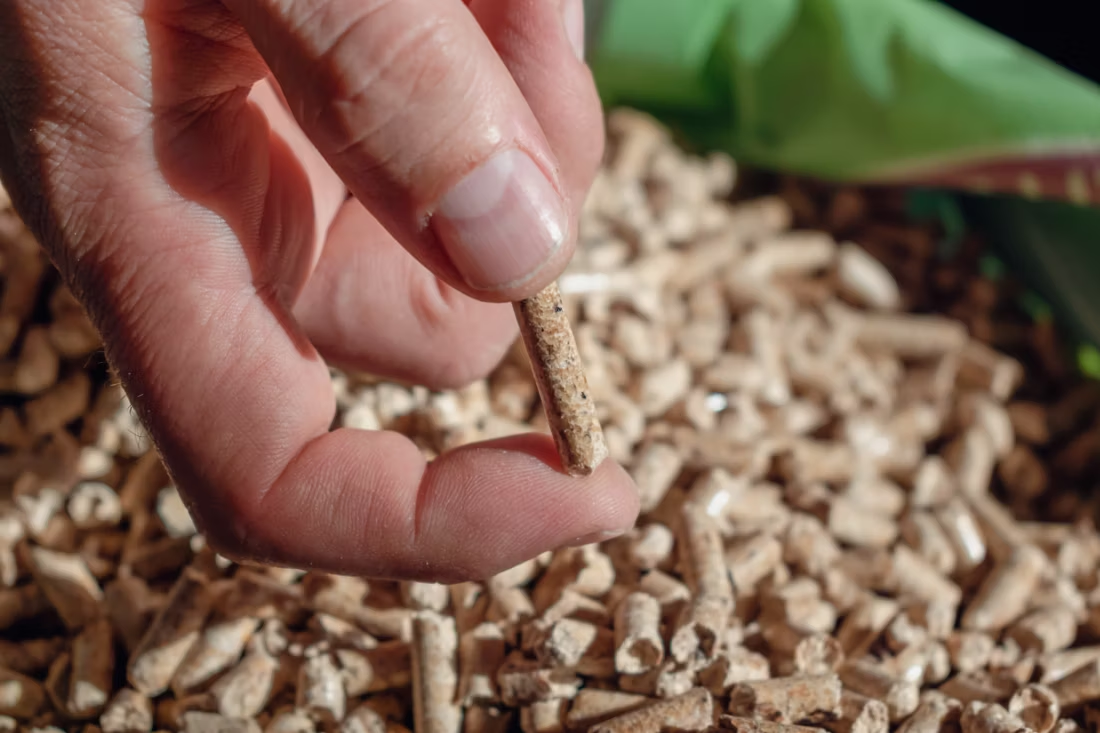
Natural gas service in Quebec is genuinely limited, and that holds true across most of the Laurentides outside a few Énergir corridors near the region's southern edge, so gas fireplaces here usually mean a propane conversion rather than a mains hookup. Pellet sidesteps that problem entirely while still delivering thermostat-controlled, set-and-forget heat. Locally, that means sourcing pellets from Quebec producers like Granules LG, Energex, or Trebio, typically $400-$575 per ton, and working with your municipal building department on a CSA B365-compliant install. Because insurers in this region commonly require a WETT inspection on wood-burning appliances before they'll write or renew a homeowner's policy, a pellet stove installed and documented by a trusted local dealer keeps that paperwork clean from day one, whether the home in question is a primary residence in Saint-Jérôme or a weekend property in the hills above Sainte-Agathe.
Three steps. No salesperson until you're ready.
Tell us about your project
Your postal code, your situation, and the fuel you're leaning toward—or let the answers point you to one.
See what's actually available
The brands dealers within 100 miles genuinely carry—real options, never a catalog mirage.
Get your dealer & Project Guide
A trusted local dealer, plus the free Project Guide & Parts List that names every component of the job.
Frequently Asked Questions
How much does a pellet stove installation cost in the Laurentides Region?
Installations across the region typically run $6,000 to $10,000 CAD. A pellet insert going into an existing masonry fireplace with a straightforward vent run through the wall lands on the lower end. A freestanding pellet stove in a chalet with no existing chimney, or one that needs the auger and hopper wired for a dedicated electrical circuit, pushes toward the top of the range. Properties farther from Saint-Jérôme or Sainte-Agathe-des-Monts, out toward Rivière-Rouge or La Minerve, may see a modest travel charge added by the installer, so it's worth confirming that up front.
Does a pellet stove make sense for a chalet we only visit on weekends?
This is one of the most common reasons homeowners in the Laurentides choose pellet over wood. A pellet stove with a full hopper and a programmable thermostat can hold a set temperature for roughly 24 to 72 hours depending on the model and how hard it's working, which means you can leave a cottage near Mont-Tremblant or Saint-Sauveur on Sunday night and come back Friday to a home that never dropped below freezing, without anyone tending a fire midweek. Wood stoves can't do that unattended. The tradeoff is that pellet appliances need electricity to run the auger and blower, so a chalet prone to storm outages should pair one with a backup power plan if freeze protection is the priority.
Do I need a permit to install a pellet stove in the Laurentides Region?
Yes. New installations go through your municipal building department, and the work needs to follow the CSA B365 installation code, which governs clearances, venting, and hearth protection for solid-fuel appliances. Most local dealers pull the permit and handle the CSA B365 details as part of the job. Separately, because insurers in this region commonly ask for a WETT inspection before covering a wood-burning or pellet appliance, it's worth confirming your dealer can provide that documentation, especially for a secondary or chalet property where the insurer may ask more questions than they would about a primary residence.
Where do Laurentides households actually buy pellets, and what do they cost?
Quebec-based brands dominate the shelf here: Granules LG, Energex, and Trebio are the three you'll see most often at hardware and building supply stores through Saint-Jérôme, Sainte-Agathe-des-Monts, and the lower Laurentides toward Blainville. Expect to pay $400 to $575 per ton, with pricing shifting a bit by season and how far a retailer is from the mill. Buying a season's supply in late summer, before demand climbs with the first cold snap, is the standard way locals avoid picking through a picked-over pallet in December.
Why choose pellet over a gas fireplace in the Laurentides?
Gas is genuinely rare as a heating option in this region. Énergir's natural gas network only reaches a handful of corridors near the southern edge of the Laurentides, so most properties here, whether in Saint-Jérôme or farther north toward Mont-Tremblant, would need a propane tank and conversion to run a gas fireplace at all. Pellet appliances avoid that problem entirely, running on bagged fuel you can buy locally, while still giving you the thermostatic, low-maintenance heat that draws people to gas in the first place. If you're set on gas, a local dealer can confirm whether your street actually has service before you plan around it.
Pellet vs. wood stove—which fits a Laurentides home better?
Wood has deep roots here: sugar maple, yellow birch, American beech, and red oak are common on Laurentian woodlots, and an MRNF cutting permit runs about $1.85 per cubic metre plus taxes up to a 22.5 cubic metre maximum, which keeps fuel costs low if you're willing to cut, split, and season it yourself. Pellet trades that self-sufficiency for convenience and hands-off heat, no cutting or stacking, a thermostat that holds temperature on its own, and cleaner, more consistent burns, which matters if the property sees long stretches unattended between visits. For a primary residence with someone home daily who wants the lowest possible fuel cost, wood still wins. For a chalet or a household that values set-and-forget reliability, pellet is usually the better fit.
How much maintenance does a pellet stove need through a Laurentides winter?
Plan on cleaning the burn pot and ash tray weekly during heavy use, since a stove running daily through a five-month season builds ash faster than most owners expect. A full annual service, checking the exhaust venting, auger, and gaskets, is worth scheduling in late summer or early fall before the first cold nights arrive, similar timing to when most people are already restocking pellets from Granules LG, Energex, or Trebio for the season.
What size pellet stove do I need for my home or chalet?
Sizing depends on square footage, insulation, and how exposed the property is to Laurentian wind and elevation. A well-insulated newer build near Saint-Jérôme or the lower Laurentides suburbs can often run a smaller unit efficiently, while an older chalet up toward Mont-Tremblant or Rivière-Rouge, with more exposed walls and colder overnight lows, typically needs the next size up to hold a comfortable temperature through a -16.5°C night. A local dealer sizing this in person, rather than off a generic chart, is the difference between a stove that keeps up and one that runs flat-out all winter.
Does insurance actually require a WETT inspection for a pellet stove?
Many insurers operating in the Laurentides ask for a WETT inspection on any solid-fuel appliance, pellet included, before they'll write or renew coverage, and that request comes up more often on secondary or chalet properties that sit empty for stretches at a time. Getting the inspection done and documented at install, alongside a CSA B365-compliant job through your municipal building department, avoids a scramble later if your insurer asks for proof after the fact. A trusted local dealer who does this regularly can typically arrange the inspection as part of the project.
Why do fireplace quotes vary so much?
Because a fireplace is an iceberg—there's more behind the wall than in front of it. A low quote often covers only the unit; the full scope includes vent pipe, gas line or electrical, framing, and the tile or stone that has to come off and go back on. Make every bidder price the whole job. If a dealer can't speak to the full scope with confidence, that's your signal to keep looking.
Is it worth replacing an old fireplace that still sort of works?
Ask three questions: Is it ugly? Is it drafty? Does it actually work? Most old fireplaces fail at least two. Beyond looks, an old unit leaks air around the damper year-round and—if it's gas with a standing pilot—quietly burns a couple hundred dollars a year. A modern replacement seals the wall, heats the room, and changes how the whole space gets used.
What do I measure to size a fireplace insert?
Four numbers tell you what fits: the front width, the front height, the back width, and the overall depth of your existing fireplace opening. Grab a tape measure, jot those down, and snap a photo of the wall—those two things do more to move your project forward than anything else you can do today.
Are pellet stoves loud?
They make some noise—there are two fans running plus an auger motor that turns as it feeds pellets. But there's a real range: premium models are engineered quiet, and the best offer a whisper-quiet mode you can comfortably watch TV next to. If noise matters in your room, ask to hear a stove running before you buy—it's a five-minute test that saves years of annoyance.
Stove and Fireplace Dealers in Laurentides Region
Listings include WhyFire partner dealers, dealers we have verified as authorized for the brands we recommend, and established local businesses that carry hearth products. Every listing shows which one it is. The ones marked Preferred run on WhyFire's software, so they can show you real pricing and book your appointment right here. No manufacturer pays for placement. How we verify dealers →
Poeles Et Foyers Saint-Sauveur
Décor Chaleur Laurentides Inc
Foyers Braizo
Boutique Poêles & Foyers Rive-Nord
Max Oxygene Pur
Les Foyer Mirabel A.m.f.
Le Ramoneur Du Foyer
Finition Belle-Flammes
Pellet Brands Stocked Around Laurentides Region
Typical price runs $400-$575 per ton—buy early-season for the best rates. Manufacturers will point you to the nearest stocking dealer.
Granules Lg
Trebio
Get your free Project Guide & Parts List for pellet heat in the Laurentides Region.
Tell me about your home or chalet, how often you're there, and what you're hoping to heat, and I'll match you with a trusted local Laurentides dealer and send a free Project Guide & Parts List, the exact parts, including the vent kit, for your pellet project, no big-box guesswork.
Find Your Fireplace →